The owner with 400 reviews sitting at position 3, under a competitor on 90, is the reason we get asked how to rank higher on Google Maps. Ranking higher on Google Maps comes down to three inputs, relevance, distance and prominence, and only one of them is set from your dashboard.
Most tradies spend their effort on the number that feels like the scoreboard, the review count, and never touch the two inputs that decide the order. The pin has not moved since the profile was verified, and the website has never grown past the pages it launched with.
This guide covers what those three inputs are, what 118 real map packs say about reviews and position, where your pin belongs, which fields carry your relevance, how prominence builds over months, and what the first six months of Maps work does to the phone.
In this guide
The three inputs Google ranks a map pack on
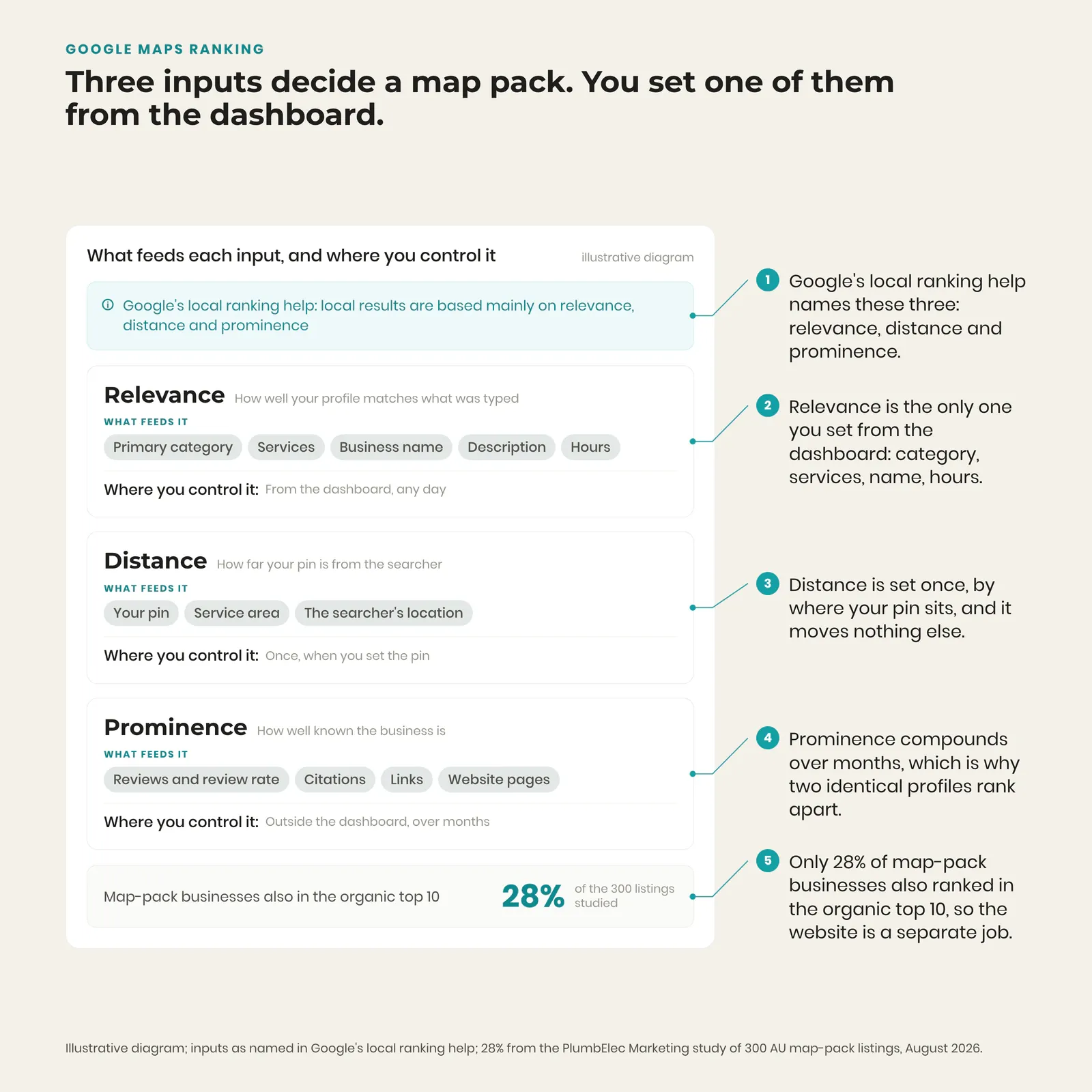
Two profiles can be filled in identically, three streets apart, and sit at positions 1 and 4 in the same search. Nothing on either dashboard explains the gap. Google’s local ranking help says local results are based mainly on relevance, distance and prominence, and only the first of those three has a field you can type in.
Relevance: the words on the profile
Relevance is the overlap between what somebody typed and what your listing says about itself. The primary category does the heavy lifting, then the services list, the description, the hours, and the words your customers use inside their reviews.
It is the only one of the three with a dashboard behind it. Our local SEO guide for plumbers and electricians sets the three inputs beside each other, and the parent guide to SEO for trade businesses shows where Maps work sits in the job.
Relevance decides which searches you are eligible for, not the order of the three that show.
Distance: your pin and their phone
Distance is the gap between the phone doing the searching and the pin on your listing, and no field on the profile shortens it. You set it once, when you enter an address or draw a service area.
Which is why the check you run from your own office flatters you. You are standing on your own pin, and the customer four suburbs over is standing nearer somebody else’s.
Prominence: how known you are
Prominence is Google’s read on how well known you are, built from reviews and the rate they arrive, citations, links and the pages on your own site. It builds over months and compounds, so two listings that look identical in the dashboard can sit two spots apart.
It also runs on a separate track to your organic rankings. Across the 300 map-pack listings we captured for plumber and electrician in 10 Australian metros, five suburbs each, on 5 to 6 August 2026, 28% of those businesses also ranked in the organic top 10, and 297 different businesses filled the 300 slots.
So the order inside a pack is mostly settled outside the dashboard, which makes the review count the first thing worth testing.
Field check: reviews are not the ranking
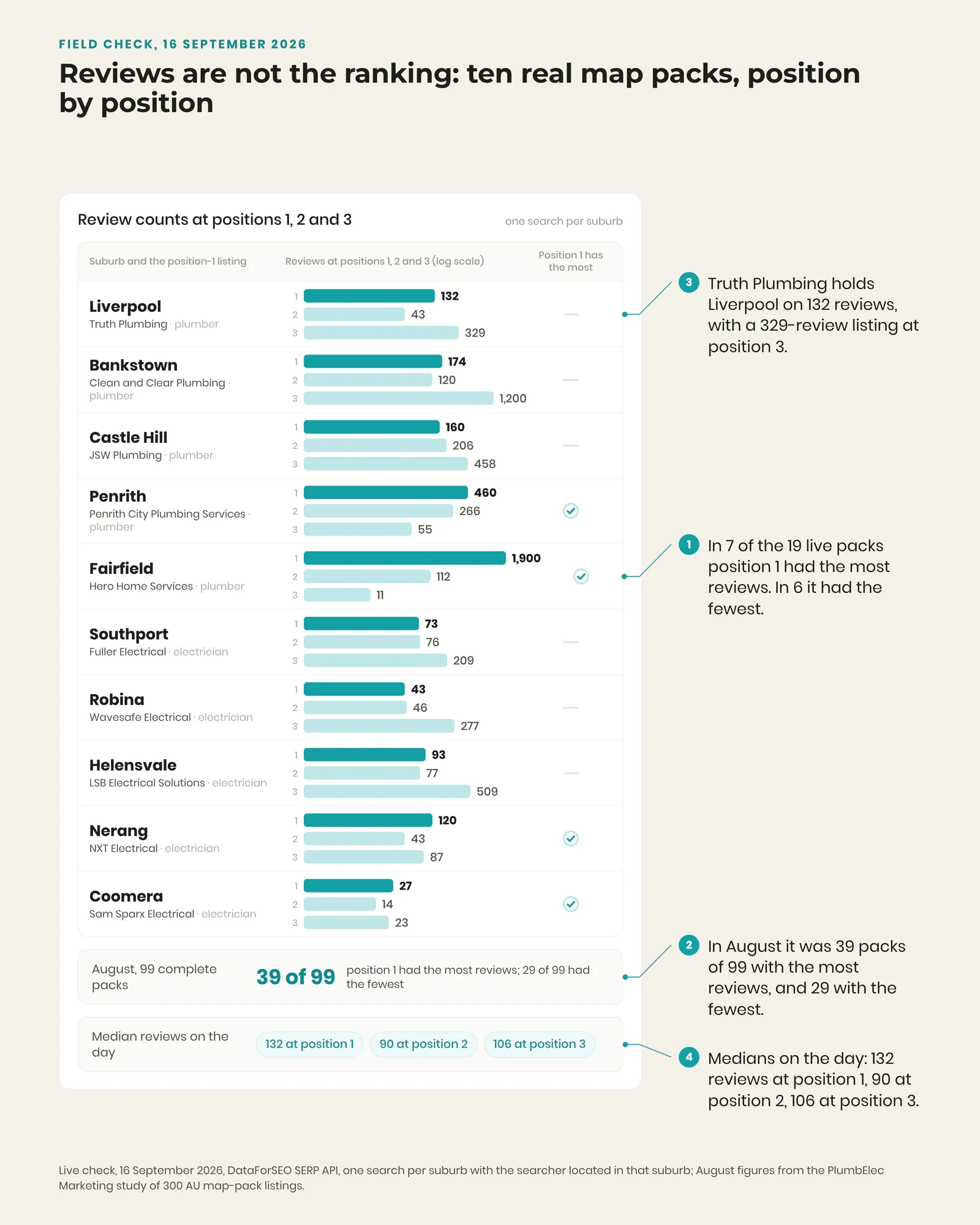
In 99 of those August packs every listing showed a review count, and the position-1 listing held the most reviews of the three in 39 of them. In 29 it held the fewest. Reviews put you in the conversation. They did not sort those three listings into that order.
How we checked
The August study captured the pack in 50 suburbs, five in each of 10 metros.
On 16 September 2026 we ran a live check through the DataForSEO SERP API, searching plumber from inside 11 Sydney suburbs and electrician from inside 8 on the Gold Coast, sponsored listings excluded. That is 19 packs and 57 listings, 118 packs in total.
August: most reviews, 39 times
The medians tell the same story: a median of 105 reviews at position 1, 67 at position 2 and 75.5 at position 3, with a median rating of 5.0 at every position.
Position 3 sitting above position 2 is the part owners do not expect. Read it as correlation: listings at position 1 were more likely to carry the bigger review file.
September: 19 packs, same shape
Six weeks later the shape held. Position 1 had the most reviews of its pack in 7 of the 19 and the fewest in 6, with medians of 132 reviews at position 1, 90 at 2 and 106 at 3, and a 5.0 median rating at each.
Five packs had position 1 holding under a far bigger listing: Truth Plumbing in Liverpool on 132 against a 329-review listing at position 3, Fuller Electrical in Southport on 73 against 209, Wavesafe Electrical in Robina on 43 against 277, Clean and Clear Plumbing in Bankstown on 174 against 1,200, and LSB Electrical Solutions in Helensvale on 93 against 509.
Ten of those packs, Sydney then the Gold Coast, with the review count at each position:
| Suburb | Position 1 (business, reviews) | Position 2 reviews | Position 3 reviews |
|---|---|---|---|
| Liverpool | Truth Plumbing (132) | 43 | 329 |
| Bankstown | Clean and Clear Plumbing (174) | 120 | 1,200 |
| Castle Hill | JSW Plumbing (160) | 206 | 458 |
| Penrith | Penrith City Plumbing Services (460) | 266 | 55 |
| Fairfield | Hero Home Services (1,900) | 112 | 11 |
| Southport | Fuller Electrical (73) | 76 | 209 |
| Robina | Wavesafe Electrical (43) | 46 | 277 |
| Helensvale | LSB Electrical Solutions (93) | 77 | 509 |
| Nerang | NXT Electrical (120) | 43 | 87 |
| Coomera | Sam Sparx Electrical (27) | 14 | 23 |
What the ratings say
Ratings barely separate anybody at the top of a pack. Of the 100 position-1 listings in August, 55 held a 5.0, 85 held 4.9 or above and 3 sat below 4.7.
Across all 299 rated listings, 59.2% held a 5.0 and 4.0% sat below 4.7. Set against the effort most owners put into the rating, it is the bar you clear, while the order gets sorted on the pin and how known the business is.
Data: PlumbElec Marketing study of 300 AU map-pack listings, August 2026, and a live check of 19 Sydney and Gold Coast map packs on 16 September 2026.
Distance: the input you set once
You have filled in every field and chased reviews for two years, and you still cannot be found in the suburb next door where half the work is. Nothing on the profile is wrong. The pin is in the wrong place, and the pin is the input you set once and then carry for the life of the listing.
Where the pin sits
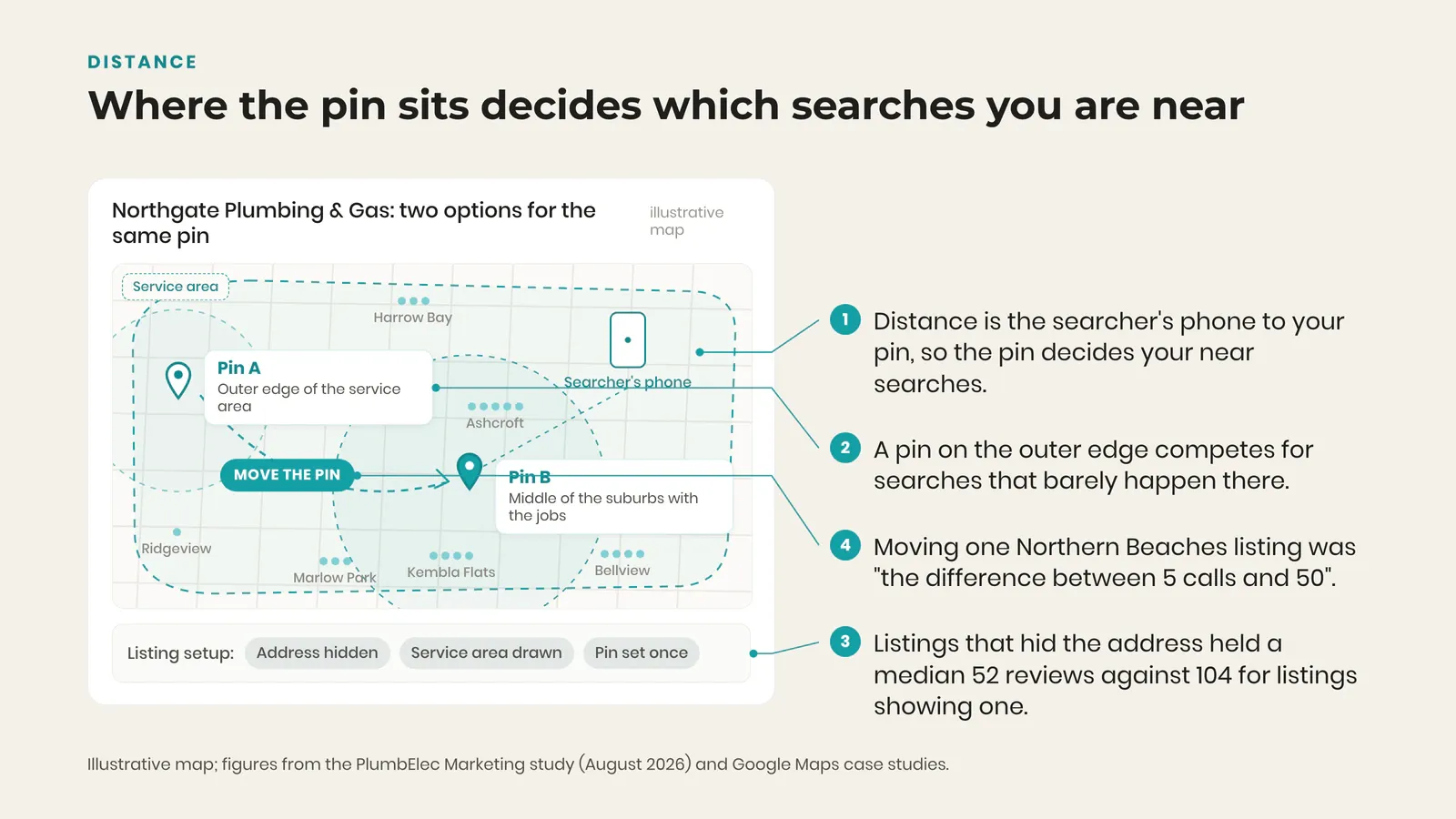
Distance is measured from the searcher’s phone to your pin, so the pin decides which searches you are close to before any other work starts. Northgate Plumbing & Gas registered at the yard on the far edge of its area is competing for the searches that happen out there, and there are not many of them.
The fix is unglamorous and permanent: put the pin in the middle of the suburbs where the jobs actually come from, not where the trailer is parked.
Service area without a shopfront
Google’s service-area guidance is that a business that does not serve customers at its address removes the address and sets a service area instead. Most plumbers and electricians fall squarely into that, and the listing keeps its pin either way.
Hidden addresses correlate with the lower spots rather than the top one. The address was hidden on 30.0% of position-1 listings against 47.0% at position 3, and listings that showed an address held a median of 104 reviews against 52 for those that hid one.
Read that as two habits travelling together, not a switch. Established businesses that show an address also tend to be the ones with the longer review file behind them.
From 5 calls to 50
A Northern Beaches electrician had a listing sitting in a low-population location and a phone that barely rang. Moving the listing was “the difference between 5 calls and 50”. Same trade, same licence, same reviews, different pin.
That is the whole argument for spending an afternoon on the address before you spend a year on reviews. More of those sit in our Google Maps case studies.
Where you really rank
Because distance moves with the searcher, one rank check tells you about one spot on the map. A grid of points across your service area shows where the listing holds and where it drops out.
Our geo grid guide for plumbers and electricians covers how to run one and how to read the pattern. Run a baseline before you touch the pin, so the move can be measured rather than argued about.
Relevance: the fields Google reads
Everything here is a dashboard job, and you can finish the lot between quotes. Three fields carry most of your relevance: the primary category, the services list and the opening hours. Get those right and you stop quietly losing searches you never knew you were eligible for.
Category, services and the name
The primary category is the trade itself, every time. Where it was visible in the August study it was Plumber for 142 of the 143 plumbers and Electrician for 132 of the 135 electricians, so the pack is filled with businesses that named their trade rather than a vaguer label.
Names are where the risk sits. Across the 300 listings, 41% had a keyword or suburb worked into the profile name, rising to 44% at position 1, which correlates with the top spot and also breaks Google’s rule that the profile name is the real-world business name.
Our Google Business Profile optimisation guide works through the services list field by field.
Verify it first
None of it counts until the profile is yours. In Google’s words, “When you verify your business on Google, you gain ownership of your Business Profile and can make sure your business info is accurate”.
Google’s verification guidance lists the methods as phone or text, email, live video call and postcard, with the postcard arriving within 14 days. It also notes that “Verification methods are automatically determined by Google and can’t be changed”, so the one you are offered is the one you use.
Hours that hold at 2am
A 24/7 claim correlates with the top spot: it showed on 70.0% of position-1 listings, 69.0% at position 2 and 56.0% at position 3. On the live September check, 42 of the 57 listings showed “Open 24 hours”.
Set them honestly. A listing that says 24 hours and goes to voicemail at 2am burns the call and the review, which is a slower problem than being closed.
Hours, categories and the name are the easy half. The half that decides the order takes months.
Prominence: reviews, replies, citations and your site
Why does one listing pull away from a competitor with the same categories, the same hours and a pin two streets away? Prominence, which is the half of the job that sits outside the dashboard. It is also where a Maps campaign actually spends its months.
The bar and the rate
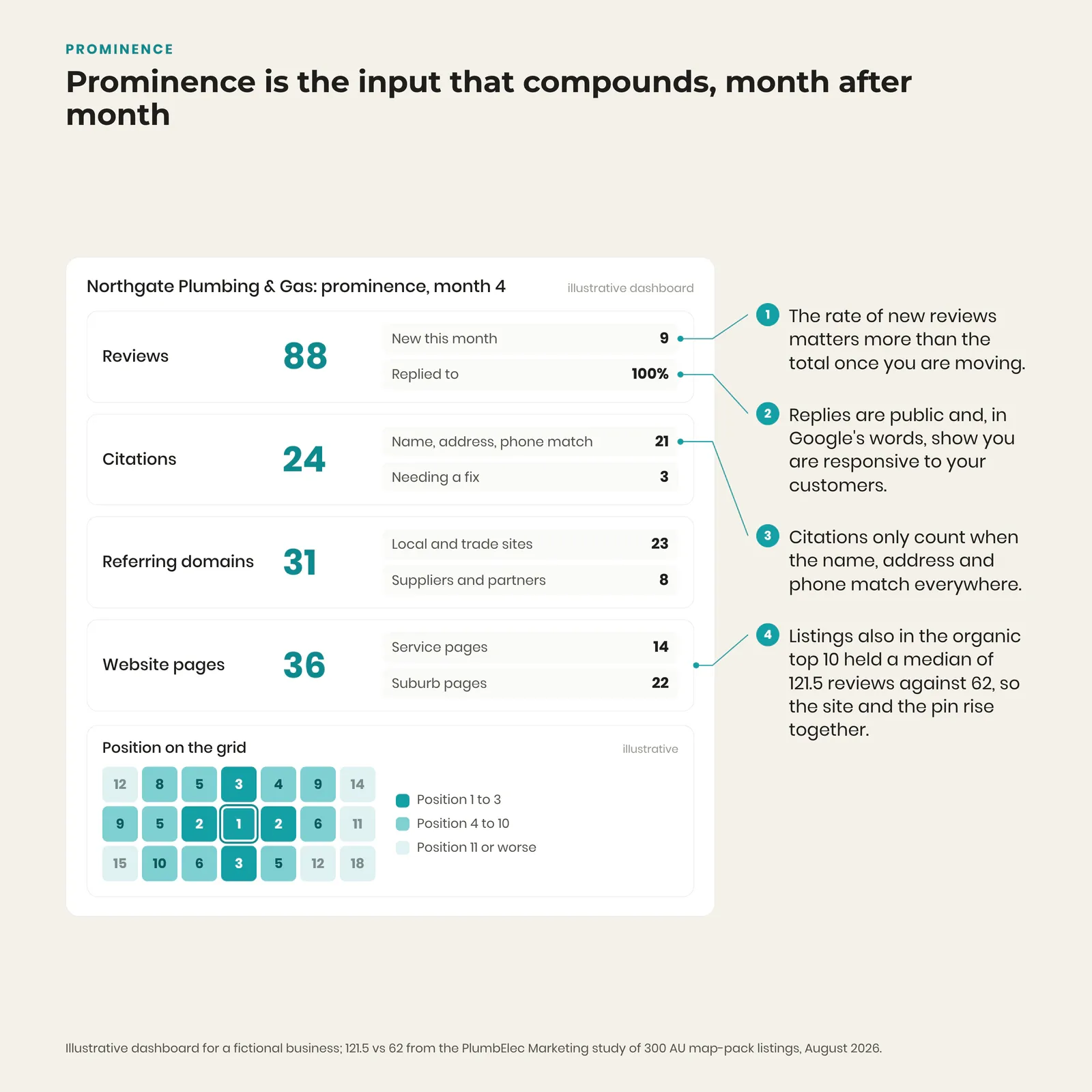
The bar at position 1 in August was a median of 105 reviews and a median rating of 5.0. Clearing it is the entry ticket, and once you are moving it is the rate of new reviews that matters more than the total.
Ask every customer, on the day, with a review link or a QR code, which is what Google’s guidance on asking for reviews suggests. The same page prohibits incentives “like free or discounted goods or services, in exchange for customers to post reviews”, so a discount for a review is off the table.
Our guide on how to ask for Google reviews covers the ask itself, and what a normal review count looks like in your trade gives you a benchmark to measure against.
Reply to every review
A verified business can reply to the reviews on its profile, and Google notes that “your reply is publicly posted” while “your personal name won’t be shown”. So the reply is written for the next customer reading it, not the one who left it.
Google’s guidance on replying to reviews puts it plainly: “helpful and positive replies to reviews can show that you’re responsive to your customers”. Name the job and the suburb in the reply and it reads like a business that remembers the visit.
Citations and links
Directory listings are the other compounding input we work on, alongside review velocity. They only do their job when the name, address and phone number match everywhere they appear.
An old number on a plumbing directory, a previous address on a council listing, a different trading name on a trade association page: each one is a small contradiction sitting against the profile you are trying to make Google confident about.
The website behind the pin
The site and the pin rise together. Listings that also ranked in the organic top 10 held a median of 121.5 reviews against 62 for those that did not, and 244 of the 300 listings, 81.3%, pointed their website button at the homepage.
We treat 30+ service pages as the minimum on a site behind a Maps campaign. A homepage cannot carry a pack spot on its own, and a listing with no service pages behind it has no prominence building while the better-known pin nearby keeps compounding.
What moving the pack looks like
Every owner who calls us wants the same thing, which is next week. Maps work does not pay out next week, and the campaigns that get abandoned are the ones that were judged on the wrong number before the pin had time to work.
Mouritz: 157 calls a month
Mouritz Air Conditioning runs three locations in Western Australia. A 3-month Google Business Profile campaign added 150+ enquiries a month and a 450% increase in phone calls across the three locations, with “an increase of 157 calls per month” from the Google Maps optimisation.
The Perth CBD location held #1 positions and took 4,100 calls in 2020. Three locations means three pins, which is how you get past what one listing can carry, because each pin sits close to a different set of searches.
Alpha & Omega: 13 to 35
Alpha & Omega Air came to us with a profile that had already been through another agency. Google Business Profile calls went from 13 to 35 in a month, and the listing reached the top 3 for all target keywords within 45 days.
Faster than a standing start, and that is the pattern: the profile already existed, so the work was the pin, the fields and the prominence rather than the verification.
The six-month shape
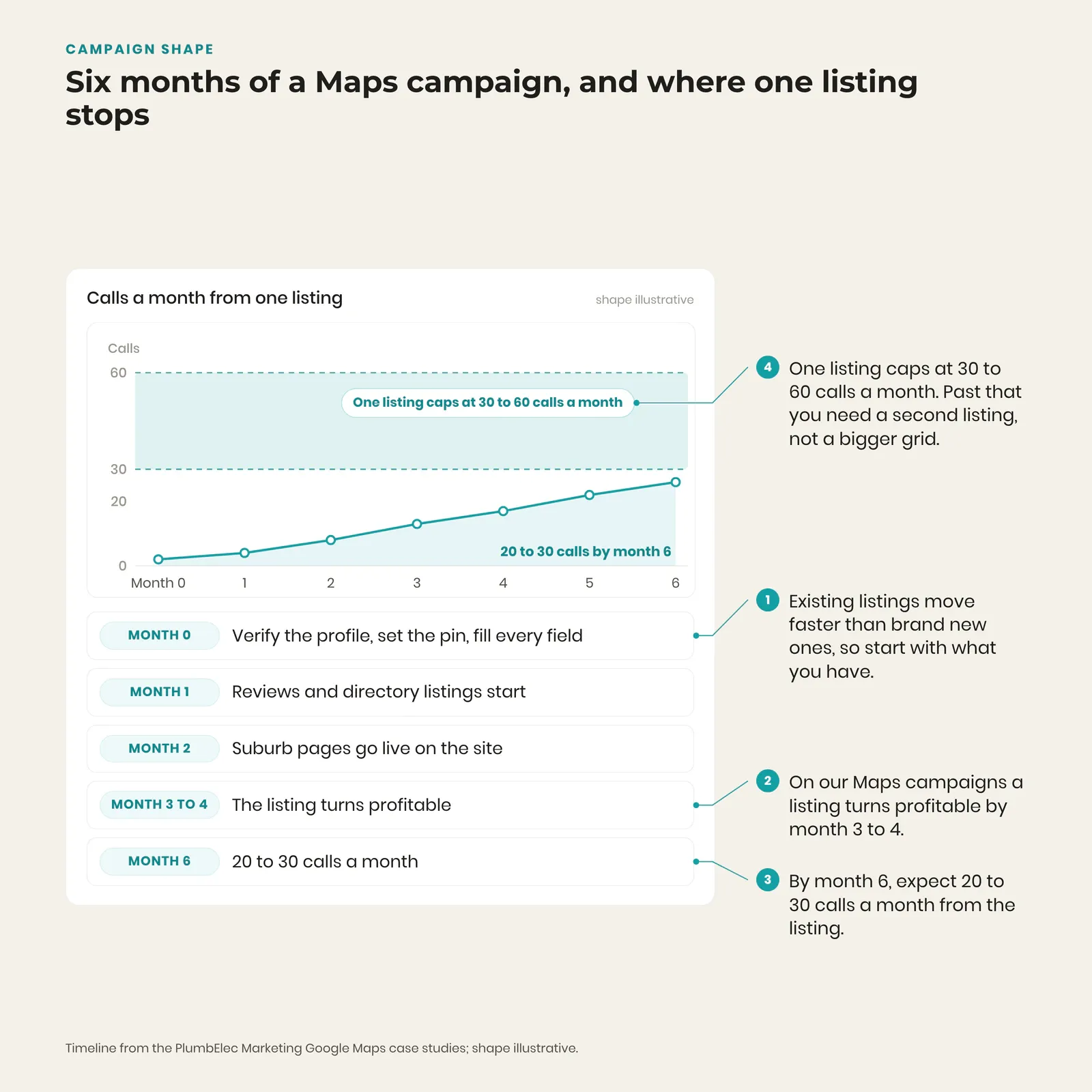
On our Maps campaigns a listing turns profitable by month 3 to 4 and reaches 20 to 30 calls a month by month 6, and an existing listing moves faster than a new one. A single listing then caps at 30 to 60 calls a month.
We measure the campaign on listing clicks, geo grid expansion and calls we can attribute to the listing. If you would rather hand the pin, the fields and the pages over, that is what our local SEO and Maps service does.
Set the review target and the call target at month 6, not month 1, and judge the work against those.
Conclusion
The three inputs are relevance, distance and prominence, and the only one with a field behind it is relevance. Most profiles get worked on the other way round.
Distance comes first because you set it once: the pin goes where the work is, and the service area matches the ground you actually cover. Then the fields, in an afternoon, so the listing is eligible for the searches that pay. Prominence is the long half, built out of review velocity, matching citations and a site with real service pages on it.
Reviews are the bar you clear to be in the conversation, not the switch that sorts the three. Measure calls rather than positions, and a listing that sits second and rings beats one that sits first in a suburb nobody searches from.
FAQs
What are the Google Maps ranking factors?
Relevance, distance and prominence. Google’s local ranking help names those three: how well your profile matches the search, how far the searcher is from your pin, and how well known your business is.
Do more reviews mean a higher Google Maps ranking?
Not on their own. In 99 August packs the position-1 listing held the most reviews of the three in 39 and the fewest in 29, so read reviews as correlation.
How many reviews do I need to rank in the map pack?
There is no threshold. Position 1 held a median of 105 reviews and a 5.0 rating across our 300 listings, which is the bar the packs we measured sat at.
Does hiding my address hurt my Google Maps ranking?
No, and Google asks a business that does not serve customers at its address to remove it and set a service area. Hidden-address listings held a median of 52 reviews against 104, which is correlation.
How long does it take to rank on Google Maps?
On our Maps campaigns a listing turns profitable by month 3 to 4 and reaches 20 to 30 calls a month by month 6. Existing listings move faster than new ones.
Can I rank on Google Maps in suburbs away from my address?
Yes, with prominence and pages. Distance works against you out there, so the listings holding distant suburbs carry the reviews, citations and service pages to go with the pin.
Want to know why you’re not in the pack?
Where does your listing sit three suburbs over, and which of the three inputs is holding it there? PlumbElec Marketing reads the pin, the profile and the pages together, then measures the campaign on listing clicks, grid coverage and calls we can attribute to the listing.
We work with plumbers and electricians right across Australia. Call (02) 9100 0985, book a time that suits you, or see how our local SEO services for trade businesses work first.