SEO for plumbers and electricians is the work of getting your business in front of a homeowner in the three places a job now comes from: the map pack, the blue links underneath it, and the answer an AI assistant reads back.
Those three run on separate machinery. The map pack comes off your Google Business Profile, organic comes off your website, and the AI answer comes off whatever the two of them left behind on the rest of the web. Most tradies we talk to are competing in one of the three and ignoring the other two.
This guide covers all three, with the numbers from our study of 1,000 Australian plumber and electrician searches and what changed for three of our clients. Every section is the short version of a deeper guide, and the full set sits in our guides for plumbers and electricians.
In this guide
What SEO means for a plumbing or electrical business
Two electricians work the same suburb, both with tidy websites and good reviews. Google sends the week’s work to one of them and skips the other.
Nothing on the surface explains that gap. The part deciding it sits across three separate systems, and most owners are visible in only one of them.
Three places a job comes from
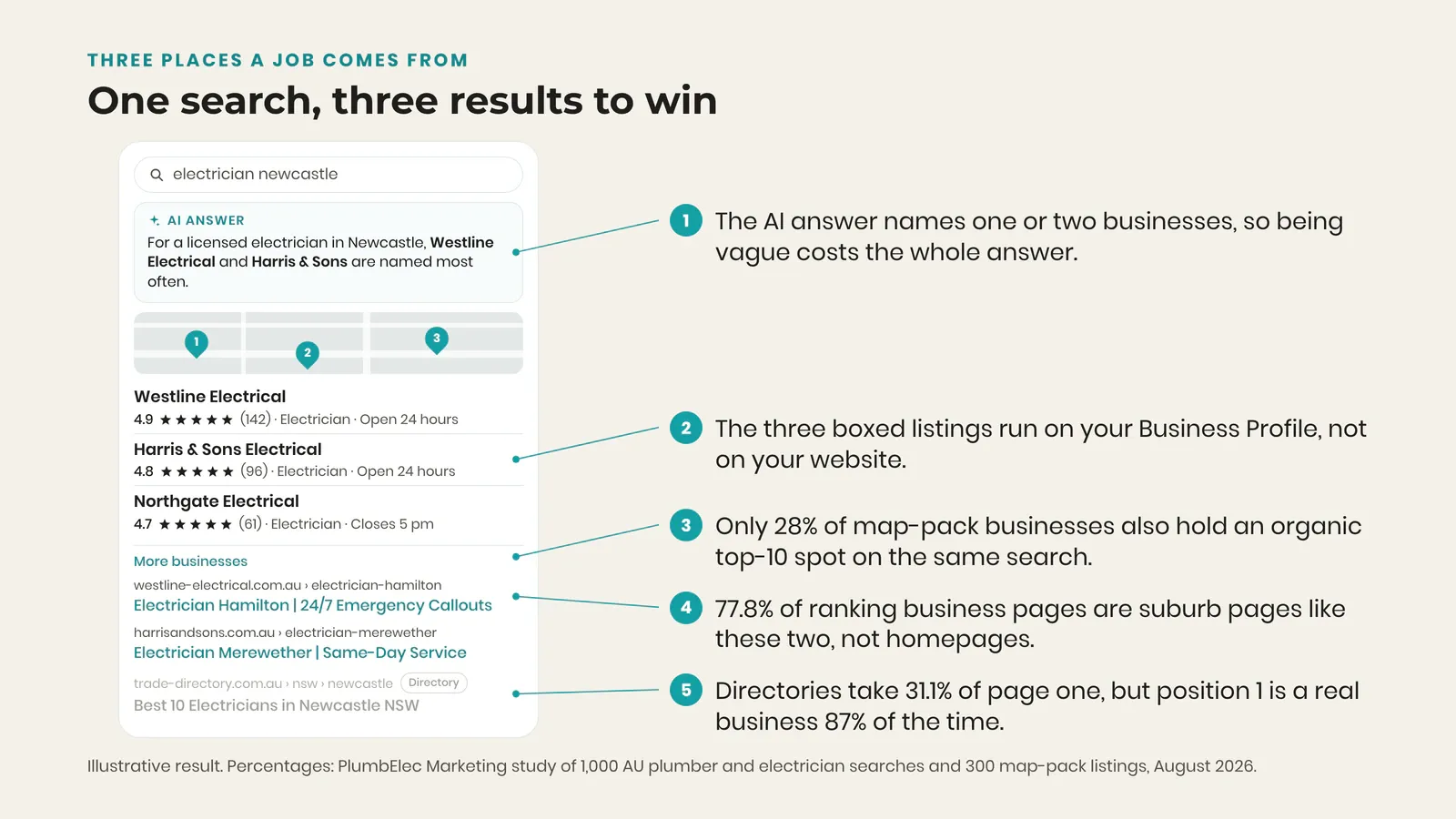
The map pack is the three boxed listings under the small map, drawn from Google Business Profiles rather than websites. Organic is the ordinary links below it, drawn from pages on your site. Third is the AI answer, which reads the web and names two businesses.
Holding one does not hand you the others. Of the 300 map-pack listings we captured on 5 to 6 August 2026, 28% of those businesses also ranked in the organic top 10 for the same search.
So the businesses in the pack are mostly missing from the links underneath. Two positions on one screen is the cheapest advantage in a trade result.
Why the trade version differs
A trade job is local and it is usually urgent. Someone with water across the laundry floor rings the first business that looks licensed and close, and does no comparing at all.
That pushes the ranking work down to suburb level. Across 657 business page observations in that same study of 1,000 Australian searches, 77.8% of the pages ranking were dedicated suburb pages, 20.9% were homepages and 1.3% were something else.
It is a different build from most small-business SEO. You are not optimising one site for one keyword, you are publishing a page for each service in each suburb you want work in.
What Google says it rewards
None of this is guesswork about the mechanics. Google’s own guide to how search works sets out three stages, crawling, indexing and serving results, and serving is the stage people mean when they say ranking.
On the content itself, Google says to create helpful, reliable, people-first content and publishes self-assessment questions to check a page against. For a trade business that reads as: explain the job, show your licence number, name the suburbs.
Our SEO basics guide for trade businesses covers that ground from scratch. What none of it settles is what the businesses already sitting in the top three do differently.
What separates the top three from the bottom of page one
The pages in the top three write less than the pages at the bottom of page one. Median word count was 618.5 words for positions 1 to 3 against 701 at positions 8 to 10, across 657 business pages in our study of 1,000 Australian plumber and electrician searches captured in August 2026 (top three n=210, positions 8 to 10 n=184).
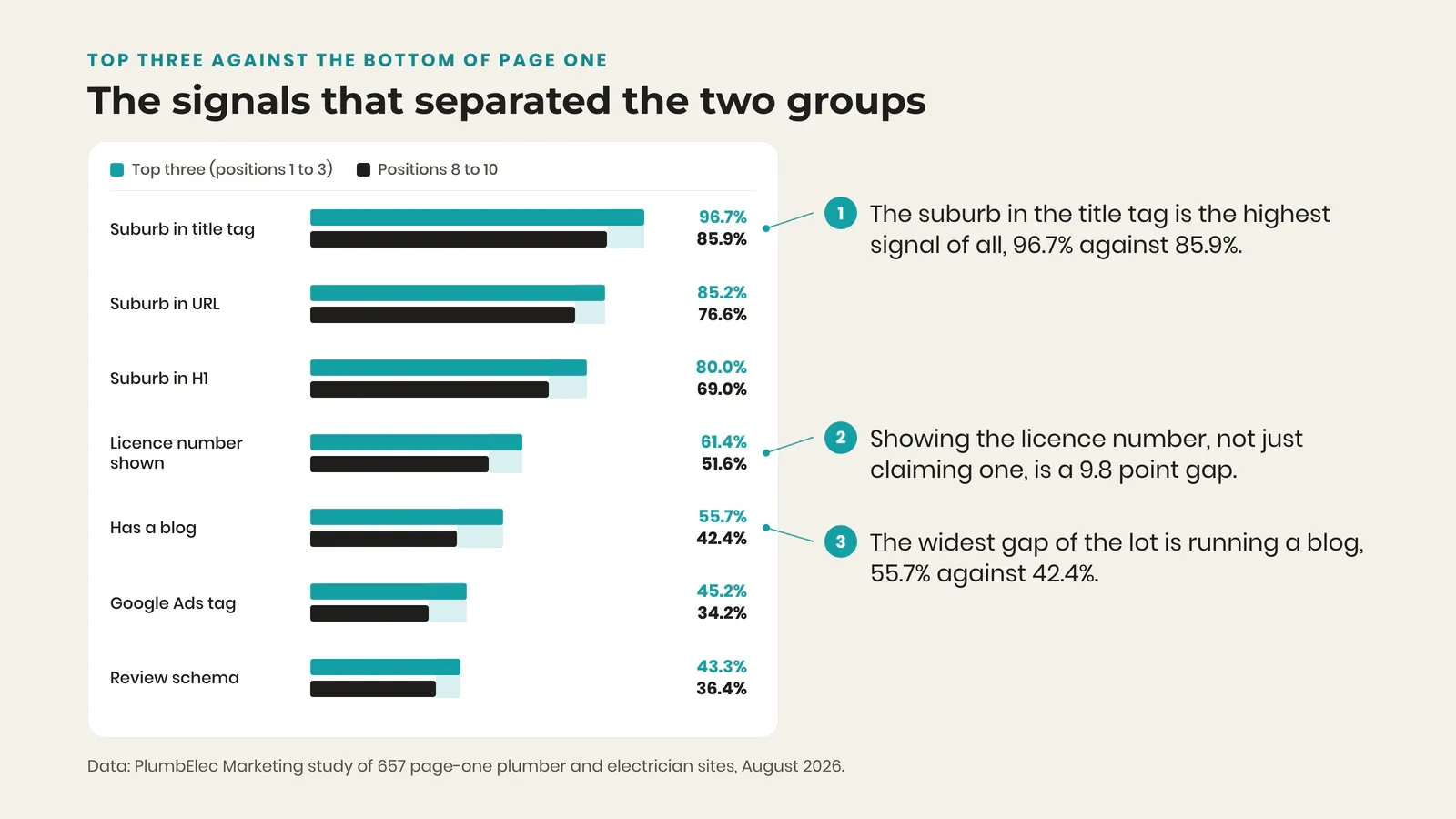
Here is every signal that separated the two groups, top three against positions 8 to 10:
| Signal | Top three | Positions 8 to 10 |
|---|---|---|
| Suburb in title tag | 96.7% | 85.9% |
| Suburb in URL | 85.2% | 76.6% |
| Suburb in H1 | 80.0% | 69.0% |
| Licence number shown | 61.4% | 51.6% |
| Has a blog | 55.7% | 42.4% |
| Google Ads tag present | 45.2% | 34.2% |
| Review schema | 43.3% | 36.4% |
| Referring domains (median) | 125 | 73 |
| Domain age (median years) | 6.1 | 5.4 |
| Word count (median) | 618.5 | 701 |
| Lighthouse score (median) | 0.40 | 0.50 |
What the top three share
Four of those gaps are wide enough to act on. The suburb appeared in the title tag on 96.7% of top-three pages against 85.9%, in the URL on 85.2% against 76.6%, and in the H1 on 80.0% against 69.0%.
Links are the widest gap of the lot, at a median of 125 referring domains against 73. A licence number was shown by 61.4% of top-three pages against 51.6%, and 55.7% ran a blog against 42.4%.
Read together, the top three are more specific about where they work, more specific about their credentials, and better referenced by other websites. Not one of those is a trick, and not one of them needs a redesign to fix.
What made no difference
A longer list of signals sat flat across both groups, including several the industry treats as gospel:
| Signal | Top three | Positions 8 to 10 |
|---|---|---|
| Phone above the fold | 86.2% | 88.0% |
| 24/7 mention | 73.3% | 71.2% |
| Pricing transparency | 66.7% | 64.1% |
| Guarantee mention | 58.1% | 59.8% |
| Contact form | 55.7% | 63.0% |
| Sticky call button | 47.1% | 48.9% |
| GA4 installed | 78.6% | 78.8% |
| WordPress | 70.0% | 67.4% |
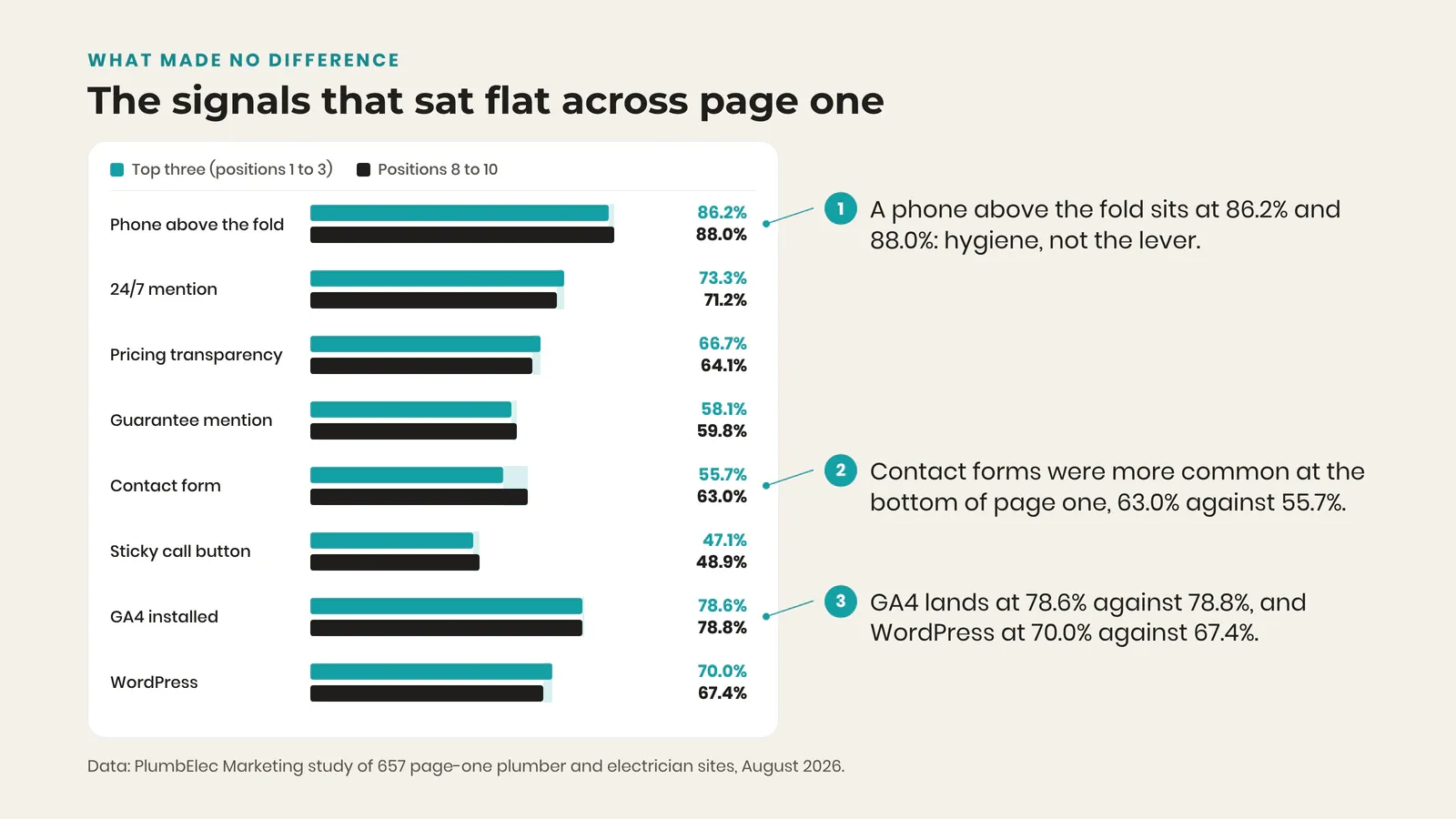
Contact forms and sticky call buttons were both more common at the bottom of page one than at the top, and GA4 was installed on 78.6% of the top three against 78.8% lower down. Every item on that table is worth having for the customer who lands on the page. None of them is what got the page there in the first place.
Reading these numbers honestly
Everything above is a correlation inside a single snapshot, captured over two days in August 2026. A signal that travels with the top three is not automatically a lever that lifts you into it, and adding a blog to a stuck site proves that quickly enough.
What the numbers are good for is ruling work out. Speed, platform, forms and 24/7 claims did not separate the two groups, which saves you a quarter spent on the wrong job. Against that long list of things making no difference, the short list that did is narrow: say where you work, prove you are licensed, get referenced elsewhere.
Data: PlumbElec Marketing study of 1,000 AU plumber and electrician searches and 300 map-pack listings, captured 5 to 6 August 2026.
Local SEO: the map pack and the suburb search
Number four in the map pack is the quietest spot on Google. Only three listings show under the map, and the fourth sits behind a “More businesses” tap, on a screen the size of a phone.
You can be the best plumber in the suburb and still be invisible in it.
Your Business Profile and reviews
The pack runs on your Google Business Profile, and reviews are the input owners ask us about most. Across the 300 map-pack listings we captured on 5 to 6 August 2026, position 1 held a median of 105.5 reviews, position 2 held 67 and position 3 held 75.5.
Position 2 sitting below position 3 is the clue that review count is one input among several. The bar also moves by city: a map-pack spot took a median of 124.5 reviews in Canberra and 38 in Adelaide, the highest and lowest of the ten metros we sampled.
So the number you work to is your own metro’s, not the country’s.
Suburb pages carry the organic side
Underneath the pack, the same search shows links, and those come off your website. The 77.8% figure above is the whole shape of it: the pages ranking for a trade plus a suburb are pages built for that suburb, not homepages doing double duty.
Title tags say the same thing from another angle, with 96.7% of top-three pages naming the suburb against 85.9% lower on page one.
Directories took 31.1% of all page-one results in that sample, and only 13% of position 1, so a real business holds the top spot 87% of the time. Directory share ran 32.6% on electrical searches and 29.6% on plumbing.
Play both, because few do
Only 28% of map-pack businesses also rank in the organic top 10 for the same search, which means the two halves of one screen are mostly held by different businesses. That is unusual in a market this competitive.
A business holding a pack spot and a page-one link takes two slots on one result, and each keeps earning while the other is built.
If your pin sits in the wrong pocket of the suburb, fix that before anything else, because distance carries the most weight in the pack. Our local SEO guide for plumbers and electricians covers the profile, the reviews and the geo grid in full.
On-page SEO: pages Google can rank
One change takes ten minutes and moves more pages than any redesign, which is the suburb in the title tag. It was there on 96.7% of top-three pages against 85.9% at positions 8 to 10, so pages near the bottom leave their suburb out of the first line Google reads.
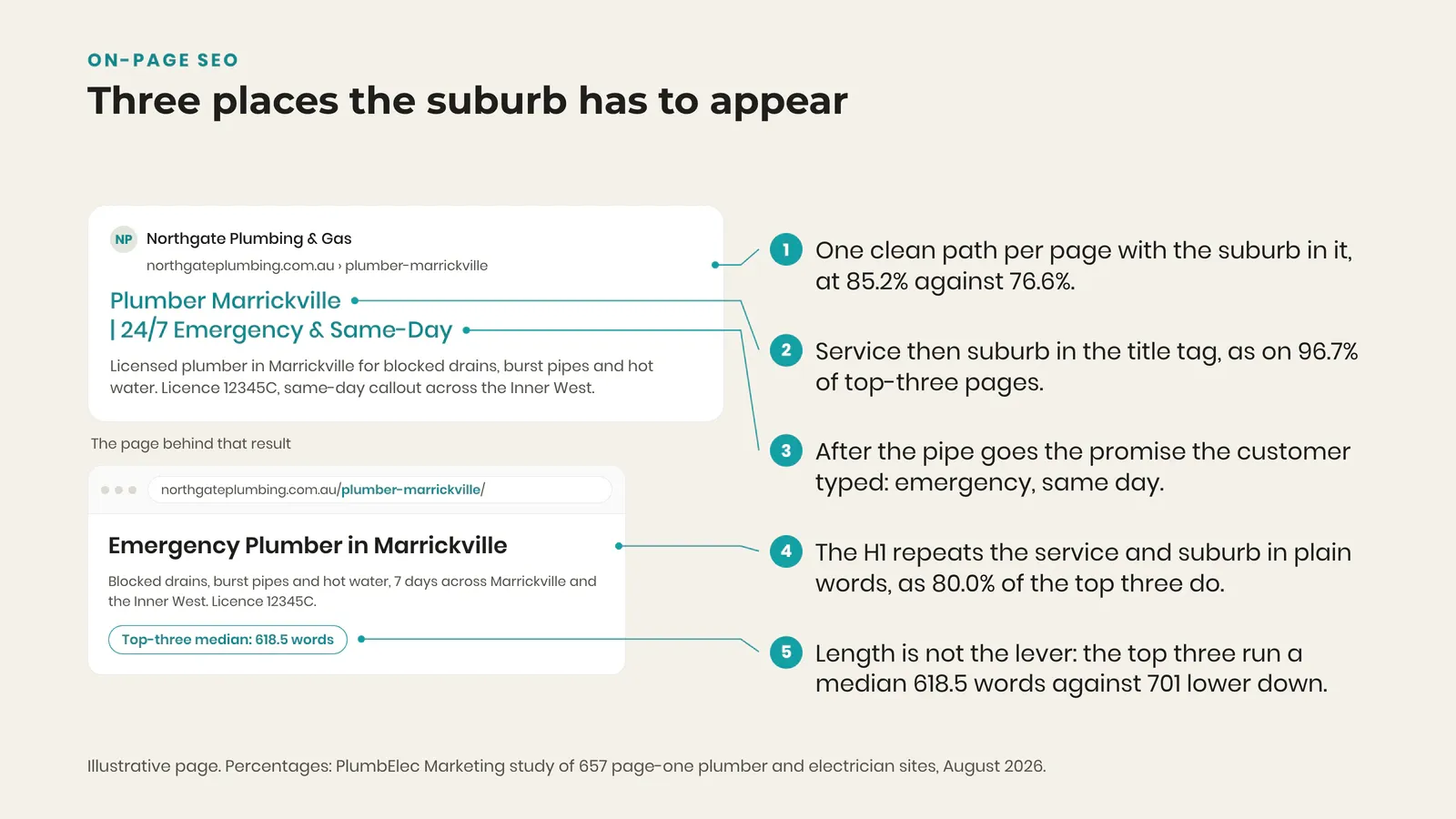
Five on-page decisions carry most of the weight on a trade page:
- Title tag: service, suburb, then business name, under 60 characters. It is the strongest place the suburb appears.
- H1: the same service and suburb in plain words, which 80.0% of top-three pages did against 69.0% lower on page one.
- URL: one clean path per page, such as /blocked-drains-parramatta/, at 85.2% against 76.6% on the same split.
- One page per service and suburb: a page covering six suburbs ranks properly for none of them.
- FAQ and review schema: mark up the questions you answer on the phone and the reviews you hold, at 43.3% against 36.4%.
Length is not the lever
The median top-three page ran 618.5 words. Lower on page one, at positions 8 to 10, the median ran 701, so the pages losing were writing more.
That kills the most common brief in trade SEO, which is a word count. A general page about hot water loses to a page about hot water replacement in one named suburb, because only one of them answers the search that was typed.
Write until the job is explained, the local detail is in and the next step is obvious, then stop. Google’s SEO starter guide is the plainest place to check the basics yourself.
Say the specific things
Specifics are the other gap the data shows. A licence number was shown on 61.4% of top-three pages against 51.6% lower on page one, and 31.4% of all sites we checked claimed a licence without showing the number.
Showing the number does work that claiming a licence cannot, which is the whole difference for a customer letting a stranger into the house.
Leave the specifics out and the page reads like every other page in the suburb, which is how it gets treated: eligible for the search, never the one that gets the call. Our on-page SEO guide has the page template.
Link building: the prominence Google measures
Two plumbing sites, the same page count, the same suburbs, written to the same standard. One sits at position 2 and the other at position 9, and the thing separating them is not on either website. It is on everybody else’s.
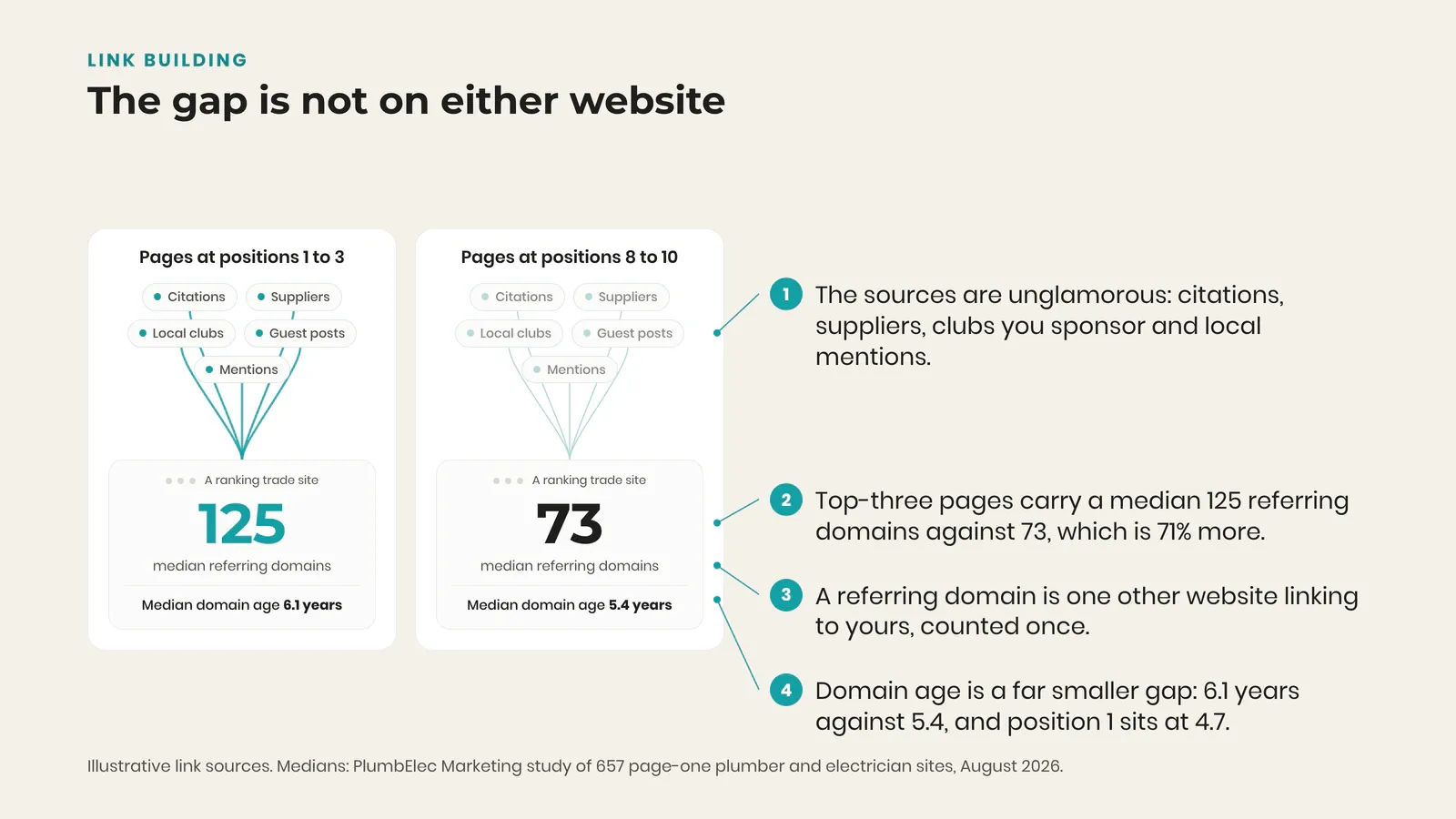
125 against 73
Referring domains were the widest gap in the study. Pages in the organic top three carried a median of 125 referring domains against 73 for pages at positions 8 to 10, which is 71% more.
A referring domain is one other website linking to yours, counted once no matter how many links it sends. Google’s published ranking systems include link-related ones, which is why that count stands in for how well known a business is.
Which is why links are the slowest part of the job and the part that compounds. Closing the 52-domain gap is a year of asking, rather than a quarter of it.
Citations, guest posts, real mentions
The links a trade business can actually get are unglamorous. Suppliers and wholesalers that list their trade customers, the associations you already pay, the junior team you sponsor, and the local paper when you do something worth reporting.
Citations sit underneath that: your business name, address and phone number listed consistently across the directories that get read. They are weak links on their own, and inconsistent ones confuse the match Google is trying to make.
The pattern in our client work is volume over cleverness, over 150 links built inside twelve months on two of the builds below. None of it needs an outreach agency, just someone to ask.
Age helps less than links
Domain age travels with rankings, but nowhere near as strongly. Median domain age was 6.1 years in the top three against 5.4 at positions 8 to 10, and the median position-1 domain was 4.7 years old.
A 0.7-year gap against a 52-domain gap tells you where the work is. Nobody can add years to a domain, so the work sits on links.
Being old is not an advantage you can spend, and it is not a defence either. Our link building guide sets out the order we work in, and the next question is whether the website is holding you back.
Technical SEO: what actually matters
The pages in the top three loaded slower than the pages at the bottom of page one. Median Lighthouse performance score was 0.40 for positions 1 to 3 against 0.50 at positions 8 to 10, across 319 Lighthouse runs on the sites in our August 2026 study.
Speed is not why you’re losing
The median ranking trade site scores 44 out of 100 on performance, and median largest contentful paint ran 7.16 seconds in the top three against 6.74 seconds at positions 8 to 10.
Both of those numbers are bad, and the winners’ numbers are the worse pair. Page speed is real and it matters to the customer waiting on a phone, but on this sample it did not decide the order of results.
So a developer quoting a month of work to lift a Lighthouse score is selling you a conversion improvement rather than a ranking one. Do it after the pages and the links, not before them.
Platform doesn’t decide it
67.0% of the ranking sites we checked run WordPress, and 57.3% of those WordPress sites run Elementor. Custom or unknown builds took 18.1% of the field, Duda 5.0%, Wix 2.7%, Squarespace 1.8% and Webflow 1.5%.
The split barely moves with position, at 70.0% WordPress in the top three against 67.4% at positions 8 to 10. Winners and losers sit on the same platform, running the same page builder.
Which settles a question I get asked most weeks. A platform migration is a fair decision for plenty of reasons, and a poor one if ranking is the reason you are doing it.
Indexing and structure do
What technical work does earn is getting every page found, crawled and kept. One page per service and suburb, linked from a page Google visits often, on clean URLs, with no duplicate version of the same page competing against itself.
Google publishes the ranking systems it uses, including the helpful content, reviews and link-related systems, which is a better guide to where effort goes than any speed score.
Check your pages are indexed before you check anything else technical, because an unindexed page cannot rank at any speed at all. Our technical SEO guide for trade sites runs the checks in order.
AI search: the third place a job comes from
Which search would you rather be found for: the one typed 1,527 times a month, or the one typed 7 times? Both are Australians looking for a plumber, and the gap between them is where the last two years went.
How people ask an assistant
On DataForSEO’s AI prompt volumes for Australia in August 2026, “recommend a plumber” appeared in AI assistant prompts 1,527 times a month. “Plumber near me” appeared just 7 times.
People type a sentence into an assistant, and they ask for a recommendation rather than a list to sort through themselves. What comes back is two or three business names with a reason attached to each of them.
Volumes inside an assistant are still small next to Google’s, so this is not where next month’s work comes from. It is the place where the shape of the question has already changed.
What the assistant reads
We checked 225 AI-recommended trade businesses across 46 Australian keywords in 2026 to see what the named ones had in common. Their own website was the source cited for 84% of the businesses.
Years in business was stated in 64% of those answers, and 24/7 availability was cited for 53% of those businesses. The assistant is repeating plain facts it found written down somewhere it could read them.
That means the facts have to sit on the page in a form that can be lifted off it: the year you started, the licence number, the hours, the suburbs, the guarantee.
Same work, different reader
Nothing on that list is separate from the work in the rest of this guide. Specific pages, specific claims and mentions on other websites are what the assistant reads, and they are what Google reads too.
The one genuine difference is the reader. Google ranks ten options and lets the customer choose, while an assistant picks two and explains why, so vagueness costs the whole answer instead of a position.
Treat it as one more output of the same build, not a separate channel with a budget. Our AI SEO guide for trade businesses has the live tests behind it.
What the numbers look like when it works
Adam had been through six agencies before us. Not one of them got him off the tools, and twelve months after we started he was off them for good.
Three clients sit below, three different starting points, twelve months of work in each case.
A one-man plumbing business
Zach runs Aussie Oncall Plumbing on his own, which is worth holding onto as you read the rest. When we started he was turning over $10,000 a month, and twelve months later he was over $50,000 a month, with a record month of $73,000.
That came off 50+ organic enquiries a month with no paid ads running, built on over 100 pages and over 150 links. The SEO spend returned 16X.
One plumber working alone, with a page count that most multi-van businesses in his city have not got near. The full build is in the Aussie Oncall Plumbing case study.
An electrician who tried six agencies
AB Electrical & Communications in Sydney is Adam’s business, the one that had been through six agencies. It was doing $50,000 a month when the work with us started.
Twelve months later it was doing $150,000 to $180,000 a month on 125+ organic leads, off over 300 pages and over 150 links, for a 33X return on the spend.
Adam is off the tools now, twelve months on from being on them every day. Six agencies had not shifted that. What shifted it was page volume and link volume, held steadily for a year, which is the least glamorous answer available.
From five calls to eighty
Plumbwell Plumbing Services in Sydney’s Inner West came to us after a year with a previous agency, and at that point it was taking fewer than 5 organic calls a month.
Year one with us took that to over 30 organic calls a month. Once Facebook ads were added on top, the business sat at 80+ enquiries a month at $40 an enquiry, a 12X return on the spend.
Sam’s own measure is independence from HiPages, because the enquiries now arrive addressed to his business. That is the part an owner feels first, well before the revenue line catches up with it.
What to expect, and when
Those are three clients rather than a promise. A well-run local campaign turns profitable by month 3 to 4, at 3x the spend, and reaches 20 to 30 calls a month by month 6.
One listing caps at 30 to 60 calls a month, and across twelve months we plan on 5x the spend. Across our clients we generate over 1,000 leads a month on Google.
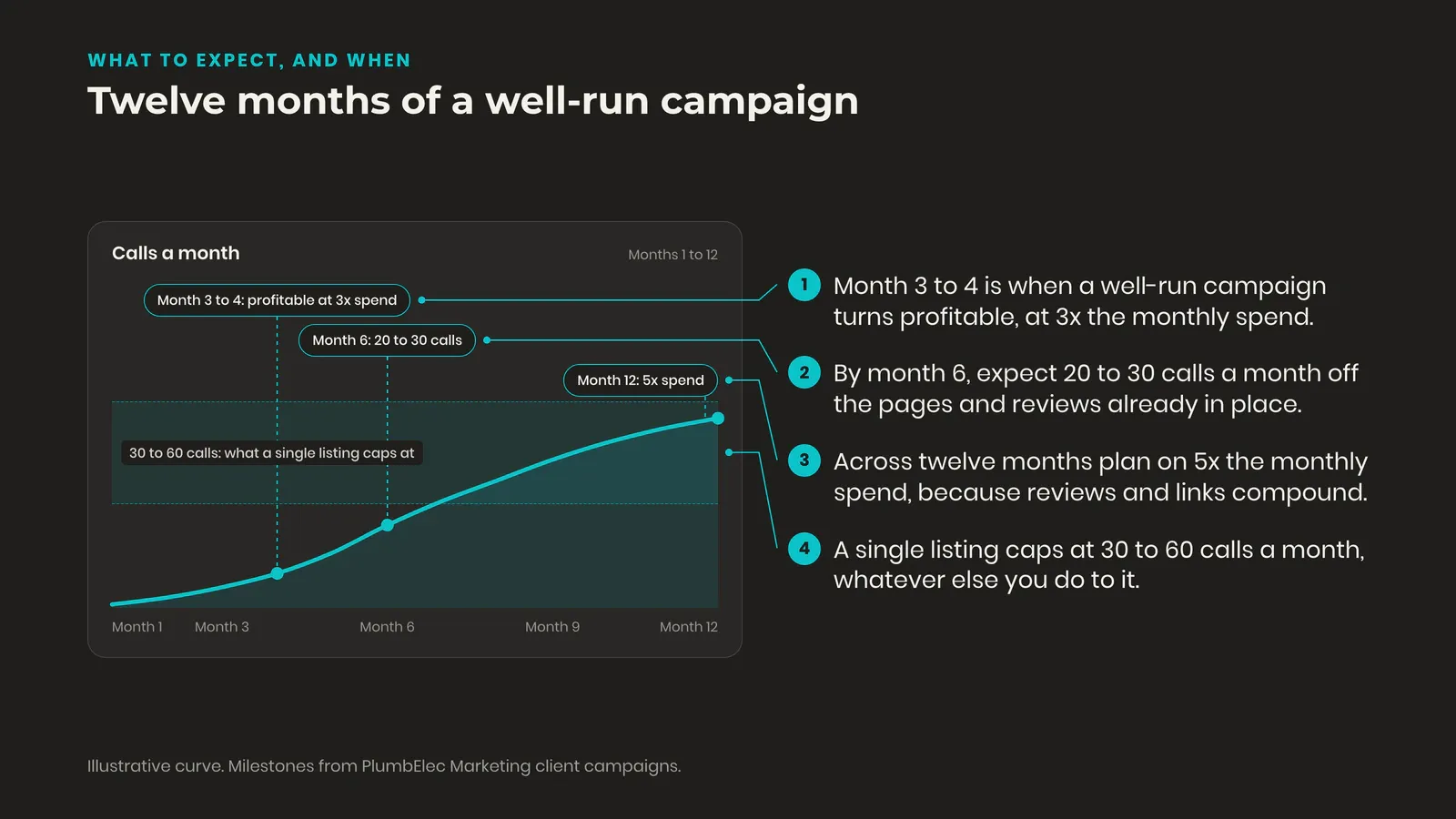
Start in six months and every number sits six months further away, because reviews, pages and links compound for whoever started first. If you would rather hand it over, our SEO services for plumbers and electricians do the build.
The order of work for a trade business
Search your own best suburb on your phone right now, from somewhere other than the office, and write down three things: who holds the three boxes, who holds the links underneath, and whether your business appears in either one. That list is your brief for the next six months.
Here is the order we run the work in, and what we check at the end of each phase:
| Phase | Work | What to measure |
|---|---|---|
| Weeks 1 to 4 | Claim and fix the Google Business Profile, set the pin and the categories, audit what is indexed, pick the service and suburb list, install call tracking | Baseline positions by suburb, indexed pages, review count and average, calls by source |
| Weeks 5 to 12 | Publish the first service and suburb pages with the suburb in the title, H1 and URL, turn the review ask on for every job, clean up the citations | Pages live and indexed, new reviews a month, positions for the new pages, tracked calls |
| Weeks 13 to 26 | Keep publishing pages, start on links through suppliers, sponsorships and trade bodies, add FAQ and review schema, rework whatever the data says is stuck | Referring domains, top-three positions held, calls a month, cost per lead |
Three mistakes cost more than anything on that table:
- Don’t chase speed scores first: the top three in our study ran a median Lighthouse score of 0.40 against 0.50 lower on page one, so a faster site is a better site and not a higher one.
- Don’t buy a directory plan instead of pages: directories hold 31.1% of page one, and you can rent a slot on one or own a page that earns for years.
- Don’t guess which channel rang: only 5% of page-one trade sites run call tracking while 80.4% have GA4 installed, so the traffic gets counted and the calls get guessed at. Our lead generation guide covers the tracking that ties a call to a search.
Six months of that order, held steadily, is what the case studies above are made of. If you would rather it was run for you, our SEO services do this exact work, and the five things it comes down to are worth putting in one place.
Conclusion
Five things decide page one for a plumbing or electrical business, and none of them are clever. Being specific comes first: the suburb in the title, the H1 and the URL, on a page built for that suburb rather than a homepage carrying twelve of them. Proof is second, because a licence number beats a claim about being licensed.
Links are third, the widest gap between the top of page one and the bottom, which also makes them the slowest to close. The map pack is fourth, run off a profile and a review count measured against your own city rather than the country. Fifth is the AI answer, which reads the same facts off the same pages.
The rest of it, the speed scores, the platform, the page word counts, is where a year gets spent without the phone ringing any more than it did before.
FAQs
How long does SEO take for a plumbing or electrical business?
Three to four months to turn profitable at 3x the spend, then 20 to 30 calls a month by month 6 on a well-run campaign. An established site moves faster than a new one.
Is Google Maps SEO the same as SEO?
No. The map pack runs off your Google Business Profile and the links underneath run off your website, and only 28% of map-pack businesses also rank in the organic top 10.
Does my website need to be fast to rank?
No. The top three in our study had a median Lighthouse score of 0.40 against 0.50 at positions 8 to 10. Speed helps the customer who is waiting, not the position.
Do I need a blog to rank?
Not to rank in a suburb. 55.7% of top-three pages had a blog against 42.4% lower on page one, so service and suburb pages come first and the blog comes later.
Can I do SEO for my trade business myself?
Yes, for the profile, the reviews, the title tags and the first few pages. Links and the page volume needed to hold a whole metro are where most owners run out of hours.
How much does SEO cost in Australia?
No single figure applies, so ask what the monthly fee buys in pages, links and reporting. Judge any quote against the shape above: 3x the spend by month 4, 5x across twelve months.
Find out where you sit on page one
Search your best suburb and look at who holds the three boxes, then look at the links underneath. If neither one is you, we will tell you what is holding the position, which pages are missing and how big the gap is in links.
PlumbElec Marketing works with plumbers and electricians across Australia. Call (02) 9100 0985, book a time that suits you, or read how our SEO services for trade businesses work first.