
A geo grid runs the same Google search from a grid of points across your service area and records where your listing ranks at each one. Check your own search from the office and you sit at position 1. Ask a mate three suburbs over and he cannot find you in the pack at all.
Both screens are telling the truth. Map-pack results move with wherever the searcher is standing, so one rank check is one point on a map. Most tradies we talk to have only ever taken that one point.
This guide covers how the pack changes from suburb to suburb, how to read a grid report, what our live check of 19 Sydney and Gold Coast suburbs turned up on 16 September 2026, how to set one up, what each pattern tells you to fix, and how to track it month to month.
In this guide
Why one rank check lies to a service-area business
The report that says you sit 4th for “plumber” in your city is describing a single phone in a single spot. Your customers are not standing there, and a service-area business is ranked from wherever the searcher happens to be standing.
Distance you cannot argue with
Distance is the straight-line gap between the searcher and your listing’s pin, and it carries more weight in the map pack than anything else.
That is why the office check flatters you: you are standing on your own pin, so the heaviest factor sits at its best setting for you and its worst for the customer two suburbs over.
Our local SEO guide for plumbers and electricians covers how distance sits alongside relevance and prominence, and the parent guide to SEO for trade businesses shows where local work fits.
The pack changes every suburb
Your categories, your reviews and your links read the same in Penrith as they do in Blacktown. The only thing that changes between the two is which pins are nearest, and that reshuffles the order.
So Google can serve a different three in every suburb you work in without a single ranking factor changing on anybody’s profile.
Which makes the honest reading a map of ranks, not one number.
What fifty suburbs showed us
We captured the map pack across 50 suburbs in 10 Australian metros, five per city and 5 to 30 km apart, on 5 to 6 August 2026. Of the 297 businesses holding a pack spot, only 3 (1.0%) held one in more than one of the five suburbs sampled in their city, and none held three.
The three that managed it: Complete Electrical Service Canberra in Gungahlin and Woden, Watts Needed Electrical in Tuggeranong and Woden, and DYFA Plumbing in Buderim and Maroochydore. Of the same 300 listings, 40.3% hid their address and 65.0% claimed 24/7.
Only 28% of those 300 map-pack businesses also ranked in the organic top 10. Holding one suburb’s pack is ordinary, holding two is rare, and a grid tells you which you are.
What a geo grid is and how to read one
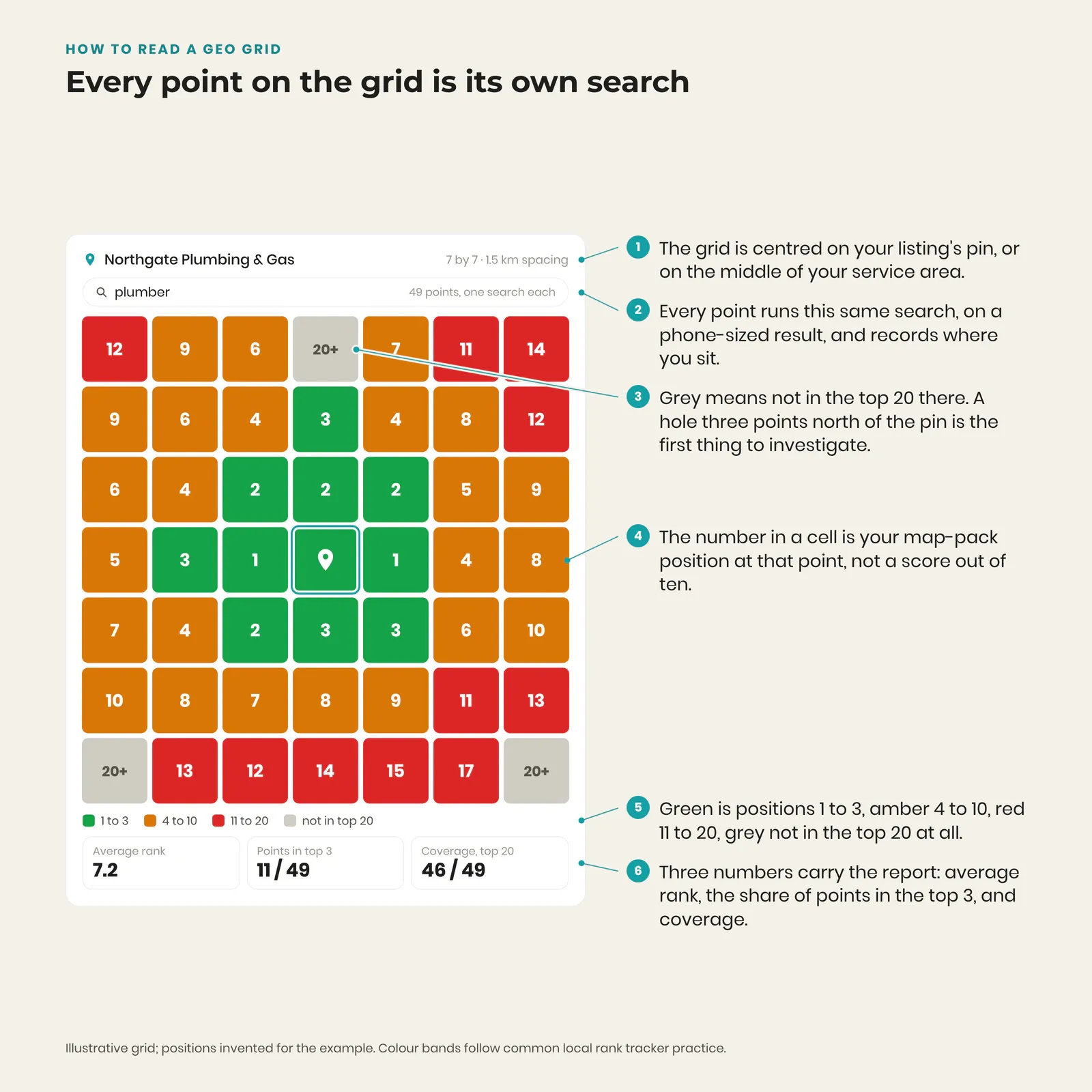
A grid report comes back as three numbers and a sheet of coloured squares, and the same listing can look healthy or hopeless depending on how the grid was set. Points, spacing and the words you type all change the answer.
Points, spacing and zoom
A grid is a set of points, 5 by 5, 7 by 7, 9 by 9 or larger, spaced a set distance apart and centred on your listing’s pin or the middle of your service area. The tool runs the same search from each point and records your position.
Spacing is the setting people get wrong, and the usual range is 1 to 5 km. Forty-nine points at 1 km apart map a suburb cluster street by street; the same 49 at 5 km cover a metro.
Google’s service area guidance says “The boundaries of your overall area shouldn’t be more than about 2 hours of driving time from where your business is based”, so a grid wider than that scores searches you were never eligible for.
The three numbers on the report
Every tool reports the same three numbers: average rank across all points, the share of points where you sit in the top 3, and coverage, the share where you appear in the top 20 at all.
Average rank is the number owners quote and the least useful, because grey points at the edges drag it down while nothing changes near the pin. Share of top-3 points is the one tied to money: a searcher sees you there without tapping anything.
The number I look at first is coverage, because it moves before the top-3 share. Coverage climbing while top-3 stays flat is a campaign that is working and not finished.
Green, amber, red and grey
The colour scale is standard across local rank tracker reports: green for positions 1 to 3, amber for 4 to 10, red for 11 to 20, and grey for not found in the top 20.
Green clustered near the pin and fading outward is the normal result for a healthy single-location trade business. What matters is where that fade starts and whether anything breaks the pattern.
A grey square sitting inside a green patch is the one to chase, because distance did not cause it.
Field check: the map pack in 19 suburbs, one afternoon
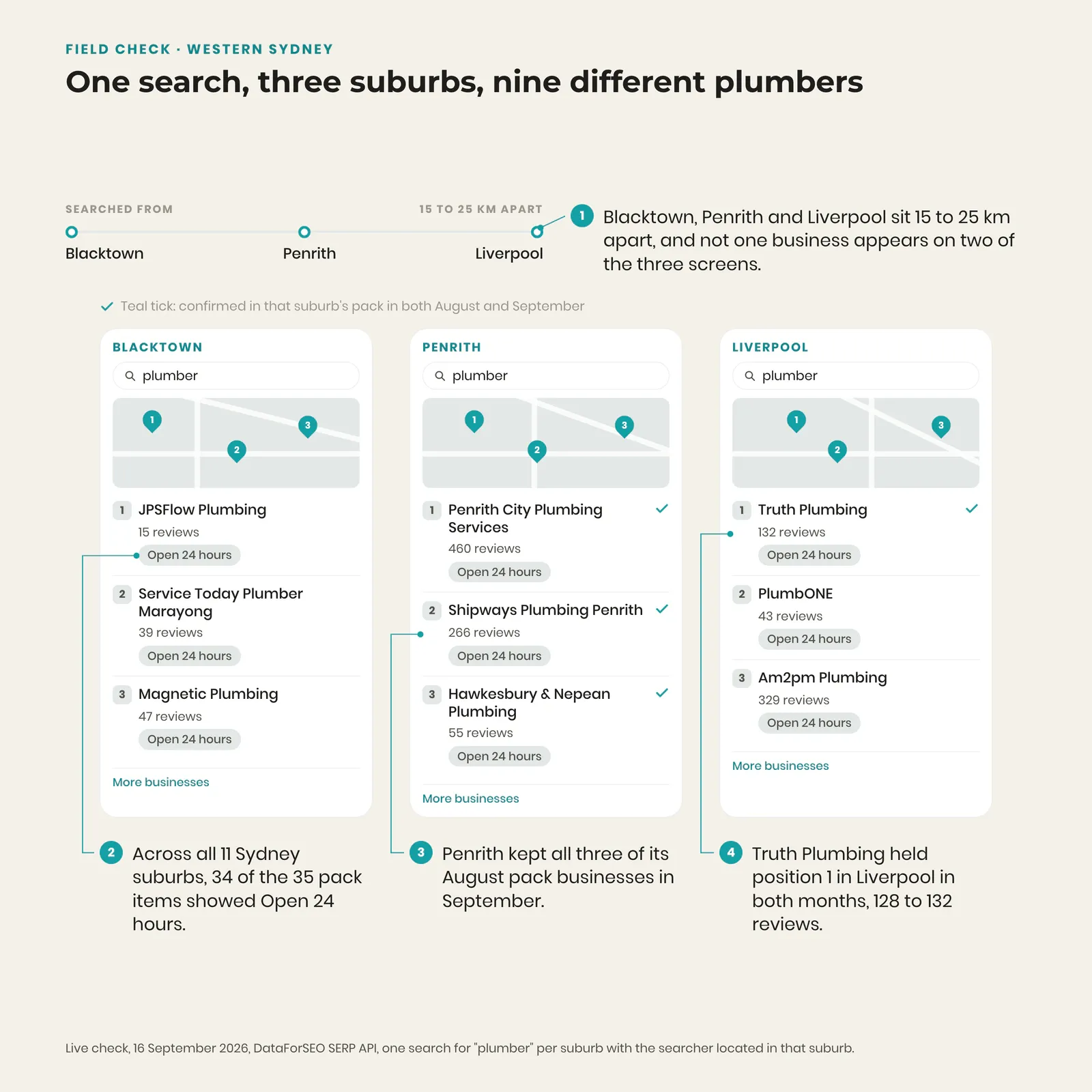
We searched “plumber” from inside 11 western Sydney suburbs on 16 September 2026, and 35 different businesses filled the 35 pack spots. Not one name appeared in two of them. Eleven packs, 35 businesses, no repeats, in one metro on one afternoon.
How we ran it
We ran one live search per suburb through the DataForSEO SERP API on 16 September 2026, the searcher located in that suburb: “plumber” across 11 Sydney suburbs, “electrician” across 8 on the Gold Coast.
A proper geo grid runs from coordinates 1 to 2 km apart and ours ran one search per suburb, which is coarser. Google returned a different pack at all 19 anyway.
Western Sydney: no repeated names
The 11 suburbs were Blacktown, Penrith, Liverpool, Castle Hill, Bankstown, Auburn, Fairfield, Hornsby, Ryde, Campbelltown and Chatswood.
Blacktown, Penrith and Liverpool sit 15 to 25 km apart and returned nine names: JPSFlow Plumbing, Service Today Plumber Marayong and Magnetic Plumbing in Blacktown; Penrith City Plumbing Services, Shipways Plumbing Penrith and Hawkesbury & Nepean Plumbing in Penrith; Truth Plumbing, PlumbONE and Am2pm Plumbing in Liverpool.
34 of 35 items showed “Open 24 hours”, and 28 of 35 showed a years in business line.
Gold Coast: one electrician, two suburbs
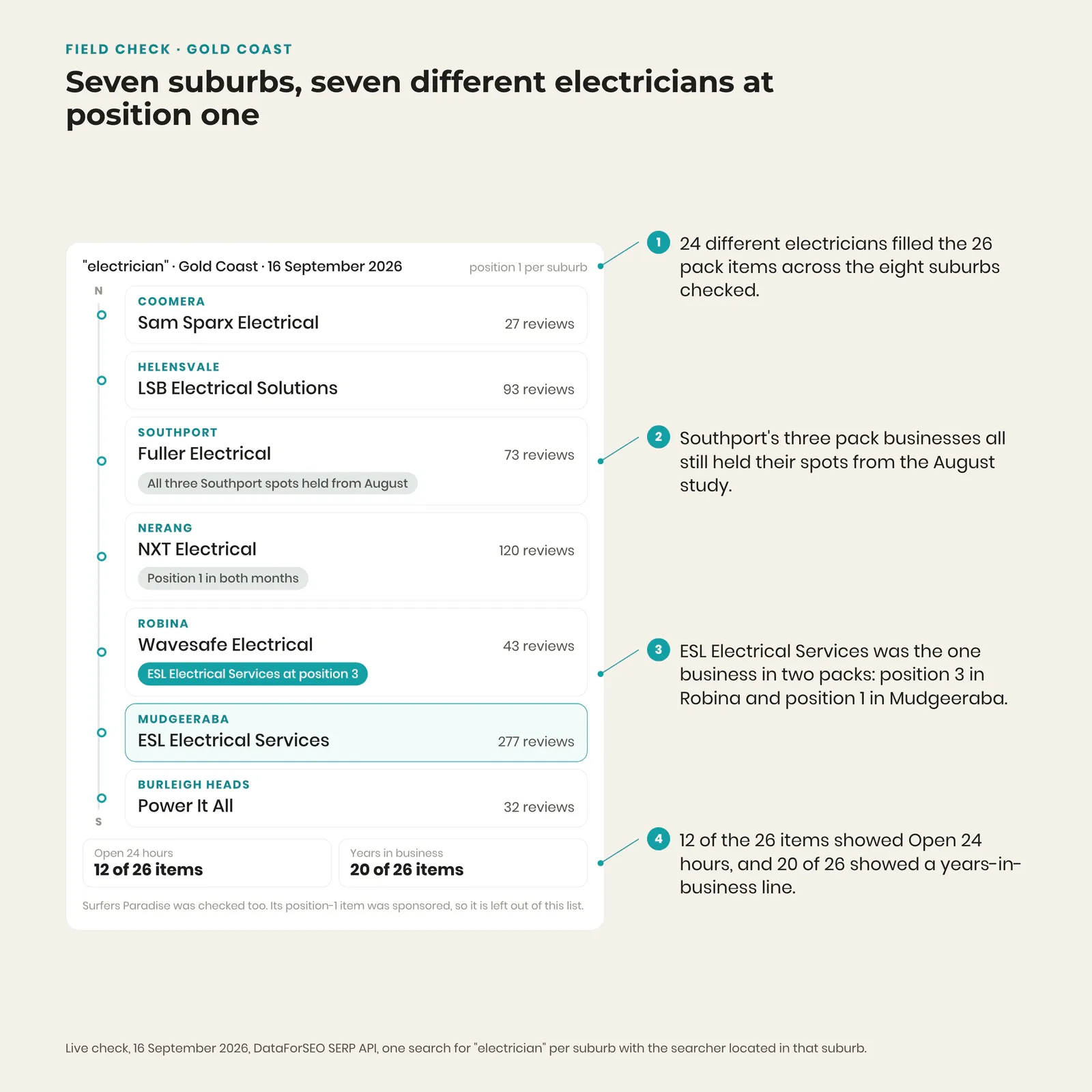
The Gold Coast run returned 24 different businesses across 26 pack items in 8 suburbs, and one held a spot in two: ESL Electrical Services, position 1 in Mudgeeraba and 3 in Robina, on 277 reviews and a 5.0 rating.
12 of 26 items showed “Open 24 hours”, against 20 of 26 showing years in business.
The full pack for seven of those suburbs, north to south, reviews in brackets:
| Suburb | Position 1 | Position 2 | Position 3 |
|---|---|---|---|
| Coomera | Sam Sparx Electrical (27) | Empower Electrical (14) | Arta Electrical (23) |
| Helensvale | LSB Electrical Solutions (93) | Sparkies Electrical (77) | MCH Electrical (509) |
| Southport | Fuller Electrical (73) | Gold Coast Better Electrical (76) | Vision Electrical (209) |
| Nerang | NXT Electrical (120) | Crescent Electrical Services (43) | Joyner Electrical (87) |
| Robina | Wavesafe Electrical (43) | Casa Electrical and Air (46) | ESL Electrical Services (277) |
| Mudgeeraba | ESL Electrical Services (277) | Summit Electrics (90) | JVK Electrical & Airconditioning (208) |
| Burleigh Heads | Power It All (32) | All Access Electrical (103) | Tradem8 Electrical (8) |
Who held their spot since August
Eight of those suburbs sat in the August study too, giving 24 pack businesses to check again. 14 of the 24 were still in that suburb’s pack in September, on a cross-method comparison: August searched “plumber” plus the suburb name, September searched “plumber” from inside the suburb.
Penrith kept all three: Penrith City Plumbing Services 453 to 460 reviews, Shipways Plumbing Penrith 264 to 266, Hawkesbury & Nepean Plumbing 51 to 55. Southport kept all three too: Fuller Electrical 73, Gold Coast Better Electrical 70 to 76, Vision Electrical 207 to 209. Truth Plumbing held position 1 in Liverpool both months, 128 to 132, and NXT Electrical did the same in Nerang, 113 to 120.
Data: PlumbElec Marketing study of 300 AU map-pack listings, August 2026, and a live suburb-level check of 19 Sydney and Gold Coast suburbs on 16 September 2026.
How to set up your own grid
You can have your first honest reading of where you rank by lunchtime. Local Falcon, BrightLocal and Whitespark’s Local Rank Tracker all do the same job, running the search from each point and recording your position there. What separates a run worth keeping from a screenshot is the settings you choose before you press go.
Set it up in this order:
- Pick the searches that pay: two or three, never twenty. “Plumber”, “emergency plumber”, “electrician”, or the trade word plus the service that earns you the most per job.
- Match the radius to where you work: centre the grid on your listing’s pin or the middle of your service area, and stop it at the boundary you have actually set on your profile.
- Space the points 1 to 2 km apart: a 7 by 7 grid at that spacing suits a business working one suburb cluster. Go to 5 by 5 or 7 by 7 at 3 to 5 km if you cover a whole metro.
- Search like a customer: phone-sized results and the plain trade word. Never your business name, because your own name shows you a screen no customer will ever see.
- Run it on a schedule: same weekday, same hour, weekly or monthly. Packs move through the week, so runs taken at different times are not comparable.
- Keep the first run: that one is your baseline, the only version of your grid you can never go back and capture.
Skip the baseline and every run after it is a snapshot with nothing to measure against, which is how a year of local work ends up being argued over instead of read off a page.
Turning the grid into a to-do list
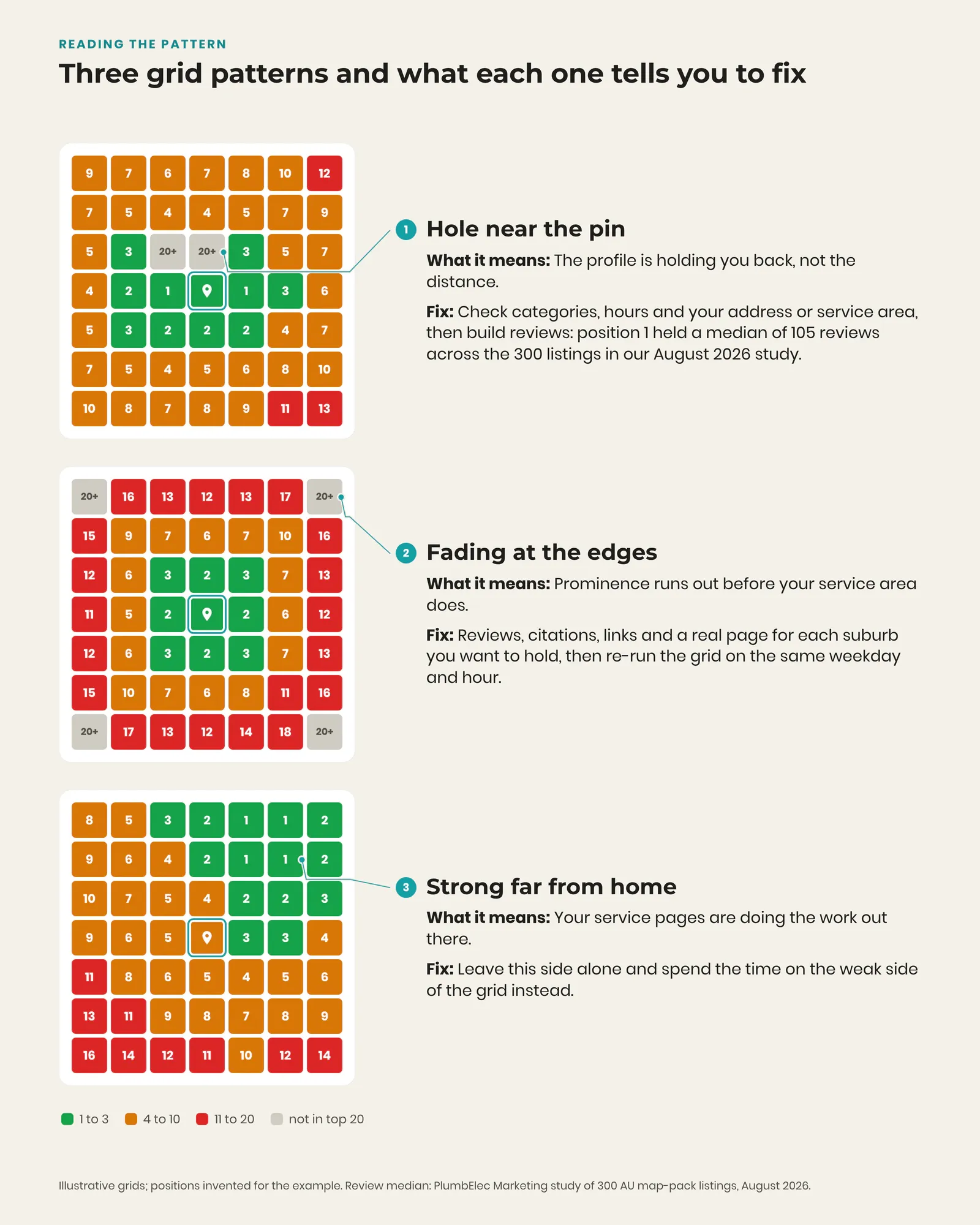
Most owners look at their first grid and start on the reddest corner, which is usually the last thing worth touching. Read the shape first, because a hole beside your own pin and an edge that fades out call for completely different work.
Holes near your own pin
Distance is at its best right next to your pin, so a grey or red point there points at relevance or prominence. Start with the profile.
Check that the primary category is the trade itself, the services list carries the job you searched for, the hours are honest, and the service area is set the way Google expects.
Across the 300 listings in our August 2026 study, the position-1 map-pack spot held a median of 105 reviews and a median rating of 5.0. Measure your own count against that.
Fading at the edges
A clean fade from green near the pin out to red and grey at the boundary is normal, and how far the green reaches is a prominence question. Prominence is the slow input: reviews, citations, links and your own site.
Edge points put you furthest from the searcher and closest to somebody else’s pin, so you have to be better known to hold one. A suburb page that genuinely covers that suburb is the piece most trade sites miss.
Strong far from home
Sometimes the grid runs green in a suburb well away from your pin and patchier closer in. That usually means your website is carrying the listing out there: a service or suburb page doing its job, links pointing at it, reviews naming the work.
Leave it alone: that pocket took months to earn and costs nothing to keep. Put the effort into the points that are close and weak instead.
When one listing can’t cover it
A grid can also tell you the listing has run out of room. On our Maps campaigns a single listing caps at 30 to 60 calls a month, and a grid gone green everywhere it reaches is sitting on that ceiling.
An electrician on the Northern Beaches was taking a trickle of work off a listing in a low-population location, and moving it was “the difference between 5 calls and 50”. Plumbwell Plumbing takes 50 to 80 leads a month from Google Maps alone in Sydney’s Inner West, across multiple Google Business Profiles.
Read when a second Google Business Profile is allowed and our Google Maps ranking factors breakdown first, or hand the grid, the profile and the pages to our local SEO service for plumbers and electricians.
Tracking it month to month
Coverage climbing while the phone stays quiet usually means the grid grew across the part of your area where nobody searches. So the grid on its own is never the report, and it earns its place next to the numbers already in your Business Profile.
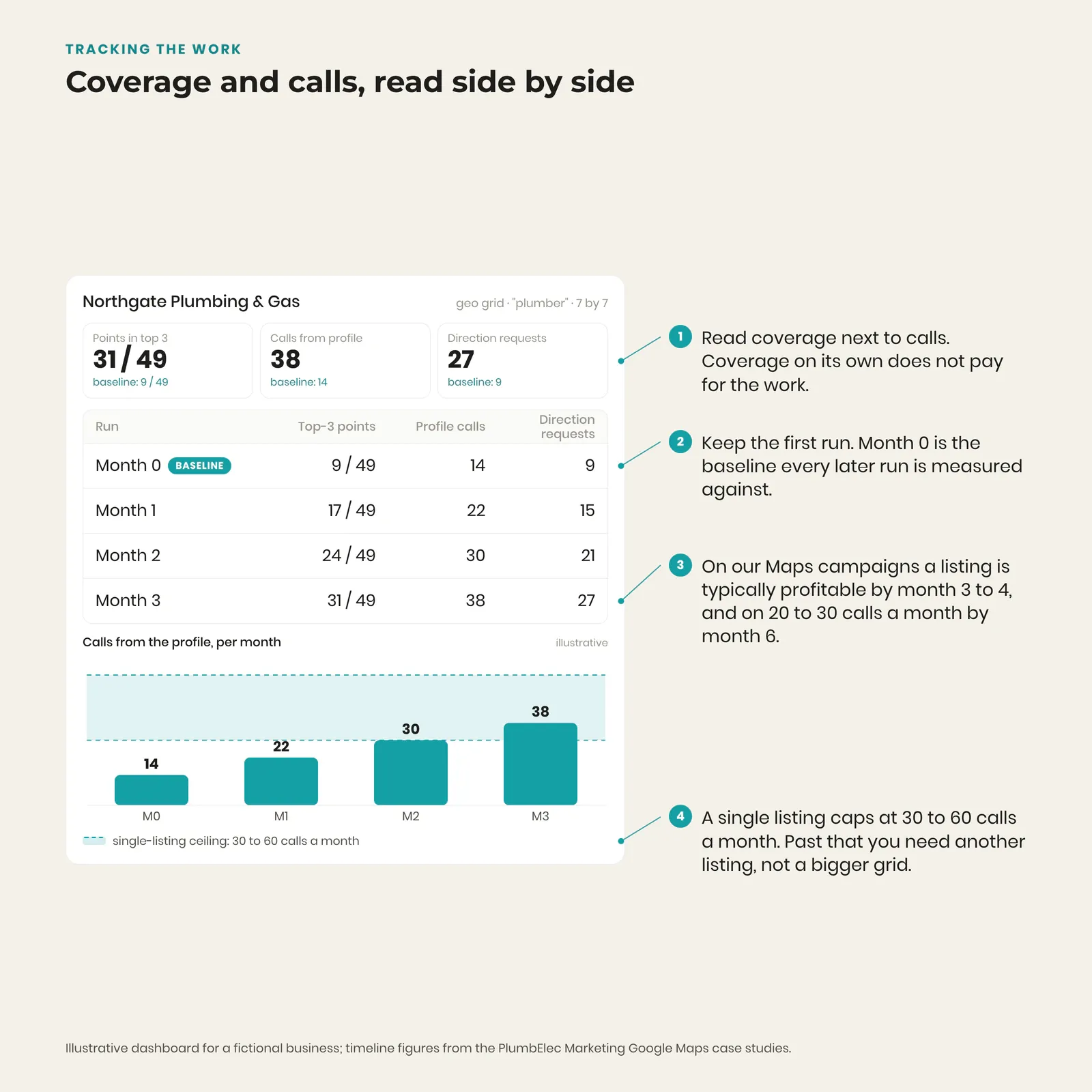
Baseline first, then the work
The first run is your baseline and only exists if you take it before anything changes. Capture it on the searches that pay, save the image and the three numbers, and date it.
Then change one thing at a time: profile work, reviews and new suburb pages all move a grid, and if they land in the same month you will not know which did it.
Run it again on the same weekday and hour, with the same points, spacing and search. An existing listing with reviews on it moves faster than a brand new one.
Three numbers beside the grid
We measure a Maps campaign on three things: listing clicks, geo grid expansion, and calls attributed to the listing.
Two of those come straight out of Google. The Business Profile Performance report shows calls, meaning clicks on the call button, plus direction requests, website clicks, messages and bookings, over a date range you set.
Attributed calls are the third, and the one most businesses go blind on. Without a tracked number you cannot separate a call off the grid work from a referral.
What T42’s grid looked like
T42 Electrical on the Gold Coast reads better on a grid than the address suggests. Their listed address sits on the outer side of the Gold Coast and they are not ranking over the main Gold Coast CBD area yet.
They have taken the entire back section of the Gold Coast on the grid for “electrician Gold Coast” and “emergency electrician Gold Coast”. More grids like it sit in our Google Maps case studies.
The timeline holds: profitable by month 3 to 4, 20 to 30 calls a month off the listing by month 6, a cap of 30 to 60 calls for one listing, and faster movement on an existing profile than a new one. One rank check, after all that work, still hands you one number.
Conclusion
Four things decide whether a grid is worth running. One rank check is one point on a map, so the reading you take in your own office is the least representative one available.
Match the grid to the area you have actually set, on the two or three searches that turn into jobs, at spacing tight enough to show the street behind your workshop. Then read the pattern rather than the average: holes beside the pin send you to the profile, faded edges to prominence, and strength at distance to the pages already doing their job.
Track calls and direction requests next to coverage, every month, off the same settings. None of that is clever. It is one afternoon to set up and ten minutes a month to keep honest.
FAQs
What is a geo grid in local SEO?
A geo grid runs the same Google search from a set of points across your service area and records your map-pack position at each one, giving a map of ranks.
How often should a plumber or electrician run a geo grid?
Monthly suits most trade businesses, weekly during an active campaign. Run it on the same weekday and hour every time, because packs shift through the week.
What grid size should a trade business use?
A 7 by 7 grid at 1 to 2 km spacing if you work one suburb cluster. For metro-wide coverage, 5 by 5 or 7 by 7 at 3 to 5 km.
Why do I rank first at the office and nowhere at home?
Distance between the searcher and your listing’s pin is the heaviest input in the map pack. At the office you stand on your own pin, at home on somebody else’s.
Can a geo grid track a listing with a hidden address?
Yes. Businesses that do not serve customers at their address remove it and enter a service area instead, but the pin still exists and the grid still reads your position.
Does a bigger grid mean a bigger service area?
No. A wider grid measures more points. Google’s guidance is that the boundaries of your overall area “shouldn’t be more than about 2 hours of driving time” from your business.
Want to see your own grid?
Where does your listing actually sit three suburbs over from your workshop? PlumbElec Marketing runs a baseline grid on the searches that pay before any local work starts, so you see the holes and the edges on your own map instead of a national average.
We work with plumbers and electricians right across Australia. Call (02) 9100 0985, book a time that suits you, or read how our local SEO services work first.