Local SEO decides which plumber or electrician gets the tap when a burst pipe or a dead switchboard sends someone to Google. Most jobs now start with one of two searches: “plumber near me”, or a trade plus a suburb name.
For a trade business, local SEO is the work of holding one of the three map listings and one of the page-one links for the suburbs you service, then turning those positions into phone calls.
Two separate games sit behind that sentence. The map pack runs on your Google Business Profile. Organic, the blue links underneath, runs on your website.
Most tradies we talk to are playing one and ignoring the other. This guide covers both: how Google picks the three, what the map pack actually looks like across ten Australian cities, how many reviews you need, what your website has to carry, and what the first 90 days should look like.
In this guide
What local SEO actually means for a plumbing or electrical business
Plenty of businesses sit at number four in the map pack for their own suburb and wonder why the phone stays quiet. Position four is the first listing nobody sees without tapping “More businesses”, and on a phone that tap rarely happens.
Map pack versus organic results
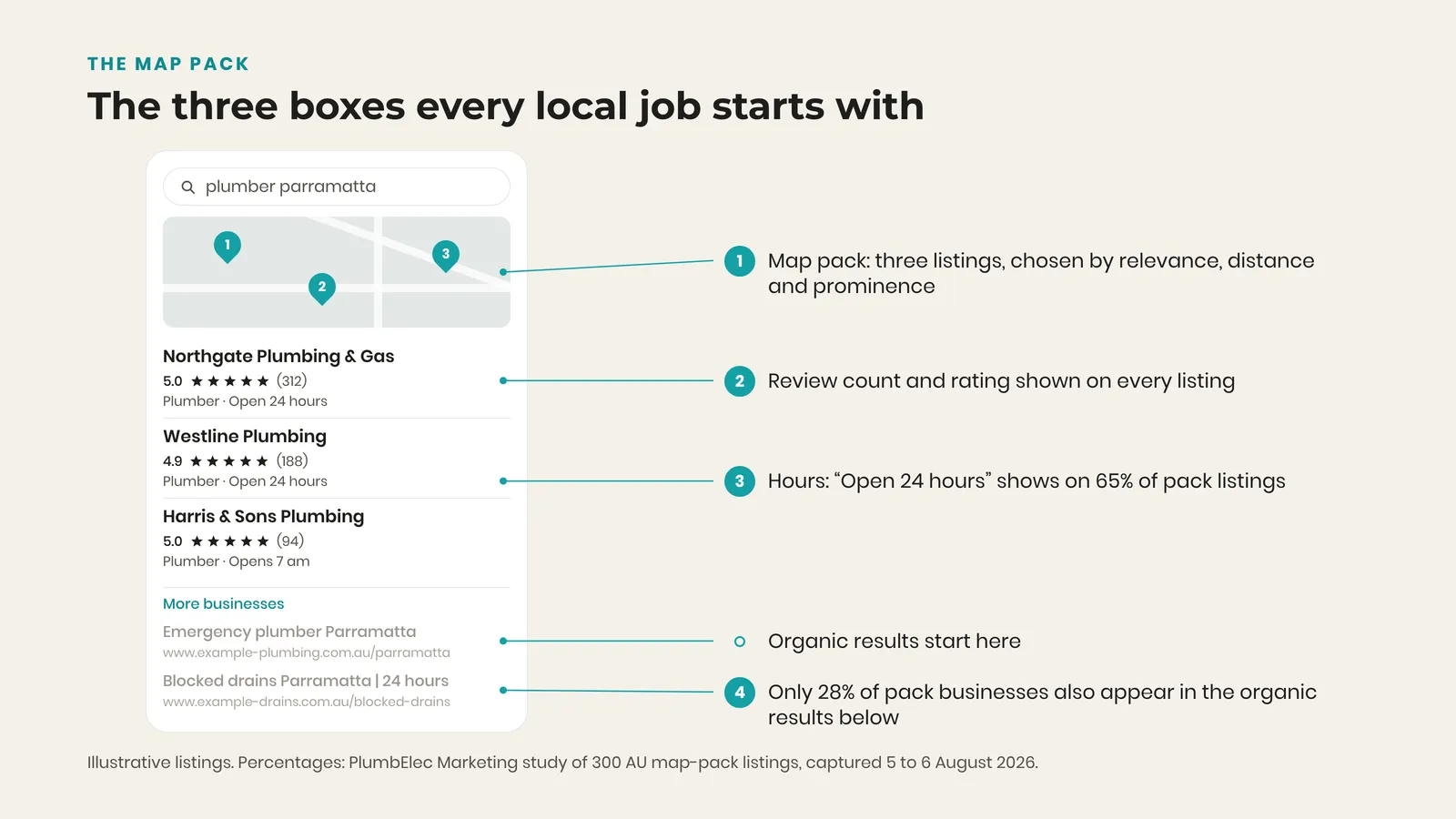
The map pack is the boxed set of three listings, with the small map above it, that Google shows for anything it reads as a local job. Those three come from Google Business Profiles rather than websites, and distance, categories, reviews and how well known your business is decide the order.
Organic results are the ordinary blue links below the pack. They come from pages on your site, they shift far less with where the searcher is standing, and they catch the searches the pack serves badly, such as “cost to replace a hot water system Sydney”.
Why holding both positions pays
The two systems overlap less than most owners assume. Of the 300 map-pack listings we captured across ten Australian metros in August 2026, only 28% of those businesses also ranked in the organic top 10 for the same search.
That gap is the opportunity. A business holding a map spot and a page-one link takes two positions on the same screen, and one keeps earning while the other is being built. For how this sits alongside everything else Google measures, our guide to SEO for trade businesses is the parent to this one.
Which makes the first question a simple one: how does Google pick its three?
How Google decides who’s in the map pack
Google publishes the three things it ranks local results on. So why do two electricians with matching categories and similar review counts sit five spots apart in the same suburb?
The answer is in how those three get weighted against each other. Google lists them as relevance, distance and prominence.
Relevance starts with your categories
Relevance is how well your profile matches what was typed. Categories do most of that work, with your services list, your description and the words inside your reviews filling in the rest. A profile set to “Plumber” with blocked drains in the services list is relevant to “blocked drain [suburb]” in a way a profile set only to “Contractor” never will be.
The distance you can’t fake
Distance is the straight-line gap between the searcher and your listing’s pin. It is the heaviest of the three in the pack and the one you cannot argue with. Put a pin in a low-population pocket and you are competing for searches that barely happen there.
That pin is measured against wherever the searcher happens to be standing, which is why your results checked from the office always look better than your customers’ do.
We moved a Northern Beaches electrician’s listing out of exactly that spot. The old location produced 5 calls a month, and the move was the difference between 5 calls and 50.
Prominence, and what to fix first
Prominence is how well known Google thinks you are: review count and review velocity, citations, links, and the weight of your website. It is the slowest of the three to build and the only one that compounds.
The annual Local Search Ranking Factors survey puts Google Business Profile signals and review signals at the top of the local pack list, which is practitioner opinion rather than measurement, so we run our own numbers alongside it.
If your pin sits where the work isn’t, fix that before you touch anything else on the list. Our breakdown of Google Maps ranking factors covers the pin and the service area in detail, and if your business genuinely operates from more than one premises, read when a second Google Business Profile is allowed before you create one.
What the map pack looks like in ten Australian cities
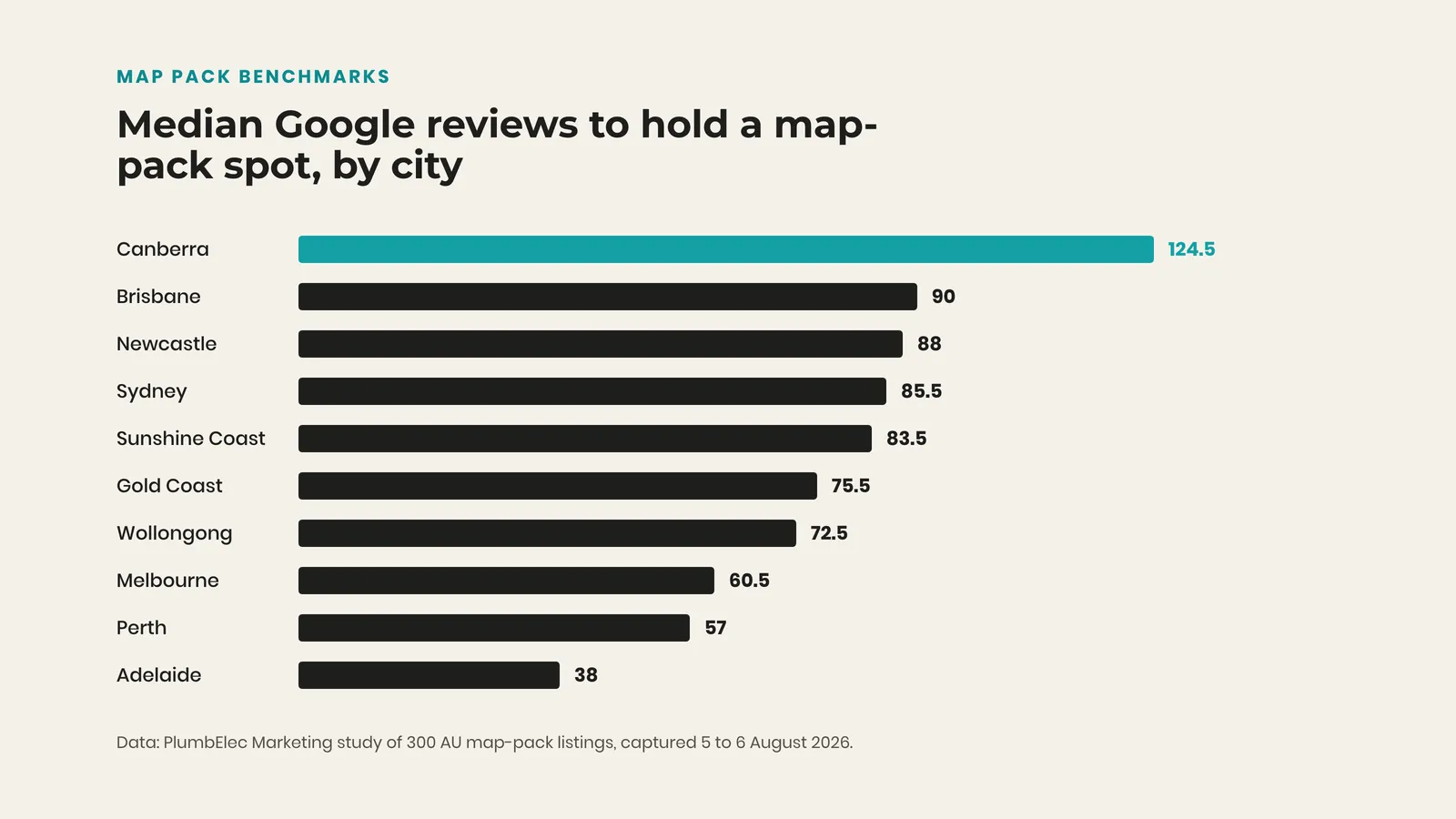
A map-pack listing in Canberra carries a median of 124.5 Google reviews. In Adelaide the median is 38.
Both of those come from the 300 map-pack listings we captured on 5 to 6 August 2026, across ten metros, five suburbs each, for plumber and electrician searches. Same country, same two trades, more than three times the review bar to sit in the same three boxes.
Here is the median review count of the listings holding a map-pack spot in each metro, with the mean rating and the share whose business name had a keyword or suburb stuffed into it:
| Metro | Median reviews | Mean rating | Keyword-stuffed name |
|---|---|---|---|
| Canberra | 124.5 | 4.94 | 47% |
| Brisbane | 90 | 4.91 | 33% |
| Newcastle | 88 | 4.94 | 43% |
| Sydney | 85.5 | 4.93 | 57% |
| Sunshine Coast | 83.5 | 4.95 | 23% |
| Gold Coast | 75.5 | 4.90 | 53% |
| Wollongong | 72.5 | 4.94 | 53% |
| Melbourne | 60.5 | 4.97 | 43% |
| Perth | 57 | 4.90 | 20% |
| Adelaide | 38 | 4.90 | 40% |
Plumbing listings ran a median of 84 reviews across the whole sample, electrical listings 75.
Sorted by position instead of metro, the same 300 listings tell a flatter story than most people expect:
| Position | Median reviews | Mean rating | Shows a 24/7 claim | Address hidden |
|---|---|---|---|---|
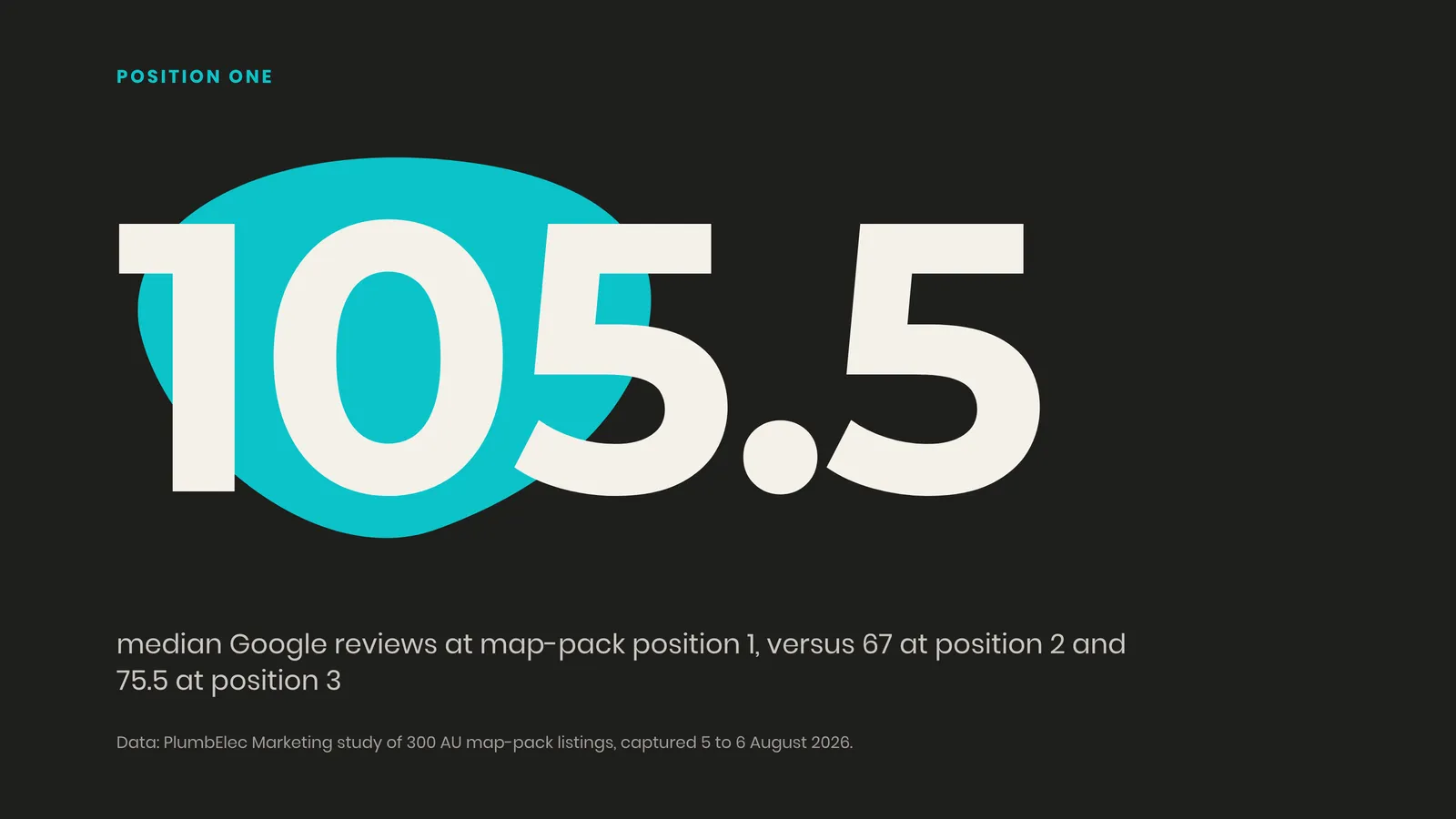
| 1 | 105.5 | 4.93 | 70% | 30% |
| 2 | 67 | 4.93 | 69% | 44% |
| 3 | 75.5 | 4.92 | 56% | 47% |
Where the field checks disagree
Position 2 sat below position 3 on median reviews, which is the first clue that review count is one factor among several.
The field checks make that clearer. In the Liverpool NSW plumber pack, Truth Plumbing holds position 1 with 128 reviews at 4.9, ahead of a competitor at position 3 with 326 reviews. Parramatta runs the other way: a listing with 563 reviews sits at position 2, behind a position 1 listing with 88.
Proximity and relevance explain those two packs better than review totals do. Barrack Electrical holds position 1 in Mayfield with 204 reviews at 5.0 and a plain business name, and Fusion Plumbing holds position 1 in Blacktown with 124 reviews at 4.8, also with no keywords in its name.
Reading these numbers honestly
These are correlations inside a single snapshot, so nothing here proves cause. Top-three listings were more likely to show a 24/7 claim and a street address, and that pattern is worth reading, but adding “24/7” to a profile is not a lever that moves you up a spot.
Read against a national average, Adelaide and Perth listings look weak and Canberra listings look untouchable. Against their own metro, each one is simply at par, which is why the number you work to is your city’s, not the country’s.
Data: PlumbElec Marketing study of 1,000 AU plumber and electrician searches and 300 map-pack listings, captured 5 to 6 August 2026.
Your Google Business Profile, done properly
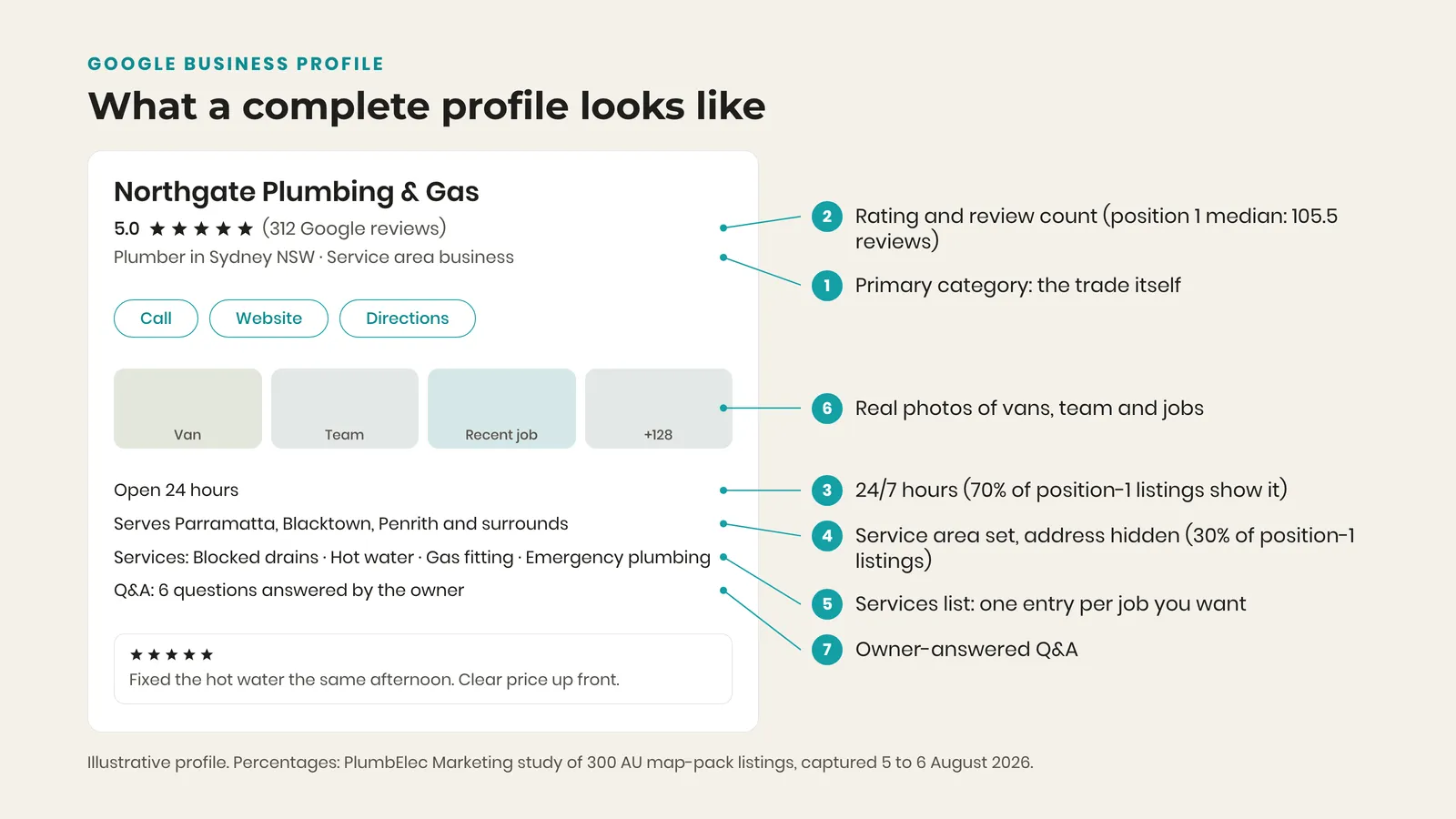
Two fields carry most of your relevance and you can fix both this morning: your primary category and your services list.
Set the primary category to the trade itself, then add secondary categories only for work you genuinely do, such as drainage service, gas installation service or electrical installation service. Every category you add for work you don’t do pulls the profile away from the searches you want.
The rest of the profile earns its keep in a set order:
- Services: list every job you want calls for, one entry each, with a short description on the ones that matter. This is the list Google matches against “blocked drain”, “switchboard upgrade” and “hot water repair”.
- Description: written for a homeowner reading it in a hurry. What you do, where you do it, and why you’re the safe pick.
- Photos: vans, team and real jobs in the suburbs you service, added monthly rather than in one batch.
- Q&A: post and answer the six questions your office answers by phone every week. You’re allowed to ask them yourself.
- Attributes and hours: set them honestly, public holidays included.
What the top listings share
Two numbers from our own data belong next to that list. Of the 300 map-pack listings we captured in August 2026, 70% of position 1 listings showed a 24/7 claim against 56% at position 3, and 30% at position 1 hid their address against 47% at position 3.
Listings in the top three were more likely to advertise round-the-clock availability and more likely to show a street address. If you answer the phone at 2am, say so on the profile. Show a real premises rather than hiding it.
Name your business honestly
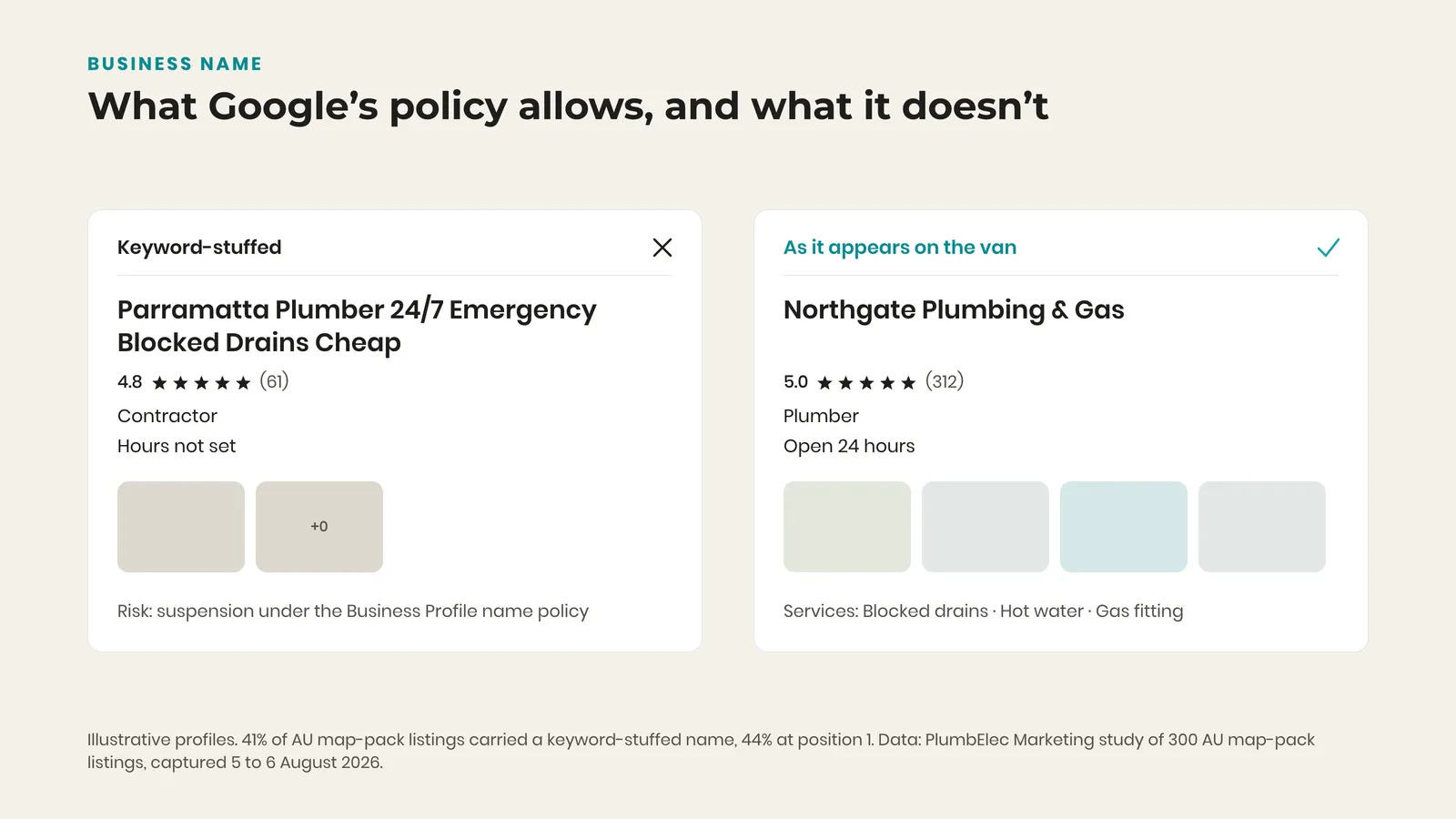
Business names are where the field gets ugly. 41% of those 300 listings had a keyword or a suburb stuffed into the business name, rising to 44% of listings at position 1.
Google’s business name policy is that the name on your profile is the name you use in the real world, on the van, the invoices and the shopfront.
We don’t stuff names and we tell clients not to. A stuffed name is one competitor report away from a suspension, and a suspended listing takes weeks to reinstate while the calls go to whoever is left in the pack. Barrack Electrical and Fusion Plumbing both hold position 1 on plain names.
Two inputs that compound
Behind the fields, two inputs compound: a steady flow of new reviews, and consistent listings across the directories that get read.
For the field-by-field walkthrough, work through our Google Business Profile optimisation guide. If you’re already up against stuffed names and fake listings in your suburb, reporting Google Maps spam is the faster win.
Leave the profile half-filled and it still ranks, just for the wrong searches in the wrong suburbs, and you pay for that in calls that never arrive.
Reviews: the number that moves the pack
59% of the 300 map-pack listings we captured in August 2026 held a 5.0 rating, and only 5% sat below 4.8. A 4.7 average puts you in the bottom of that field rather than the top of it.
Mean ratings across the three positions were 4.93, 4.93 and 4.92. Rating works as a filter: under 4.8 you stand out for the wrong reason, and past 4.9 the extra decimals do very little.
Velocity beats the raw total
Review count is where the separation happens. Position 1 listings ran a median of 105.5 reviews against 67 at position 2, and the metro medians ran from 124.5 in Canberra down to 38 in Adelaide.
What moves faster than the total is the rate. A listing picking up 8 reviews a month reads as an active business in a way a listing with 400 reviews and nothing since March does not.
Set the quota per tech rather than per business, because a business-wide target gets owned by nobody. Four techs asking one customer each a week is 16 reviews a month, and that rate holds through the quiet weeks as well as the busy ones.
The ask that actually works
Getting there is a process problem more than a marketing one. The easiest review to win is the one asked for on site, by the plumber or sparky who just fixed something at 7pm, before the van leaves the driveway.
Two things make that stick: a script every tech uses, and something physical in the customer’s hand. Our guide to getting Google reviews covers the ask itself, and creating your review card covers the card and QR code that takes the typing out of it.
Reviews that name the job and the suburb do double duty, because those words sit on your profile and feed the relevance Google reads off it.
Reply publicly, never buy reviews
Reply to every review, good and bad. A reply is public and indexed, and the way you answer a one-star tells the next reader more than the complaint does, which is why we walk through replying to a Google review line by line.
Never buy them and never write them. The ACCC treats fake and incentivised reviews as misleading conduct under Australian Consumer Law, and Google strips them when it finds them.
Set your target off your own city before you set anyone a quota: our Google review benchmarks by city give the median you’re aiming at and the gap you’re closing.
Your website is the engine behind the listing
A 200-review listing sitting on top of a three-page website is a common shape, and it caps out fast. The listing wins the searches where someone is standing nearby with a burst pipe, and the same business stays invisible for every “hot water replacement cost Newcastle” search in its own city.
What Google reads as evidence
Google reads your website as evidence that the business is real, specific and known for the work. The pages doing that job are service and suburb pages rather than the homepage.
Of the 1,000 AU plumber and electrician search results we captured in August 2026, 77.8% of ranking business pages were dedicated suburb pages, 20.9% were homepages and 1.3% were something else.
Directories took 31.1% of all page-one results in that sample, but only 13% of position 1, so real businesses held the top spot 87% of the time.
Put the suburb in the title
The pages that ranked were also blunt about where they were for. 96.7% of top-three pages had the suburb in the title tag against 85.9% of pages at positions 8 to 10, and 80% had the suburb in the H1 against 69% at 8 to 10.
Which gives you the build: a page per service, a page per suburb you want work in, the suburb in the title, the H1 and the URL, and content that is genuinely about that suburb. Leaving the suburb to the footer is what separates a page at position 9 from a page at position 2. Our own floor is 30 service and suburb pages before a site competes properly in a metro.
Local detail, built up over years
A suburb page that works names the local housing stock, the jobs you actually do there and the problems that come with the area’s pipework or wiring, because a page written off a template reads like one to the customer as well as to Google.
Where that lands over a couple of years is worth seeing. Aussie Oncall Plumbing runs 100+ pages and 150+ links and takes 50+ organic enquiries a month, and AB Electrical runs 300+ pages and 150+ links for 125+ organic leads a month. Both were built a page at a time over years rather than in a launch week.
Thin pages count for nothing
Thin pages count toward none of that. Each one needs the job explained, the local detail, the proof and a clear next step, which is the ground our on-page SEO guide covers in full. If you’d rather it was built and written for you, that’s the work in our SEO services for plumbers and electricians.
Pages make you eligible for the searches. What decides the order among the businesses that are all eligible is how well known you are, and that gets built off your site.
Citations and links: the prominence you can build
Two plumbers, one suburb, same review count, same pages. One holds a pack spot and the other doesn’t, and the difference usually sits somewhere off both of their websites.
Prominence is the part of local ranking that lives outside your own control panel. Google builds it from how often your business gets referenced elsewhere: links pointed at your site, and citations of your name, address and phone number.
Pages ranking in the organic top three carried a median of 125 referring domains against 73 for pages at positions 8 to 10, 71% more, across the 1,000 AU search results we captured in August 2026. Here is where that referencing comes from, and what each part asks of you:
- What a citation is: any listing of your business details on another site, whether it links to you or not. Consistency is the whole job: the same business name, the same address format and the same phone number everywhere, so Google can match them all to one business.
- Where to start: the ones that actually get read. Apple Maps, Bing Places, the main Australian business directories, your industry bodies, your suppliers, and local sources such as the chamber of commerce and the club you sponsor.
- The directories AI assistants cite: directory choice matters more than it used to, because AI assistants lean on a short list of them. Across 225 AI-recommended trade businesses we checked, Localsearch was cited for 29%, Oneflare for 18%, ThreeBestRated for 13% and HiPages for none.
- Suppliers and trades you already pay: ask your accountant, your uniform supplier and your wholesaler whether they list their trade customers, because those pages are already relevant and few competitors bother with them.
- Links, the harder half: links separate a competitive site from a stuck one. Sponsorships, supplier pages, trade association profiles, local news and the occasional piece of genuinely useful content do most of the work, and our link building guide for trade businesses sets out the order we work in.
Citations you can finish in a fortnight with a spreadsheet and a free afternoon. Links take a year of steady work, which is why the businesses that started last year are the ones you’re currently looking up at.
Track calls and grid position, not a single ranking
Only 5% of the page-one sites in our study of 1,000 AU plumber and electrician searches ran call tracking, while 80.4% had GA4 installed. So the traffic gets counted and the phone calls get guessed at.
You check the search from the office, see position 1, and the phone still isn’t busy. A mate three suburbs over checks the same words and you’re nowhere in the pack.
What a geo grid shows
Both readings are correct. Map-pack results change with the searcher’s location, so “where do I rank” means nothing without a pin on a map next to the answer.
A geo grid fixes that by running the same search from a grid of points across your service area and recording your position at each one. What comes back is a picture of where you actually rank: strong near the pin, fading at the edges, with visible holes.
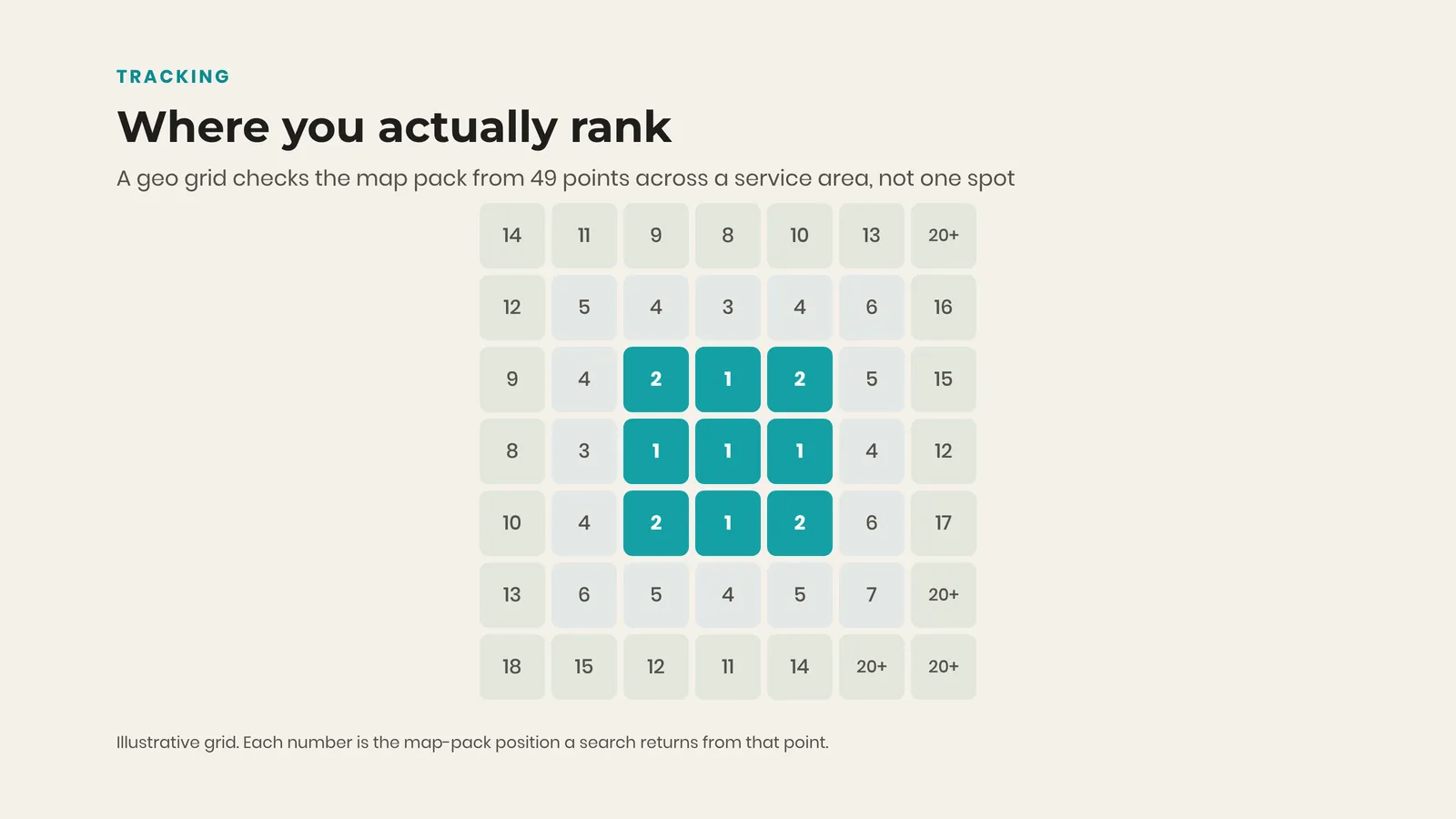
Run it for the two or three searches that actually pay rather than for twenty keywords. “Plumber [suburb]” and “emergency plumber [suburb]” tell you more than a long list ever will.
Three numbers worth tracking
That picture is often better than the address suggests. T42 Electrical owns the back section of the Gold Coast on the grid for “electrician Gold Coast” despite an address out on the outer side.
Three numbers tell you whether the work is paying: listing clicks and calls in your profile insights, grid coverage expanding month on month, and calls you can attribute to the listing. Attribution is where most businesses go blind, and it is the cheapest gap on that list to close.
Run the grid before you start the work so you have something to compare against. Our geo grid guide covers the tools and the reading, and lead generation for trade businesses covers the tracking that ties a call back to the search that caused it.
What to expect, and when
An existing listing with reviews already on it moves faster than a new one, so if you’ve had a profile sitting there for years, your first result is weeks away rather than months.
New listings take longer because prominence starts at zero, so the first months go into reviews, citations and pages before the grid moves much at all. The shape we work to on a local campaign is consistent enough to plan against:
- Month 3 to 4: the campaign turns profitable, at 3x spend.
- Month 6: 20 to 30 calls a month coming off the listing.
- Month 12: a 5x return across the year.
- The ceiling: a single listing caps at 30 to 60 calls a month, which is the point where a second profile or a much stronger website becomes the next lever.
Those are the numbers we plan against rather than a promise for any one business, and a listing pinned in a weak spot sits behind all of them.
Campaigns that beat the shape
Two client campaigns beat that. Mouritz air conditioning in WA ran three profiles and added 157 calls a month, up 450%, across a three-month campaign. Alpha & Omega Air reached the top three for all target keywords inside 45 days, with profile calls moving from 13 to 35 in a month.
Plumbwell Plumbing Services in Sydney’s Inner West is the long version. Fewer than 5 organic calls a month at the start, over 30 by the end of year one, then 80+ enquiries, and 50 to 80 leads a month from Google Maps alone across multiple profiles. More of these, with the grids and the call numbers behind them, sit in our Google Maps case studies.
Wait another year and the gap is a year wider, because review counts, page counts and links all compound for whoever started first.
A 90-day local SEO plan for a plumbing or electrical business
Why do two businesses that start local SEO in the same week end up a year apart?
Usually the order they did the work in. Ninety days is enough to fix the profile, get the review engine running and have the first suburb pages live and indexed. Here is the order we run it in, and what you check at the end of each month:
| Month | What to do | What to measure |
|---|---|---|
| Month 1 | Claim and verify the profile, fix the pin and service area, set primary and secondary categories, load every service, write the description, add photos, post the first Q&As | Baseline geo grid, profile views and calls, current review count and average, indexed pages |
| Month 2 | Turn the review ask on for every job, hand out review cards, reply to every review, publish the first six service and suburb pages with the suburb in each title and H1, clean up the citations | New reviews per month, grid squares in the top three, positions for the new pages, calls from the listing |
| Month 3 | Hold the review rate, publish the next six pages, start on links through suppliers, sponsorships and trade bodies, set up call tracking, re-run the grid | Grid movement against month 1, referring domains, tracked calls by source, cost per lead |
Four things decide whether that plan works or stalls:
- Pin and service area first: the rest is worth less if the listing sits where the work isn’t.
- Reviews are a weekly number, not a project: one per tech per week beats a push in March and silence after it.
- Pages before links: links pointed at a three-page site have nothing to lift.
- One tracked number per channel: if you can’t attribute the call, you can’t tell which half of the spend to cut.
Ninety days won’t finish the job. A local position compounds, so the profile you complete this month is the base the reviews, pages and links stack on for the next two years. If you’d rather hand it over, the grid, the pages, the reviews and the reporting are what our local SEO and map pack services cover.
Five things decide the pack for a trade business, and they’re worth putting in one place.
Conclusion
Where your pin sits comes first, because distance carries the most weight in the pack and is the hardest thing to change after the fact. Your profile’s relevance is next, set by the primary category, the services list and a description written for a homeowner.
Reviews are third, judged on your count against your own metro’s median, 124.5 in Canberra against 38 in Adelaide, and on how steadily you add to it. Your website is fourth, carrying a page for every service and every suburb you want work in, with the suburb in the title and the H1. Prominence is fifth, built from citations and links over months rather than weeks.
None of it is clever. A list of jobs, done in order and kept up long enough for the compounding to show.
FAQs
How many Google reviews do I need to rank in the map pack?
Aim for your metro’s median. Across the 300 map-pack listings we captured in August 2026, position 1 ran a median of 105.5 reviews, though Adelaide sat at 38 and Canberra at 124.5.
Does my address matter if I’m a service-area business?
Yes. Distance is still measured from your listing’s pin even when the address is hidden, and 40% of the listings we captured hid theirs, rising to 47% at position 3.
Can a plumbing or electrical business have more than one Google Business Profile?
Only where each one has its own staffed premises. A second profile at a virtual office or a family home risks the listing you already have, so check the rules before you create one.
How long does local SEO take to work?
Existing listings often move within a month, new ones take longer. On our campaigns month 3 to 4 is where it turns profitable at 3x spend, and month 6 brings 20 to 30 calls.
Should I put my suburb or trade in my Google Business name?
No. Your profile name has to match the name on your van and your invoices, and a stuffed name risks suspension, even though 41% of the listings we captured had one.
Do I need a website to rank on Google Maps?
You can rank without one, but not for long. Only 28% of the map-pack listings we captured also ranked in the organic top 10, and the website is what closes that gap.
Talk to us about your map pack
Where does your listing sit for your best suburb right now? If it’s position four, or you’re not in the pack at all, we’ll run the grid, tell you what’s holding it there and show you what the fix looks like on your own map.
PlumbElec Marketing works with plumbers and electricians across Australia. Call (02) 9100 0985, book a time that suits you, or read how our local SEO services work first.