AI SEO is what decides whether your business gets named when a homeowner in Newcastle opens ChatGPT at 9pm and types “recommend a plumber”. No map pack, no ten blue links, just two business names and a reason for each.
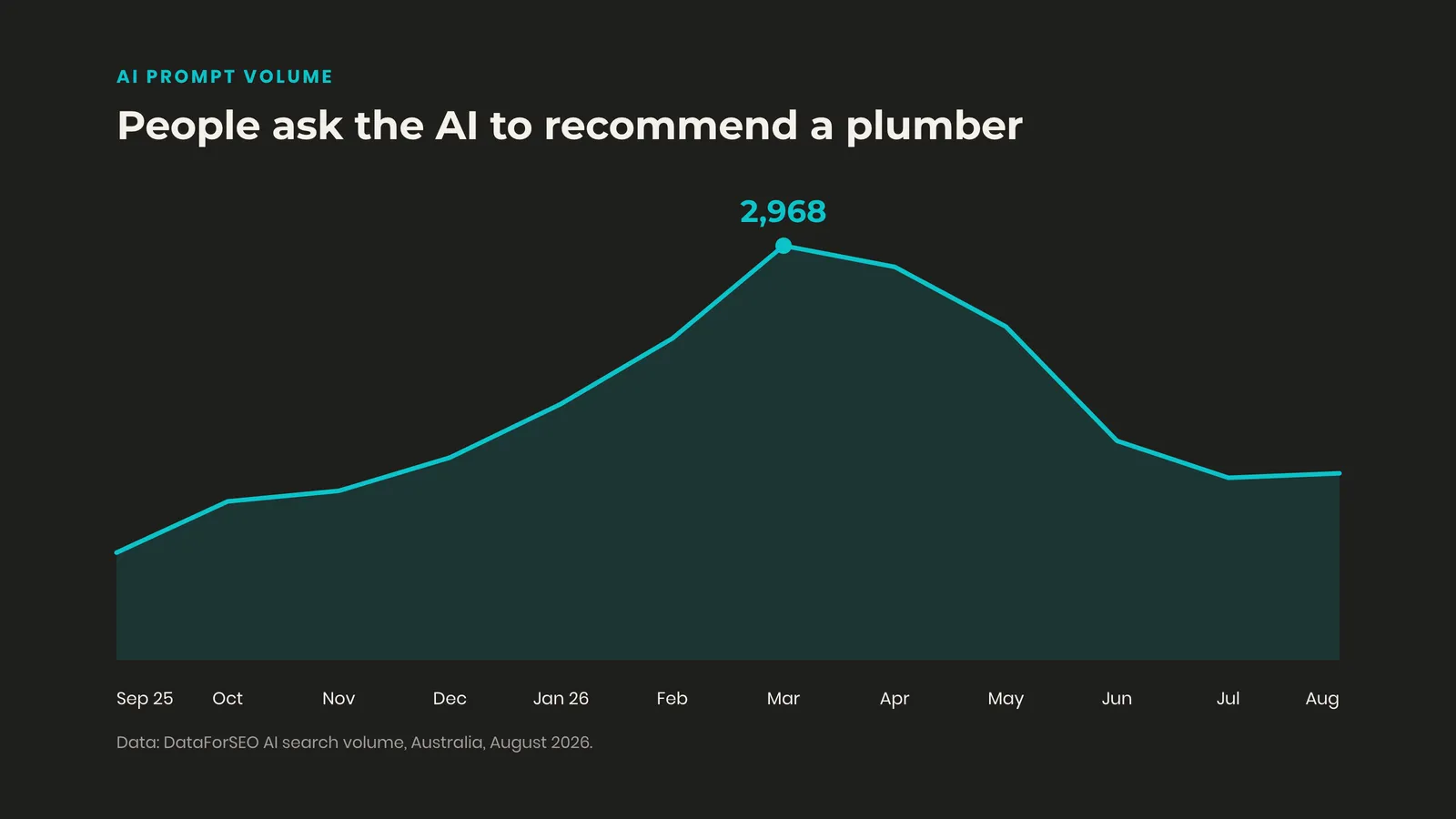
Put plainly, AI SEO is the work of putting facts an assistant can repeat in the places it reads. Australians type that exact prompt 1,527 times a month, on DataForSEO’s AI search volume for August 2026, and most tradies have never checked what the answer says about them.
That answer is not random, and it is not decided by whoever has the most reviews. This guide covers what we found in 225 AI-recommended trade businesses across 46 competitive trade keywords, what three assistants said when we asked them live in September, which directories they read, what your website has to carry, and a 60-day plan.
In this guide
What AI search means for a plumbing or electrical business
“Plumber near me” was typed into an AI assistant 7 times in Australia in August 2026, down from 145 in September 2025, on the same DataForSEO prompt data. “Recommend a plumber” ran 1,527. The keyword a decade of SEO was built on has turned into a sentence, and the answer that comes back names two businesses instead of listing ten.
Three places an answer comes from
Google’s AI Mode is the tab that answers in prose with links underneath, and Google’s help pages explain what AI Mode is and how it works. It rolled out to more countries including Australia in 2025. Australians search “google ai mode” 27,100 times a month and “ai overviews” 12,100.
ChatGPT is the second place, and it passed 900 million weekly active users in February 2026. Gemini is the third, sitting inside Android handsets and Google’s own apps.
All three search the web before they answer, and all three cite the pages they read. That last part is the whole opportunity for a trade business.
Questions are replacing keywords
Across the same DataForSEO prompt data for Australia, “recommend a plumber” ran 1,527 in August 2026, off a peak of 2,968 in March 2026 and up from 1,025 in September 2025. “How much does a plumber cost” ran 345, “how much does an electrician cost” 259, and “recommend an electrician” 32, up from 3 in July.
The keyword-shaped prompts went the other way. “Electrician near me” fell from 164 in September 2025 to 9, and “plumber near me” from 145 to 7.
People ask an assistant in sentences, and they ask for a recommendation rather than a list of options to sort through themselves.
What people call this work
The same job travels under several names, and the search volumes split between them. Generative engine optimisation (GEO) is searched 210 times a month in Australia, with the American spelling adding 260, and answer engine optimisation (AEO) runs 110 and 110. “Geo seo” takes 320 a month, and “ai seo”, the term we use, takes 1,000.
All of them describe getting a business named inside an AI-generated answer. We use AI SEO through the rest of this guide because it is the phrase our clients type into Google. If you want the ground this sits on, our guide to SEO for trade businesses is the parent to this one.
The obvious question is what one of those answers actually looks like, so we went and asked.
We asked the AI who the best electrician in Newcastle is
Three assistants, the same question, and one business named by all three. On 15 September 2026 we asked ChatGPT, Gemini and Claude who the best electrician in Newcastle NSW is and why, with web search turned on for each.
Every answer named two or three businesses, gave a reason for each and pointed at the page it had read. Here is what each one said:
| Assistant | Businesses it named | Sources it cited |
|---|---|---|
| ChatGPT (GPT-5.5) | AMCM Electrical, 5.0 from 234 reviews, and Barrack Electrical, 5.0 from 203, with Newcastle Emergency Electrical, 4.9 from 152, as an emergency alternative | A “50 best electricians in Newcastle” roundup on starworks.com.au, and Birdeye |
| Gemini (3.8 Flash) | Barrack Electrical and Nova Air & Electrical | ThreeBestRated, Localsearch, ServiceSeeking, and one business’s own website |
| Claude (Sonnet 5) | Duncan Kerr Electrical and Barrack Electrical, with Top Notch Electrical, Bluewater Electrical and Abode Electrical as honourable mentions | ThreeBestRated, Localsearch, and Top Notch Electrical’s own website |
All three named one business
Barrack Electrical was the only name that came back from every assistant. It also holds map-pack position 1 in Mayfield in our August study, with 204 reviews at 5.0, so the AI picks and the map pack agreed on at least one business in that city.
Every assistant cited a third-party list or a review site rather than Google Maps itself. Starworks, ThreeBestRated, Localsearch and Birdeye did the job that Maps does in an ordinary search.
And every assistant told the user to verify the NSW licence before booking. Gemini went further and raised ASP Level 2 accreditation for grid work. If your licence number sits nowhere an assistant can read it, you are missing the one check all three of them made.
Two plumber prompts in Sydney
Asked for a plumber on Sydney’s Northern Beaches, ChatGPT named Mitchell Plumbing Co in Brookvale, 5.0 from 248 reviews cited from homedone.com.au, and Triple Zero Plumbing in Beacon Hill, 4.9 from 117 ratings cited from HiPages, which it quoted as “licence-checked, ABN-checked”.
That HiPages citation is worth flagging. Our August analysis of 46 trade keywords found no HiPages citations at all, so this is movement since August rather than a contradiction of it.
In Parramatta, ChatGPT named Rhino Plumbing and Drainage, 4.9 from 158 on wordofmouth.com.au with a verified ABN and a licence number shown, and Aussie Plumbing Services, 5.0 from 277 carrying the same two signals.
What ChatGPT said it looked for
Asked why it chose those two Parramatta businesses, ChatGPT gave licence visibility plus a substantial review count as its reason. Both listings showed a verified ABN, a licence number and 24-hour availability on the page it had read.
Its own search queries fill in the rest. Before answering the Newcastle prompt, ChatGPT ran “best electrician Newcastle NSW reviews” and “site:hipages.com.au electrician Newcastle NSW reviews”, searching a directory by name, which tells you where an assistant expects a trade business to be listed.
A Google search for the same words would have handed back ten links and a map to sort through. These answers handed back two names and a reason.
Data: PlumbElec Marketing live test, 15 September 2026, three assistants, five prompts.
What 225 AI-recommended trade businesses had in common
You hold a 5.0 rating and the top spot in your suburb’s map pack, and the assistant names two businesses you have never heard of. That happens often enough that we went and measured it, across 225 businesses named in AI answers for 46 competitive trade keywords in Australia. The pattern sits somewhere most owners never think to look.
Your own website is the source
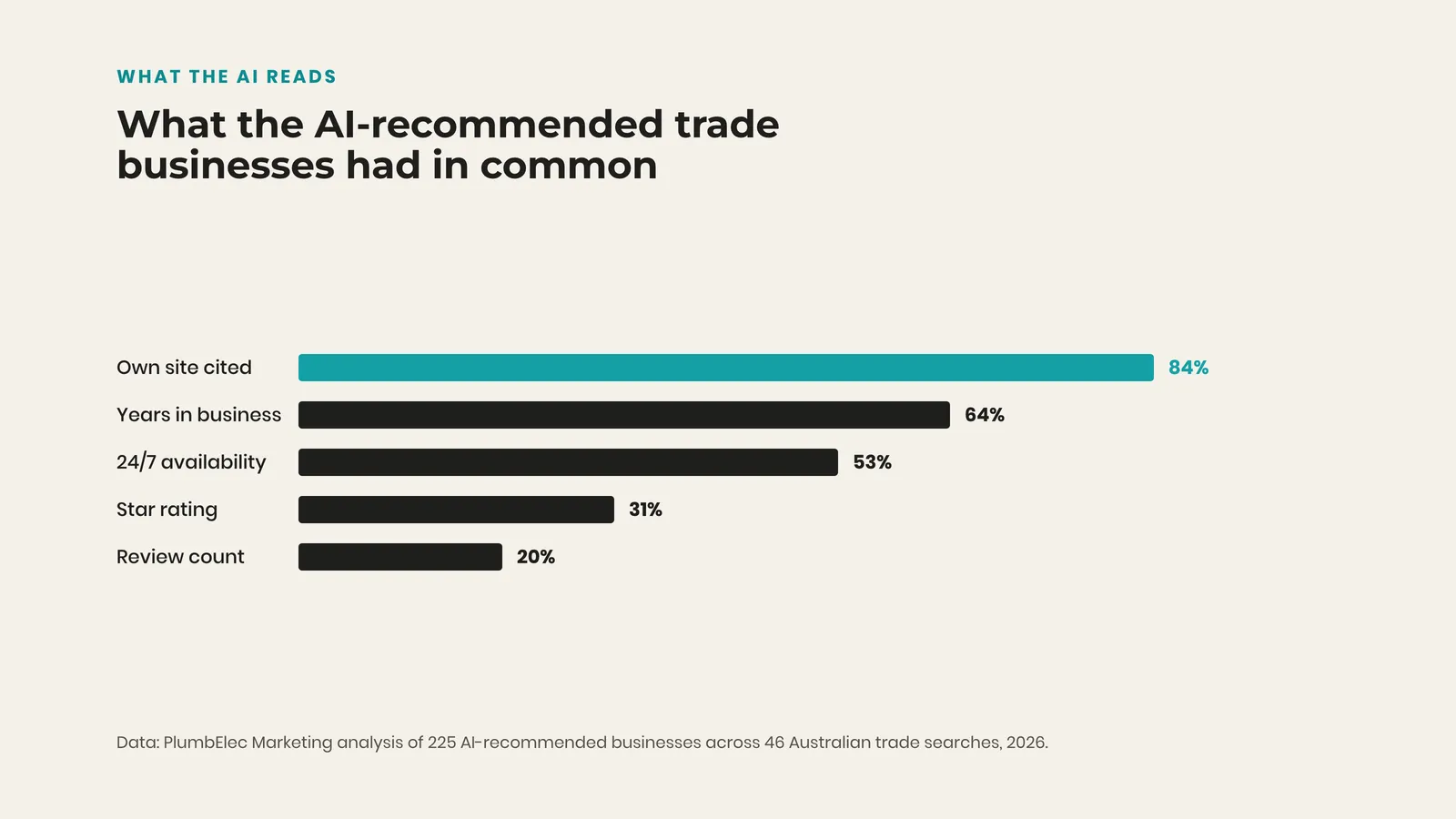
84% of the AI-visible businesses in that study had their own website cited directly. The assistant read the business’s own pages and quoted them back to the customer.
Traditional domain authority showed near-zero correlation with being named. A small site with clear facts on it got quoted where a bigger, vaguer one did not.
What earned nothing is just as useful to know. Social media profiles, blog content without supporting structure and generic website copy produced no citations at all in that sample of 225 businesses. An assistant cannot repeat “quality service at competitive prices”, because there is nothing inside it to repeat.
Years in business and availability
Years in business appeared in 64% of the AI responses we analysed. The assistant could state a number, which a line about “years of experience” never gives it.
24/7 or emergency availability was cited for 53%. Every assistant in our Newcastle test raised availability without being asked, and ChatGPT volunteered an emergency alternative nobody had requested.
These two are the cheapest wins on the whole list, because most trade businesses already qualify and simply never write it down. If you started in 2009, the page should say 2009. Where someone answers the phone at 2am, the page should say that in those words.
How the AI reports ratings
Star ratings were mentioned for 31% of the AI-visible businesses and review counts for 20%. Both sit well below years in business and availability, which is the reverse of what most owners expect.
In the live test the assistants quoted ratings as supporting evidence after picking a business off a list or a website, rather than as the reason for the pick. Both figures are correlations in our sample rather than ranking factors.
Every rating they quoted arrived with a count attached, such as 5.0 from 234 reviews or 4.9 from 158. The number of reviews travelled with the score every single time.
Appearing three times out of three
Businesses that appeared three times, the maximum in our sample, almost always shared four things. Their own website was cited in 95%+ of cases, and at least one directory cited them as well.
They carried a clear unique claim: years in business, a guarantee, an award, or “#1 rated” where that was genuinely true. And they had an availability signal on the page, the 24/7 or emergency line that turned up for 53% of the whole sample.
Nothing on that list is expensive. Three of the four are a copywriting job on pages you already own, and the fourth is a directory listing that takes an afternoon.
If you change one thing this month, put the founding year, the licence number and the hours onto the pages you already have. That is three of the four traits, written once.
Directories: the ones AI reads and the ones it ignores
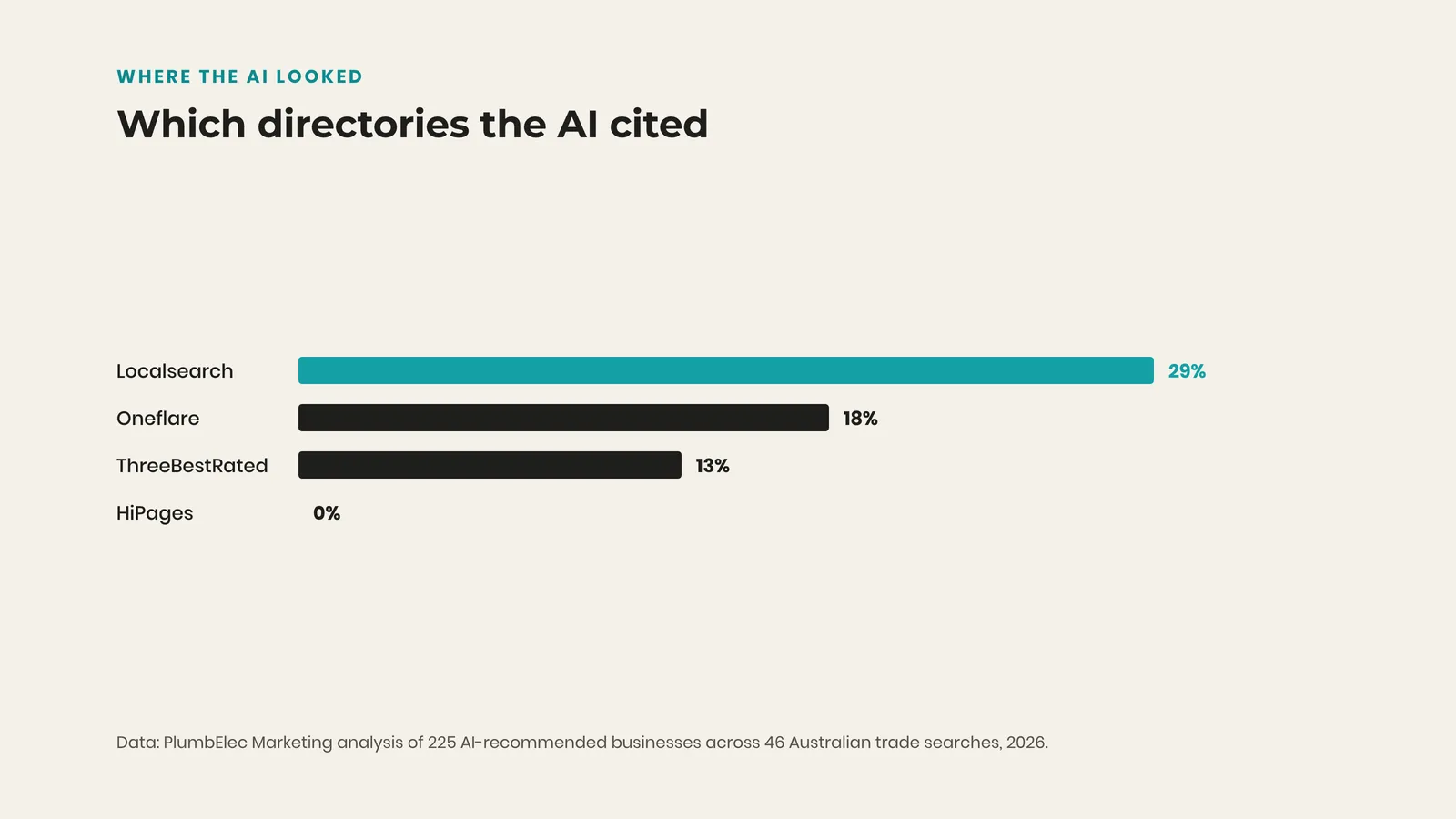
Two directory listings put you in front of the sources these assistants actually read. Across the 225 AI-recommended businesses we analysed, Localsearch was cited for 29% of them and Oneflare for 18%.
HiPages, the name every trade business knows, was cited for none of them across all 46 keywords. Our August analysis ranked them like this:
| Directory | Share of AI-visible businesses it was cited for | What to do |
|---|---|---|
| Localsearch | 29% | Claim it, complete it, match the details to your Google profile |
| Oneflare | 18% | Claim it and keep the listing current |
| ThreeBestRated | 13% | Apply, because the assistants quote its shortlists directly |
| HiPages | 0% in August, one citation in our September test | Keep it if it brings you work, but do not rely on it for AI visibility |
| Yelp and Airtasker | URLs cited, no business names extracted | Low priority against the three above |
What moved between August and September
Zero in August meant zero. Across 46 competitive trade keywords, not one AI response cited HiPages as the source for a business name, and Yelp and Airtasker surfaced as URLs with no business names pulled out of them.
Then in September, one of our five live prompts returned a HiPages citation, for Triple Zero Plumbing on the Northern Beaches, with ChatGPT quoting the “licence-checked, ABN-checked” wording off the listing. ChatGPT also ran a site:hipages.com.au search inside its Newcastle fan-out.
The shortlist moves, which is the argument for checking it every month rather than setting the listings once and walking away from them.
Roundups and review sites they read
The sources doing the heaviest lifting in our live test were not directories in the usual sense. ChatGPT pulled its top two Newcastle picks from a “50 best electricians in Newcastle” roundup on starworks.com.au, and its emergency alternative from Birdeye.
For the plumber prompts it used Word of Mouth for both Parramatta businesses and Home Done for one on the Northern Beaches. Gemini leaned on ThreeBestRated harder than on anything else, and Claude quoted customer comments straight off the same site.
Getting onto a roundup somebody else wrote is link work, and our link building guide for trade businesses covers how those relationships get built.
Leave those listings empty and an assistant has one source for you instead of three.
Making your website the page the AI quotes
Your homepage says quality workmanship, competitive prices and fully licensed. An assistant reading that has nothing to lift, because every competitor’s homepage says it too.
The pages that got quoted in our study carried facts with numbers attached, and 84% of AI-visible businesses had their own site cited directly. Six changes make a page quotable, and all six are copy rather than development work:
- State your years as a number: Years in business appeared in 64% of the AI responses we analysed, so “serving Newcastle since 2009” does work that “years of experience” never will. Put it in the first paragraph of the homepage and every main service page.
- Show the licence number, not the word licensed: 31% of page-one trade sites in our August local search study claimed a licence without showing a number. Every assistant in our live test told the reader to verify the licence, and both Parramatta businesses ChatGPT picked had their number visible on the page it read.
- Name your availability in plain words: 24/7 or emergency availability was cited for 53% of AI-visible businesses. Write “24/7” or “same day” where a reader sees it in the first screen, and keep it honest.
- Make one specific claim per page: A guarantee, an award, a founding year, or “#1 rated” only where that is genuinely true. Every top performer in our study carried one, and a claim you cannot back up costs more than no claim at all.
- Answer the question in the first paragraph: Suburb and service pages that lead with the answer hand an assistant a clean passage to quote, which is the same discipline our on-page SEO guide applies to pages built for ranking.
- Give the page a structure a machine can follow: Schema, clear headings and one subject per page. Google’s own guidance on AI features and your website asks for content that is helpful, current and well structured, with the technical fundamentals in place.
What Google says about AI features
Google’s position is that AI features need no special optimisation beyond the fundamentals. Helpful content, kept current, structured so a crawler can follow it, with the technical basics working.
That matches what we measured. The 84% figure is a website citation rate, and a website only gets cited if it can be crawled, read and understood.
The work is unglamorous. Facts on pages, written for a homeowner in a hurry, structured so a machine can find the paragraph it needs, which is what our AI optimisation services cover. Reviews are the other half of what those pages get judged against, and the assistants read them somewhere you might not expect.
Reviews are read by the AI, not just by customers
Star ratings were mentioned for 31% of the 225 AI-recommended businesses we analysed and review counts for 20%. Both numbers land lower than most owners guess, and neither one means reviews have stopped mattering. What changed is where an assistant reads them from, and which parts of a review it can use.
Where the assistants read reviews
Not one assistant in our live test cited Google Maps. ChatGPT quoted review counts off a starworks.com.au roundup and off Birdeye, Gemini off ThreeBestRated and Localsearch, Claude off ThreeBestRated and Localsearch as well.
Your Google reviews still feed those sites indirectly, because roundup writers and directories pull their star ratings from somewhere. The number an assistant states, though, is the number on the page it read.
That gives you a second job on top of collecting reviews, which is keeping the directories carrying your rating up to date. The listing it read is the figure it quotes, stale or not.
Reviews the AI can quote
The comments that made it into answers named something specific. Claude repeated customer comments about responsiveness and tidy, labelled work. Gemini described a family-run business handling everything from switchboards to EV chargers.
A review saying “great service, highly recommend” gives an assistant nothing to lift. One naming the job, the suburb, how fast you turned up and whether the price matched the quote gives it four usable facts.
Which makes the ask specific rather than general. Prompt the customer with the job you just finished and the suburb you did it in. Most of them will write down what you name for them.
This joins your map pack work
Barrack Electrical was named by all three assistants and holds map-pack position 1 in Mayfield with 204 reviews at 5.0. Across the 300 map-pack listings we captured in August 2026, position 1 ran a median of 105.5 reviews.
The review work that wins the map pack is the same work feeding these AI answers, which is the argument for doing it once and properly. Our local SEO guide for plumbers and electricians covers the pack, and how to get Google reviews covers the ask on site.
Set the quota per technician rather than per business, and have them ask before the van leaves the driveway.
How to check whether the AI recommends you
Five prompts across three assistants cost us US$0.31 and told us more about our own visibility than a month of rank tracking would have. You can run the same check yourself in a browser for nothing.
Do it before you spend a dollar fixing anything, because the answer decides what you fix first. This is the check we run for clients:
- Ask the way a customer types it: “Recommend a plumber in [suburb]” and “who is the best electrician in [city]” are the shapes people actually use. “Plumber near me” fell to 7 prompts a month in Australia, so testing with it tells you nothing.
- Ask for the reasons: Add “and explain why you chose them” to the prompt. The reasons are where you learn what the assistant found, and ChatGPT gave licence visibility plus a substantial review count as its reason in Parramatta.
- Write down every source it cites: Those sources are your target list, and two of the sites behind our Newcastle answers, Starworks and Birdeye, were a roundup and a review site rather than directories. If ThreeBestRated and Localsearch keep appearing and you are on neither, the next job picks itself.
- Repeat it monthly, because the answers move: HiPages was cited zero times across 46 keywords in our August analysis, then once in five prompts in September. A check from six months ago is describing a different internet.
- Track it beside your map-pack grid: One row per assistant, one column per month, named or not named. Sitting it next to your grid positions shows which of the two is moving and which has stalled, and three months of that table tells you whether the page work landed.
A rank tracker tells you where you sit for a keyword you chose. This tells you whether you exist inside the answer your customer is reading.
What our clients are seeing in AI search
A Gold Coast electrician sitting behind competitors on both review count and Maps position holds number 3 in Google AI Mode for its main search. That combination turns up often enough across our own client work to be worth putting on the record. These are the five results we can show right now:
- Kitson Electricians Newcastle: Launched from scratch with no trading history behind the domain, and ten months on it ranks for “best electrician Newcastle”. Ten months is the timeline we quote when an owner asks how long this takes.
- Two Sydney electrician clients: They hold positions 1 and 2 in Google AI Mode for “best electrician Sydney”, which is the head term for the biggest trade market in the country.
- A Northern Beaches plumbing client: Ranks number 1 on Google AI Mode, ChatGPT and Gemini for “best plumber Northern Beaches”. All three assistants, one business, same search.
- T42 Electrical: Ranks number 3 in Google AI Mode for “best electrician Gold Coast”, against competitors carrying more reviews and higher Maps rankings than it does.
- Byrd Electrical: Ranks number 1 on all three platforms for “best electrician Bayside”, which is the clean sweep the study’s top performers kept producing.
What those five share is the pattern out of the study rather than anything exotic. Each one runs its own website carrying the facts an assistant can quote, a specific claim it can repeat back to a customer, and a review profile showing up on the sites these assistants read.
That is the same shape the 225-business analysis produced, where 84% of named businesses had their own site cited and the repeat winners all carried a claim of their own. The prompts, the dates and the full numbers sit in our AI SEO case study.
Leave it alone and the assistant still answers the question, using whichever competitor gave it something to quote.
A 60-day AI search plan for a plumbing or electrical business
Sixty days is enough to fix the pages, claim the listings that get read and find out whether any of it moved the answer. Start on your own website, because it is the one source cited for 84% of the businesses that get named, and the only one you control outright. We run it in this order:
| Weeks | What to do | What to check |
|---|---|---|
| 1 to 2 | Run the baseline. Ask each assistant the way a customer would, record who it names, and log every source it cites | Whether you are named at all, and which directories and roundups keep coming back |
| 3 to 4 | Put the facts on the pages. Founding year, licence number, availability, one specific claim per page, and the answer in the first paragraph of every service and suburb page | Pages updated, licence number visible on every service page, schema valid and rendering |
| 5 to 8 | Claim and complete Localsearch, Oneflare and ThreeBestRated, chase the roundup and review sites the assistants quoted, and keep the review ask running on every job | Listings live and consistent, new citations appearing, the monthly prompt check rerun against week 1 |
What sixty days will not do
Two months gets the inputs right. It does not guarantee the answer changes, because assistants re-read their sources on their own schedule and the shortlists move, as the HiPages citation did between August and September.
What we watch inside that window is whether the sources an assistant cites start including yours. Being named comes after that, and on our own client work it has taken months rather than weeks, ten of them for Kitson Electricians Newcastle. The check itself takes minutes once the baseline exists, so the monthly rerun costs nothing but the habit.
If you would rather it was run for you, our AI optimisation services for plumbers and electricians cover the audit, the page work and the monthly check, alongside the SEO services that build the pages underneath. Which leaves five things to get right, and they fit in a paragraph.
Conclusion
Five things decide whether a trade business gets named in an AI answer, and none of them are new work.
Your own website comes first, because it is the source cited for 84% of the businesses we analysed and the only one you own outright. The facts on it come second, meaning the founding year, the licence number and the availability, written as numbers and plain words a machine can repeat.
A specific claim is third, one per page, true and checkable. Directory presence is fourth, weighted towards the ones these assistants actually read rather than the one every trade business already pays for. Reviews are fifth, judged on where they show up as much as on what they average.
FAQs
What is AI SEO for a trade business?
AI SEO is the work of putting facts an assistant can quote, such as your founding year, licence number and availability, onto the pages and listings it reads, so your business gets named.
Does ChatGPT actually recommend local plumbers and electricians?
Yes. In our September 2026 test it named two Newcastle electricians, two Northern Beaches plumbers and two Parramatta plumbers, each with a rating, a review count and the source it read them from.
Do I need HiPages to show up in AI answers?
No. HiPages was cited for none of the 225 AI-recommended businesses in our August analysis, though one September prompt did quote it. Localsearch, Oneflare and ThreeBestRated were cited far more often.
Does my Google rating affect whether AI recommends me?
Indirectly. Star ratings were mentioned for 31% of AI-recommended businesses and review counts for 20%, and the assistants read those numbers off directories and roundup sites rather than off Google Maps.
Is AI SEO different from normal SEO?
It overlaps heavily. Google says AI features need no special optimisation beyond the fundamentals, though directory citations and facts stated as numbers carried more weight than domain authority in our sample.
How long does it take to be named by AI?
Months rather than weeks. Kitson Electricians Newcastle ranks for its main search ten months after launching from scratch, and answers move between checks, so we re-run the test monthly.
Find out what the AI says about your business
Ask ChatGPT who the best plumber or electrician in your city is and see whether your name comes back. If it doesn’t, we will run the full check across ChatGPT, Gemini and Google AI Mode, tell you which sources the assistants are reading in your suburb and show you what is missing from your pages.
PlumbElec Marketing works with plumbers and electricians across Australia. Call (02) 9100 0985, book a time that suits you, or read how our AI optimisation services work.