Link building for plumbers and electricians decides which of two near-identical websites ends up on page one. Same suburb, same services, same review count, and the difference sits on other people’s websites rather than on either of theirs.
Put plainly, link building is the work of earning links and mentions from other sites so Google treats your business as the known one in your suburb. It is also the only major ranking factor you cannot set from inside your own admin panel, which is what makes it hard.
Most tradies we talk to have either bought a folder of links that moved nothing, or have never thought about links at all. This guide covers what a link does, how many the top three carry across 1,000 Australian trade searches, which links count for a local business, which ones cost you, and the 90-day order we work in.
In this guide
What a link does for a trade website
Why do two trade websites with the same pages, the same photos and the same services end up four spots apart?
Google has always treated a link from another site as a vote it did not have to take your word for. Everything else on your site you wrote about yourself.
Sites linking to you, counted once
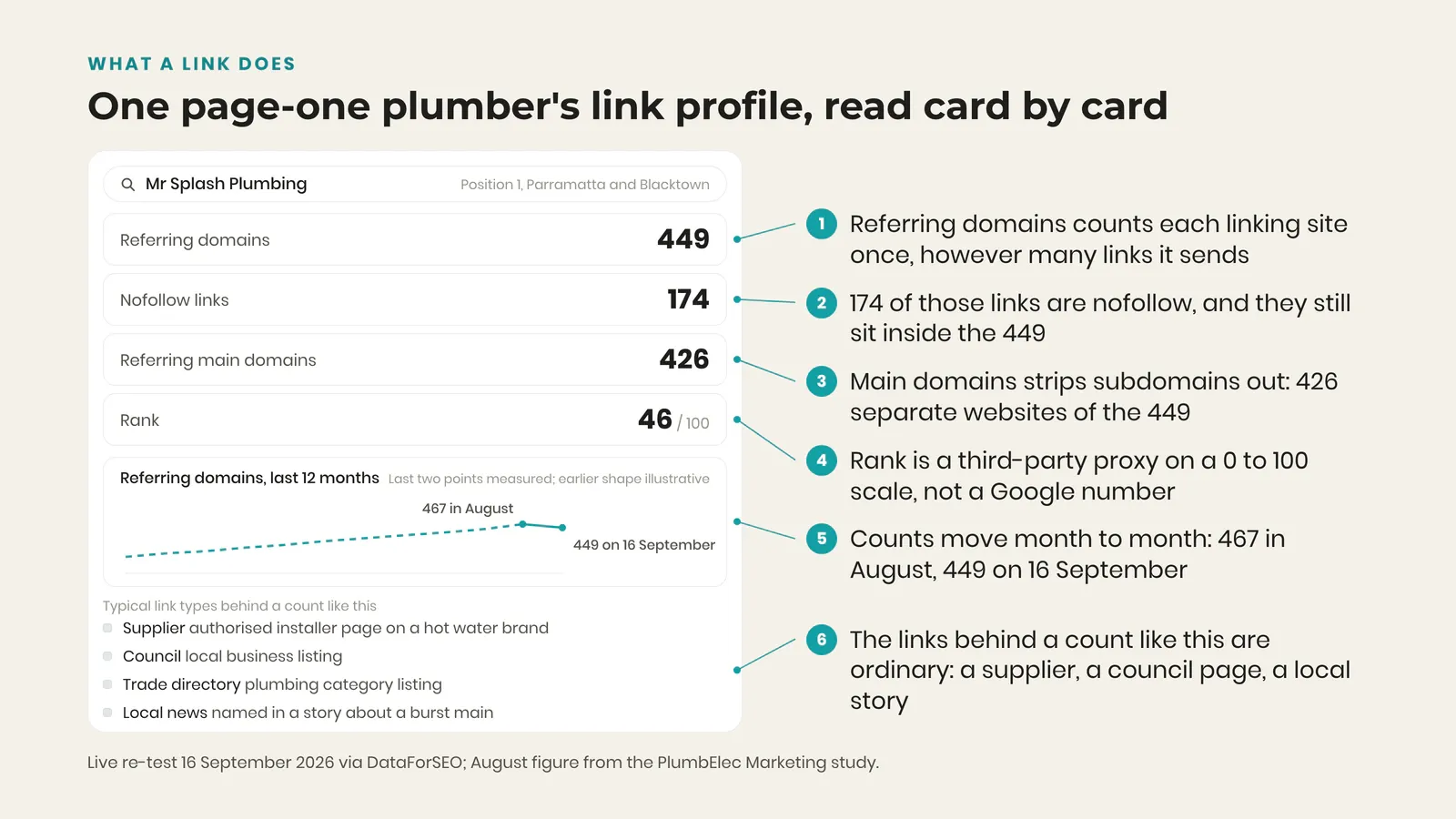
Backlinks are individual links, so one blog that links to you from its header, its footer and three articles counts as five. Referring domains counts the sites linking to you once each, however many times they do it.
Referring domains is the number worth watching, because ten links from one site count for far less than one link each from ten. Across the 1,000 Australian plumber and electrician search results we captured in August 2026, pages in the organic top three carried a median of 125 sites linking to them against 73 for pages at positions 8 to 10, 71% more.
Why Google still counts them
Nothing in the last decade has replaced the link as a signal of whether a business is known outside its own website.
Three things have to be true for a link to do anything, and Google’s guidance on crawlable links sets them out: the link has to be crawlable, the anchor text has to describe what is on the other end, and anything paid or sponsored has to be marked with rel=“sponsored”.
A link inside a sentence on a real page beats a logo in a footer, and a link that says “emergency plumber in Parramatta” beats one that says “click here”.
Prominence, not just relevance
Links do two jobs. On the organic side they help decide which of the eligible pages ranks above the others. In the map pack they feed prominence, which is Google’s read on how well known your business is.
The second job is the one most owners miss. A link and a citation both tell Google the business exists somewhere other than its own site, and our local SEO guide for plumbers and electricians covers prominence inside the map pack.
Links sit inside a bigger set of signals, and our guide to SEO for trade businesses is the parent guide. Which leaves the question every owner asks first: how many do the sites above you carry?
How many links the top three actually have
3.4% of the position-one plumbing and electrical sites in our study carried fewer than 20 sites linking to them, on a sample of 87 position-one pages. That is the exception owners cling to. In the same sample, 42.5% of position-one sites carried more than 200.
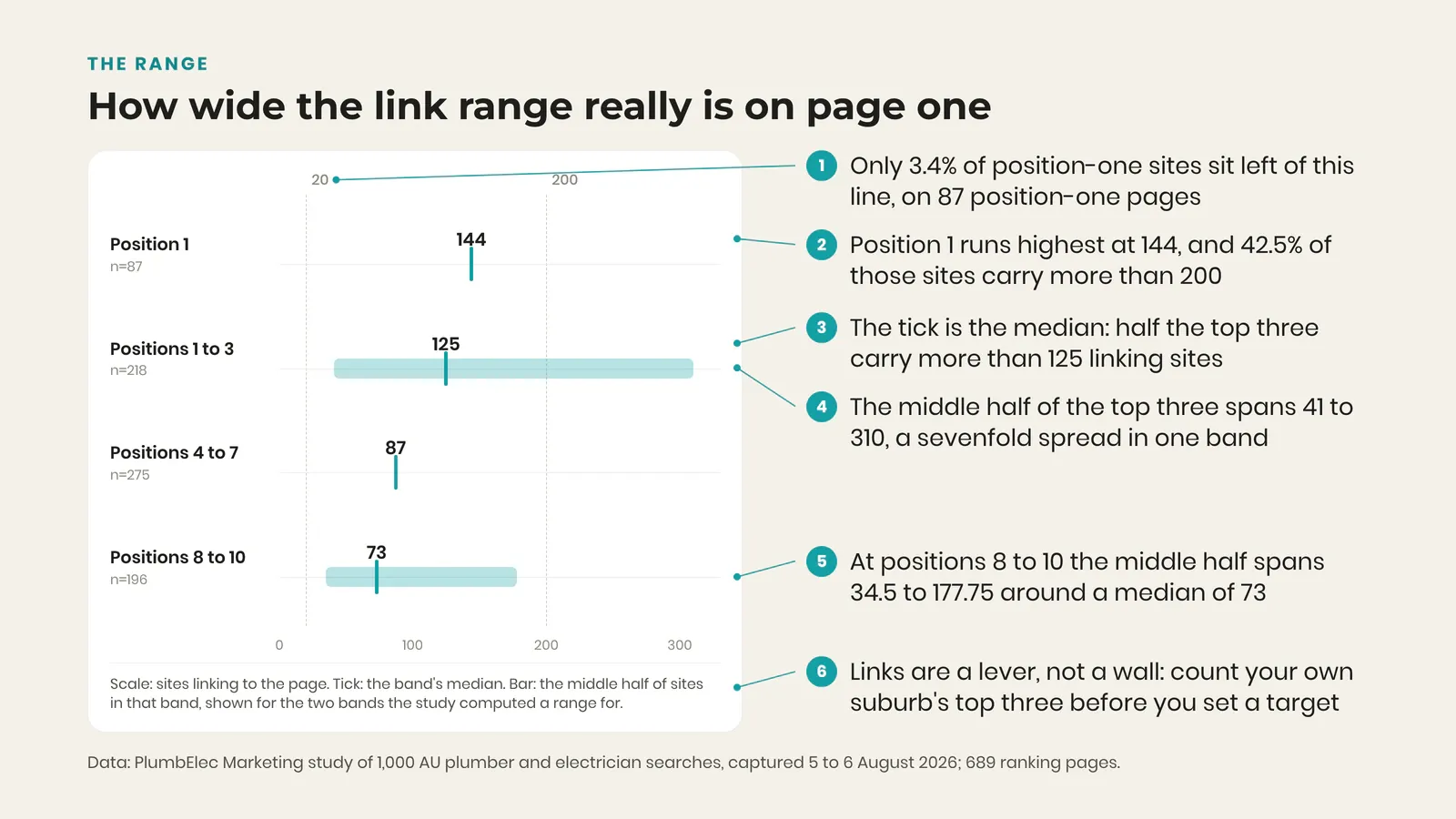
Here is the full join across 689 pages, by rank band:
| Rank band | Median sites linking | Under 20 | Over 200 |
|---|---|---|---|
| Position 1 (n=87) | 144 | 3.4% | 42.5% |
| Positions 1 to 3 (n=218) | 125 | 8.3% | 36.7% |
| Positions 4 to 7 (n=275) | 87 | n/a | n/a |
| Positions 8 to 10 (n=196) | 73 | 13.3% | 21.9% |
Plumbers need more than electricians
The two trades are not playing the same game. Splitting that sample by trade, plumbing pages in the top three carried a median of 163.5 sites linking to them against 84 at positions 8 to 10, while electrical pages in the top three carried 103 against 73.
Plumbing is the harder of the two on links by a wide margin. The gap between the bands is wider too: 79.5 sites for plumbing against 30 for electrical.
An electrician reading the national median of 125 is reading a number set partly by plumbers. Work to 103 instead, and treat anything above it as clear air.
Sydney and Brisbane raise the bar
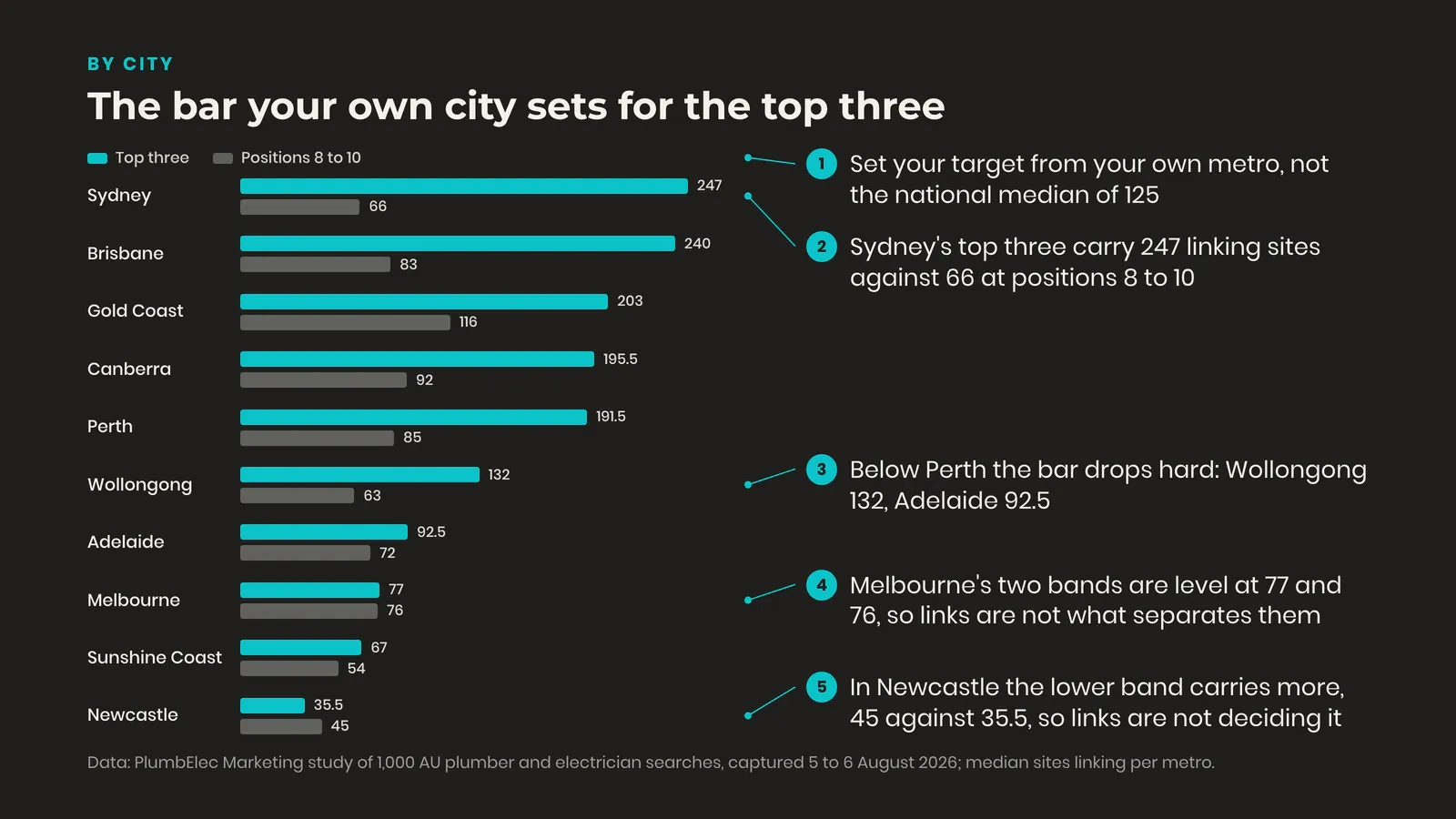
City matters more than trade. Across the ten metros, Sydney’s top three carried a median of 247 sites linking to them against 66 at positions 8 to 10, Brisbane 240 against 83, Gold Coast 203 against 116, Canberra 195.5 against 92 and Perth 191.5 against 85.
The bar drops hard further down the list: Wollongong 132 against 63, Adelaide 92.5 against 72, Melbourne 77 against 76, Sunshine Coast 67 against 54 and Newcastle 35.5 against 45.
Newcastle and Melbourne are the two metros where links did not separate the bands. In Newcastle the lower band carried more, so the fight there is won on something else.
Three sites that show the ceiling
We re-tested the study’s position-one sites on 16 September 2026 to see whether August held. Mr Splash Plumbing holds position 1 in Parramatta and Blacktown, with 467 sites linking to it in August and 449 in September, on a 3.05-year-old domain.
Wills Plumbing Adelaide holds position 1 in Prospect with 616 in August and 608 in September, on a 3.18-year-old domain. Level Plumbing Canberra holds position 1 in Tuggeranong with 676 in August and 574 in September, at 4.08 years.
O’Brien, a national brand, holds position 1 in Burleigh Heads and Maroochydore with 1,101 sites linking to it on a 29.6-year-old domain. For scale, plumbelecmarketing.com had 61 on 16 September.
Five sites that show the floor
The same study holds the opposite cases. A Baldivis plumber holds position 1 with 5 sites linking to it, a Cardiff plumber in Newcastle with 6, a Corrimal electrician with 19, a Randwick electrician with 21 and a Nambour plumber with 21.
The spread inside the band explains both. Half of the top-three sites sat between 41 and 310 sites linking to them, and at positions 8 to 10 between 34.5 and 177.75.
Links are a lever, not a wall. A suburb where the businesses above you carry single-digit counts can be won on pages first, and that is where a new site should start.
Age is not the explanation
Age is the excuse owners reach for next. Median domain age ran 6.57 years for positions 1 to 3 and 5.45 years for positions 8 to 10, so the top of page one is older on average.
Position 1 breaks the pattern. On its own, position 1 ran a median domain age of 4.68 years, younger than the top-three band it sits inside and younger than positions 8 to 10. An older business has simply had longer to collect links, and a young site that goes and gets them outranks an old one that never bothered.
Data: PlumbElec Marketing study of 1,000 AU plumber and electrician searches, captured 5 to 6 August 2026; live re-test 16 September 2026.
The links that count for a local trade business
Most owners who have paid for link building have a folder of directory listings on sites nobody has heard of, and no movement to show for it.
The links that move a local trade site are duller and fewer than what gets sold. Six types do most of the work, and suppliers and local organisations sit near the top of the list.
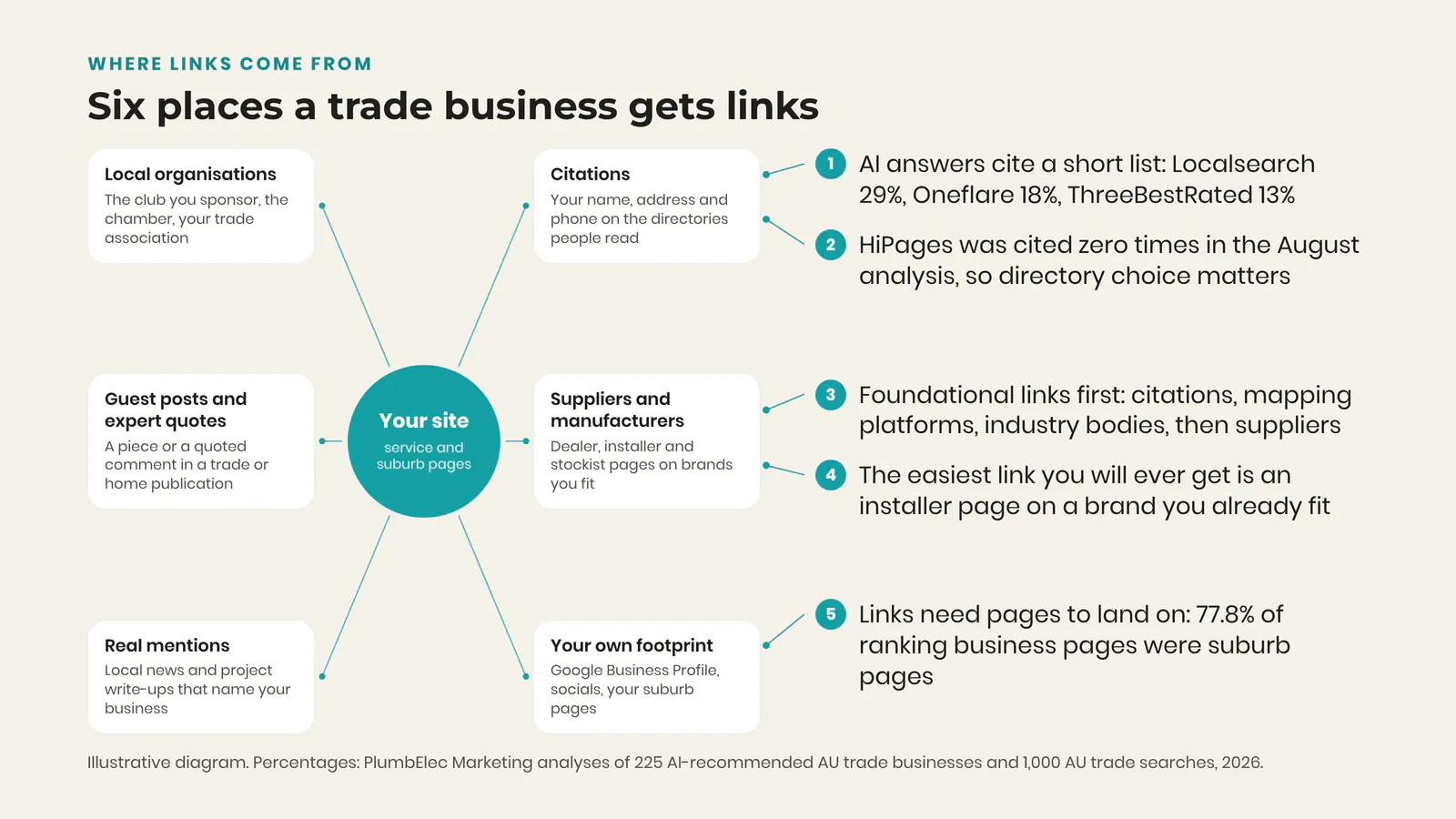
Here are the six, in the order we build them:
- Citations: your business name, address and phone number listed on the directories customers and AI assistants actually read. Consistency across them matters more than how many you have.
- Suppliers and manufacturers: dealer, installer and stockist pages on the sites of the brands you already fit. Ask your wholesaler and every manufacturer whose warranty you register.
- Local organisations: the club you sponsor, the school newsletter, the chamber of commerce, your trade association profile and your council’s business listing. Relevant, permanent, and on pages Google already reads as local.
- Guest posts and expert quotes: a written contribution or a quoted comment in a trade or home publication. One good placement beats a batch of guest posts on sites built to sell them.
- Real mentions: local news, community pages and project write-ups where your business gets named for work it actually did. These arrive unlinked as often as linked, and both count.
- Your own footprint: your Google Business Profile, your social profiles and the service and suburb pages links can point at, covered in our on-page SEO guide for trade sites.
Foundational links first
Before anything clever, there is a list every trade business should finish once. Australian business directories, the mapping platforms, your industry bodies, your suppliers and the local sources tied to your suburb.
That list is finishable in a fortnight with a spreadsheet and a free afternoon, and it is the base everything else stacks on. Our guide to foundational link building works through it in order, with the Australian directories named.
Do not start pitching publications until it is done. A site with no citations and no supplier pages is a site with no foundation, and a guest post pointed at it lifts less than it should.
What AI answers are reading
Directory choice matters more than it used to, because AI assistants lean on a short list of them. Across 225 AI-recommended trade businesses over 46 Australian keywords, Localsearch was cited for 29%, Oneflare 18% and ThreeBestRated 13%. HiPages was cited for none at the time.
One ChatGPT citation to a HiPages listing turned up in our September test, so the list moves. The principle does not: the assistant reads third-party pages about you before it names you.
Traditional authority scores showed near-zero correlation with being named in those answers. So finish your listings on the directories the assistants quote before you pitch a publication. Our AI search guide for plumbers and electricians covers the rest.
The links that hurt
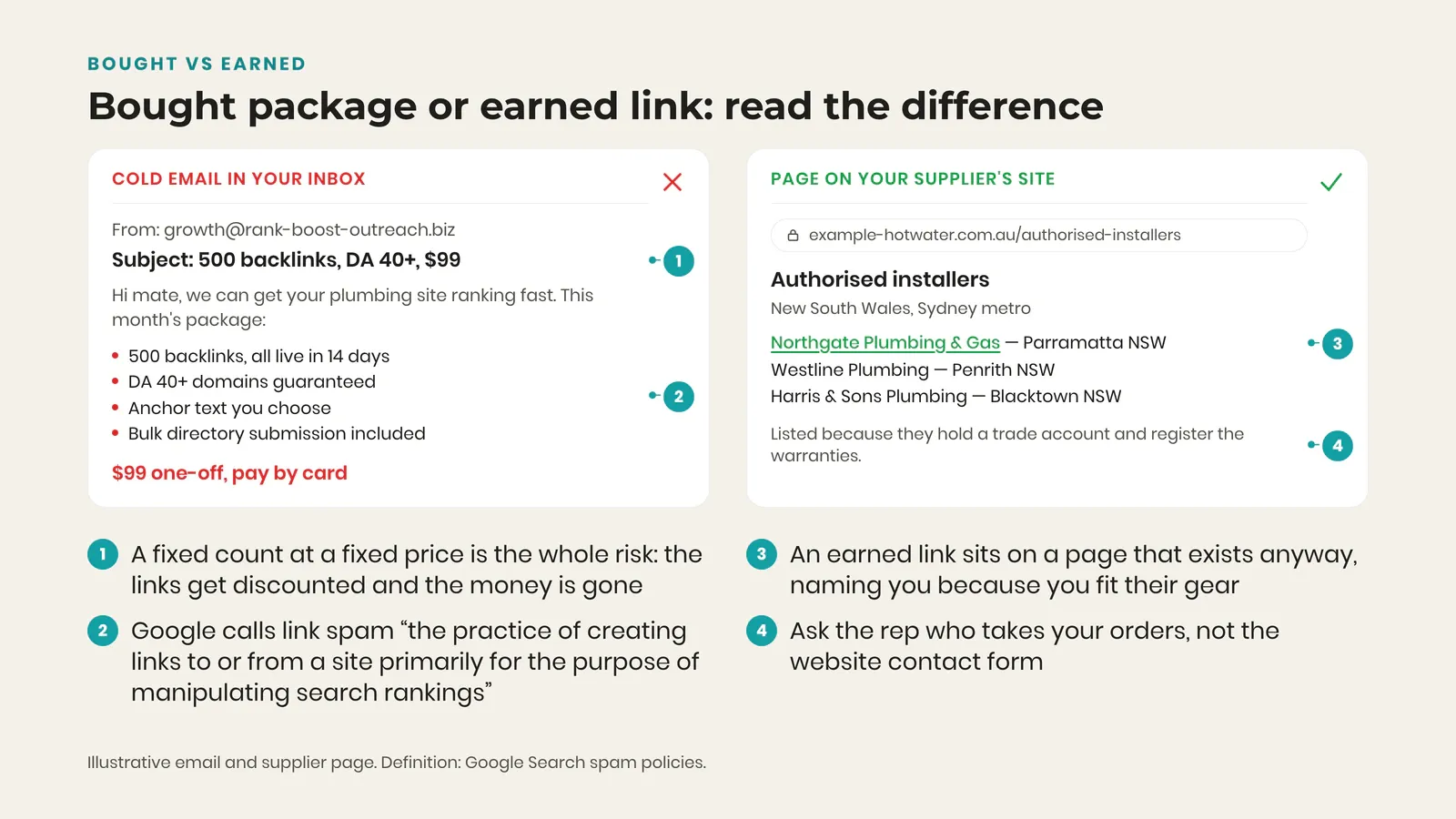
Pull up your last link building invoice and read what you actually bought. If it lists a number of links, a turnaround time and a minimum authority score, you bought the category Google wrote a policy against. That check takes five minutes.
What Google calls link spam
The definition is narrower than most people assume and wider than the industry likes. Google’s link spam policy calls link spam “the practice of creating links to or from a site primarily for the purpose of manipulating search rankings”.
The examples it lists are the products most cheaply available: buying or selling links, excessive link exchanges, automated link programs, low-quality directory or bookmark links, and optimised forum comments.
The test in that definition is intent. A supplier page that lists you because you buy from them is not spam. The same page bought as a placement, with a price and an anchor you specified, is.
Bought packages and PBNs
Bought links are sold the same way everywhere: a fixed count, a fixed price and a promised score. The sites behind them are usually a private blog network, a set of expired domains kept alive to sell links, or a content farm that will publish anything at all.
Two things go wrong. The links get discounted when the network is identified, which is a question of when rather than whether, and the money is gone either way.
The worse outcome is a manual action against your site, which takes months to clear while the calls go to whoever is left on page one.
Directory dumps and comment links
Not every directory is worth a listing, and the cheap ones travel in packs. A submission service that puts your details on hundreds of directories in a week produces listings with no traffic, no editorial standard and often no Australian presence.
Google names low-quality directory links and optimised forum comments in the same policy. A forum profile with your keyword as the anchor, a blog comment signed with a service page link, a bookmarking site nobody uses: the pattern is obvious.
Every one of those links is a line in a file you will pay someone to clean up later, and the cleanup costs more than the links did.
Citations: the boring links that carry the map pack
Directories took 31.1% of every page-one result in our study of 1,000 Australian trade searches, but only 13% of position 1. Real businesses hold the top spot 87% of the time.
The directories beating you on page one also carry your citations, which is why the boring half of link building is worth doing first.
Name, address, phone, everywhere the same
A citation is any listing of your business details on another site, whether it links to you or not. Google’s job is to match them all to one business, using the strings you give it.
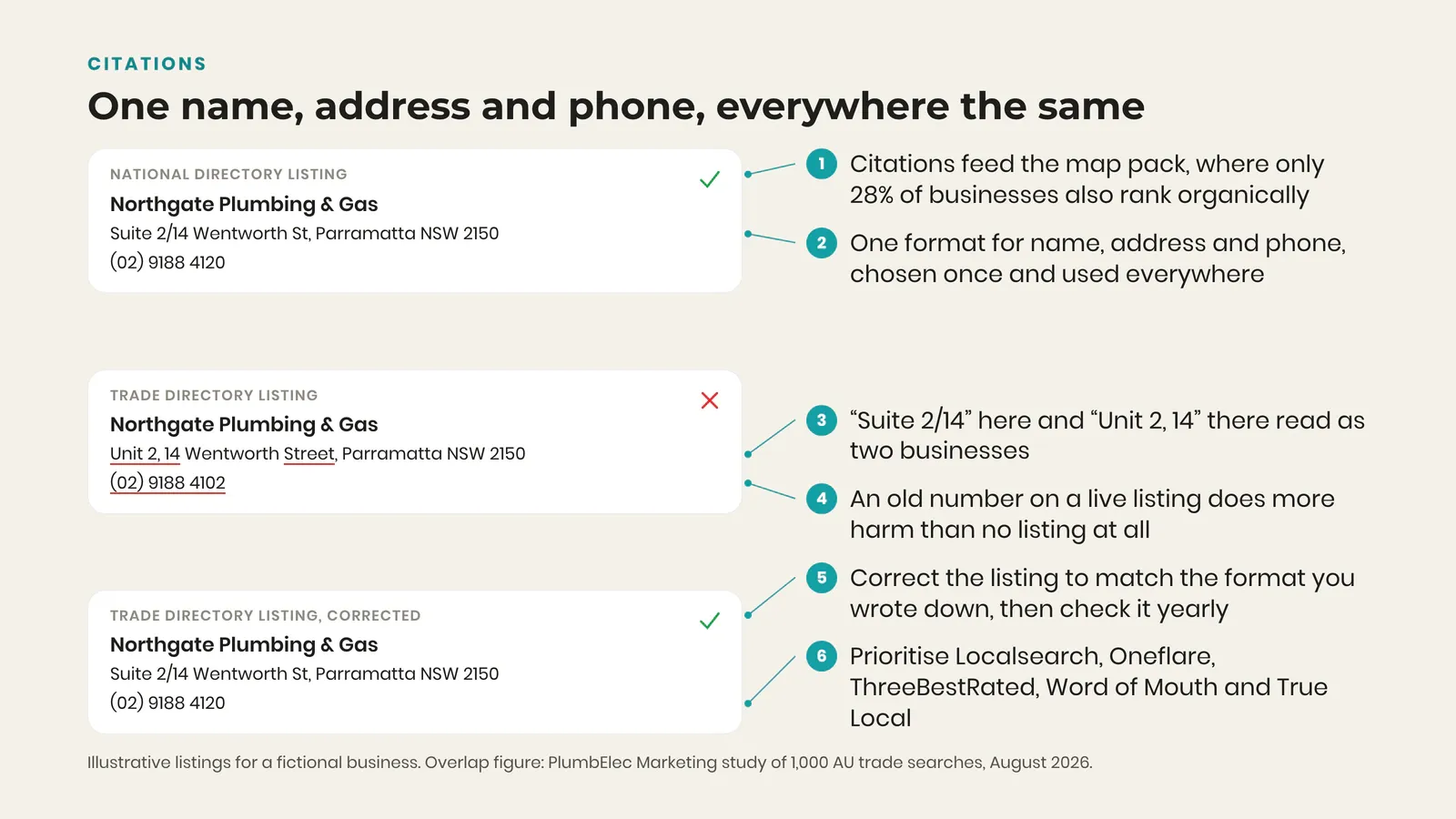
Which means the format has to be identical everywhere: same business name and suffix, same unit and street format, same phone number. “Suite 2/14” on one listing and “Unit 2, 14” on another are two businesses to a matching system.
Pick one version, write it down, and use it everywhere from then on. Old listings with a dead number or a previous address do more harm than a missing listing.
Which directories matter in Australia
Fewer than you think, and the list is not secret. The mapping platforms come first, then the national business directories Australians actually use, then your industry bodies and your suppliers.
Three names earned their place on evidence rather than habit. Localsearch, Oneflare and ThreeBestRated were the three most cited directories in our AI study, and each is a listing you complete once and check yearly.
Then go local: your council’s business listing, the chamber of commerce, the sporting club you sponsor and the school. Those are worth more to a suburb ranking than a batch of generic listings, because they sit on pages about the place you work in.
How citations feed Google Maps
Citations do their heaviest work on the map side rather than the organic one. They feed prominence, the part of local ranking Google builds from how often your business is referenced elsewhere.
The two systems barely overlap. Only 28% of the map-pack businesses we captured in August 2026 also ranked in the organic top 10 for the same search, so work that lifts one does not automatically lift the other.
Citations are the cheapest thing on either list and the first thing we finish, as our local SEO guide sets out. The harder half is the links nobody hands you.
Guest posts and mentions: earning the rest
We once put an article on a high-authority news site and watched it outrank the client’s own page.
The article had nothing our page didn’t, except the domain it sat on and the links pointed at it. That is the whole logic of earning mentions rather than building them.
Pitching a trade story
Publications don’t want your services page written as an article. They want something only a working tradesperson knows: what fails in local housing stock, what a job costs this year, what a new standard means for a homeowner.
Pitch three lines, not a draft. Say what the piece is, who it is for and what you can say that their usual writer cannot, then offer to answer questions by phone.
One placement in a publication homeowners read beats a batch of guest posts on sites built for links. It also gets quoted back to you by customers, which no purchased link has ever done.
The parasite experiment
We tested how far a borrowed domain goes. An article we published on a high-authority news site reached the top three for its target search in under a month, then fell to position 11.
Pointing guest posts at that article brought it back to number 1. Same article, same site, same words: the only thing that changed was who linked to it.
The lesson is not to go and rent someone else’s domain. It is that links decide the order among pages already eligible, including pages you do not own. The same mechanism works on your own site, at less risk.
Supplier and community pages
The easiest links a trade business will ever get are on sites belonging to people who already invoice you. Manufacturers run dealer and installer directories, wholesalers list their trade accounts, and warranty registrations often come with a stockist page.
Ask the rep, not the website. One email to the person who takes your orders gets further than a contact form, and that page is already about the work you do.
Community pages work the same way. The club you sponsor, the school you wired, the local charity page: each is a link on a site genuinely about your suburb, which a purchased link can never be.
What a link campaign looks like when it works
Twelve months of link building and no ranking movement is the most common complaint we hear about this work.
Usually the links were fine and there was nothing for them to lift, because the site had five pages and three of them were the same page with a different suburb in the title.
150 links alongside 100 pages
Aussie Oncall Plumbing is the version we point clients at. Over twelve months we built more than 150 quality links, from citations through to guest posts, alongside more than 100 pages on the site.
The result was 50 or more organic enquiries a month inside that year, with no paid ads running, at a 16X return. That is a plumbing business taking its lead flow off Google instead of renting it.
Neither half would have done it alone. The pages made the site eligible for hundreds of suburb and service searches, and the links decided where it sat among the businesses that were also eligible.
Recovering in 45 days
Links also work as a recovery lever. Alpha & Omega Air came back into the top three within 45 days, on a campaign led by high-quality links plus Google Business Profile work.
Calls to the business went from 13 to 35 in a month over the same period. Forty-five days is fast for link work, and it was only possible because the pages were already there to be lifted.
Recovery is a different job from a launch. The site had history, content and a profile, so the links had something to push, which is what a new three-page site does not have.
Links do not replace pages
AB Electrical ran the same pairing at a larger scale: more than 150 links against more than 300 pages, for 125 or more organic leads a month and a 33X return.
The page count is the part most owners skip. Of the 1,000 Australian trade search results we captured, 77.8% of ranking business pages were suburb pages.
Links pointed at a site with no suburb pages have nowhere useful to send their value, which is the most common reason a campaign stalls. If you want both halves built and written for you, that is the work in our SEO services for plumbers and electricians.
A 90-day link plan for a plumbing or electrical business
Put your domain and your suburb’s top three into any backlink checker, and you have the only number this plan needs. The gap between your count and theirs tells you how much work the next ninety days is worth.
Ninety days is enough to finish the foundations and start on the earned half. Here is the order we run it in, and what you check at the end of each month:
| Month | Links to build | What to measure |
|---|---|---|
| Month 1 | Citations fixed to one name, address and phone format: mapping platforms, main Australian directories, industry bodies | Your count against your suburb’s top three, plus listings with wrong details |
| Month 2 | Suppliers, manufacturers, wholesalers, warranty and stockist pages, council and chamber listings, the club or school you support | New linking sites that month, listings live and verified, positions for your suburb pages |
| Month 3 | Earned placements: a pitched trade story, an expert quote, a project write-up, a sponsorship page | Linking sites against month 1, movement on target searches, calls you can attribute |
Three ways a plan like this goes wrong:
- Don’t buy a package: a fixed count of links for a fixed price is the product Google’s spam policy describes, and the cleanup costs more than the links ever returned.
- Don’t chase a score: domain rating and domain authority are proxies for links, not ranking factors, and those scores showed near-zero correlation with being named in AI answers.
- Don’t outbuild your pages: our best results paired more than 150 links with 100 to 300 pages, so if your site has five pages, write before you build.
Ninety days will not finish it. Sydney’s top three carry a median of 247 sites linking to them, and that count was built over years by whoever started first, so the gap widens every quarter you leave it.
If you would rather hand the whole thing over, our SEO services for trade businesses cover the citations, the pages and the earned links together.
Conclusion
Four things decide this, and none of them are complicated. Count the right number first, which is sites linking to you counted once each. Measure it against the top three in your own suburb and your own trade rather than a national median.
Finish the foundations second. Citations with identical details, supplier and manufacturer pages, industry bodies and the local organisations you already deal with, and none of it bought. Then earn the rest through guest posts, expert quotes and real mentions, which take longer and are the only links that keep working.
Build the pages those links will lift, because every result we have came from the two halves together. Nothing on that list needs a specialist. It needs somebody to keep doing it after the novelty wears off.
FAQs
How many backlinks does a plumbing or electrical website need?
Work to your suburb’s top three, not a national figure. Across our study the top three held a median of 125 sites linking to them against 73 at positions 8 to 10.
Are directory listings still worth it?
Yes, the ones Australians and AI assistants actually use. Localsearch, Oneflare and ThreeBestRated were the three most cited directories across 225 AI-recommended trade businesses, and a bulk submission service is not the same thing.
Should I buy backlinks?
No. Google’s link spam policy names buying or selling links, link exchanges and automated link programs as spam, and a manual action takes months to clear while your competitors keep ranking.
What is domain authority and does it matter?
It is a third-party score estimating a site’s link strength, not a Google ranking factor. Traditional authority scores showed near-zero correlation with being named in AI answers, so treat it as a rough proxy.
Do guest posts still work for a trade business?
Yes, when the publication is real and the piece is worth reading. One placement in a publication homeowners read did more for our clients than a batch of link-built guest posts ever has.
How long do links take to move rankings?
Months, not weeks, and only on a site that already has pages. One recovery campaign led by high-quality links moved rankings into the top three within 45 days, but that site had history behind it.
Find out how many sites link to you
How many sites link to your website right now, and how many link to the three businesses above you in your best suburb? That gap is the number we start with, and it takes us an afternoon to put in front of you alongside your trade’s and your city’s median.
PlumbElec Marketing works with plumbers and electricians across Australia. Call (02) 9100 0985, book a time that suits you, or read how our SEO services for plumbers and electricians handle the links and the pages together.