Multiple Google Business Profiles come up the moment one listing stops growing. The rule behind the question is short: Google allows one profile per real, staffed location, and a service-area business gets one profile for the whole area it serves. On our own Maps campaigns a single listing caps at 30 to 60 calls a month.
So the honest answer disappoints most tradies who ask. A second profile belongs to a second real premises, one with signage, staff and customers walking in, and there is no version of that you can rent by the month.
This guide covers Google’s rules in its own words, why one pin runs out of room, which businesses in our August study held pack spots in two suburbs, when a second premises makes a second profile the right call, how we run multi-listing clients, and the checklist we work through to set one up.
In this guide
What Google allows, in its own words
Two plumbers can run the same size business across the same suburbs, and one of them is entitled to a second profile while the other is not. Turnover has nothing to do with it. The test sits in Google’s guidelines for representing your business, and it turns on the address.
One profile per real location
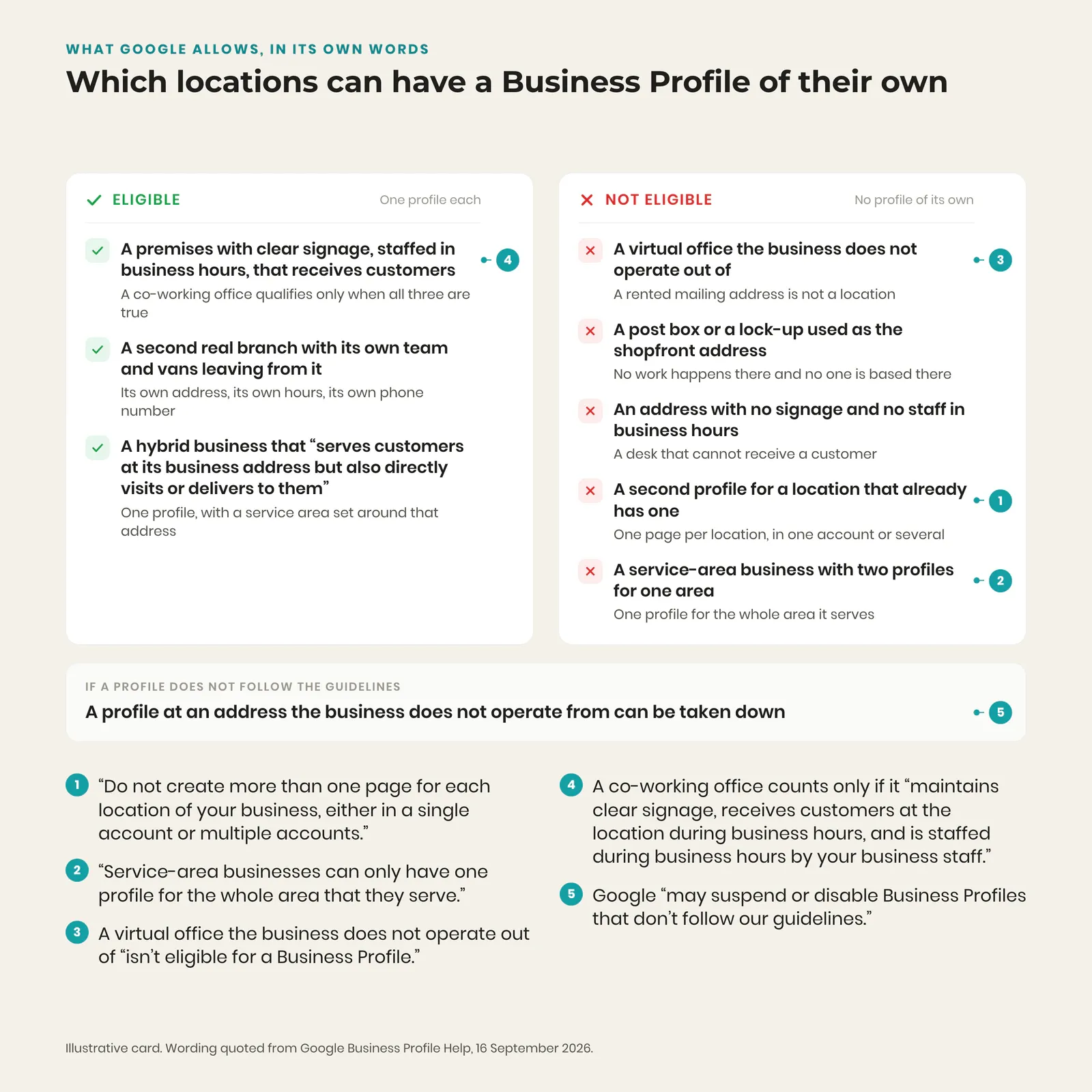
Google’s guidelines for representing your business put it in one line: “Do not create more than one page for each location of your business, either in a single account or multiple accounts.” For trades working out of vans, the same guidelines add that “Service-area businesses, or businesses that serve customers at their locations, should have one profile for the central office or location with a designated service area.”
Google’s service areas page says the same thing shorter: “Service-area businesses can only have one profile for the whole area that they serve.” Widening the service area does not earn a second pin, which is the first thing to settle before reading our local SEO guide for plumbers and electricians.
Virtual offices are not eligible
The address has to be one you work from. Google’s guidelines are explicit: “If your business rents a physical mailing address but doesn’t operate out of that location, also known as a virtual office, that location isn’t eligible for a Business Profile.”
A co-working desk clears the bar only where the business “maintains clear signage, receives customers at the location during business hours, and is staffed during business hours by your business staff.” Signage, customers and your own staff, all three, in business hours.
So the usual shortcuts are out: a PO box, a storage unit, or a desk nobody sits at. The parent SEO guide for trade businesses covers where that effort belongs instead.
Hybrid businesses and the 2-hour boundary
Some trade businesses serve customers on site, a showroom with hot water units out the front and vans leaving from the yard. Google calls that a hybrid business, “A business that serves customers at its business address but also directly visits or delivers to them”, and it still runs on one profile with a service area around it.
That service area has a boundary. Google says it “shouldn’t be more than about 2 hours of driving time from where your business is based”, and none of it costs money: Google’s page on adding and claiming a Business Profile says “You can add or claim your business at no charge”.
Put a pin at an address you don’t work from and the listing is reportable rather than rankable. Google “may suspend or disable Business Profiles that don’t follow our guidelines”, and the profile goes dark while the phone should be ringing.
Why one listing runs out of room
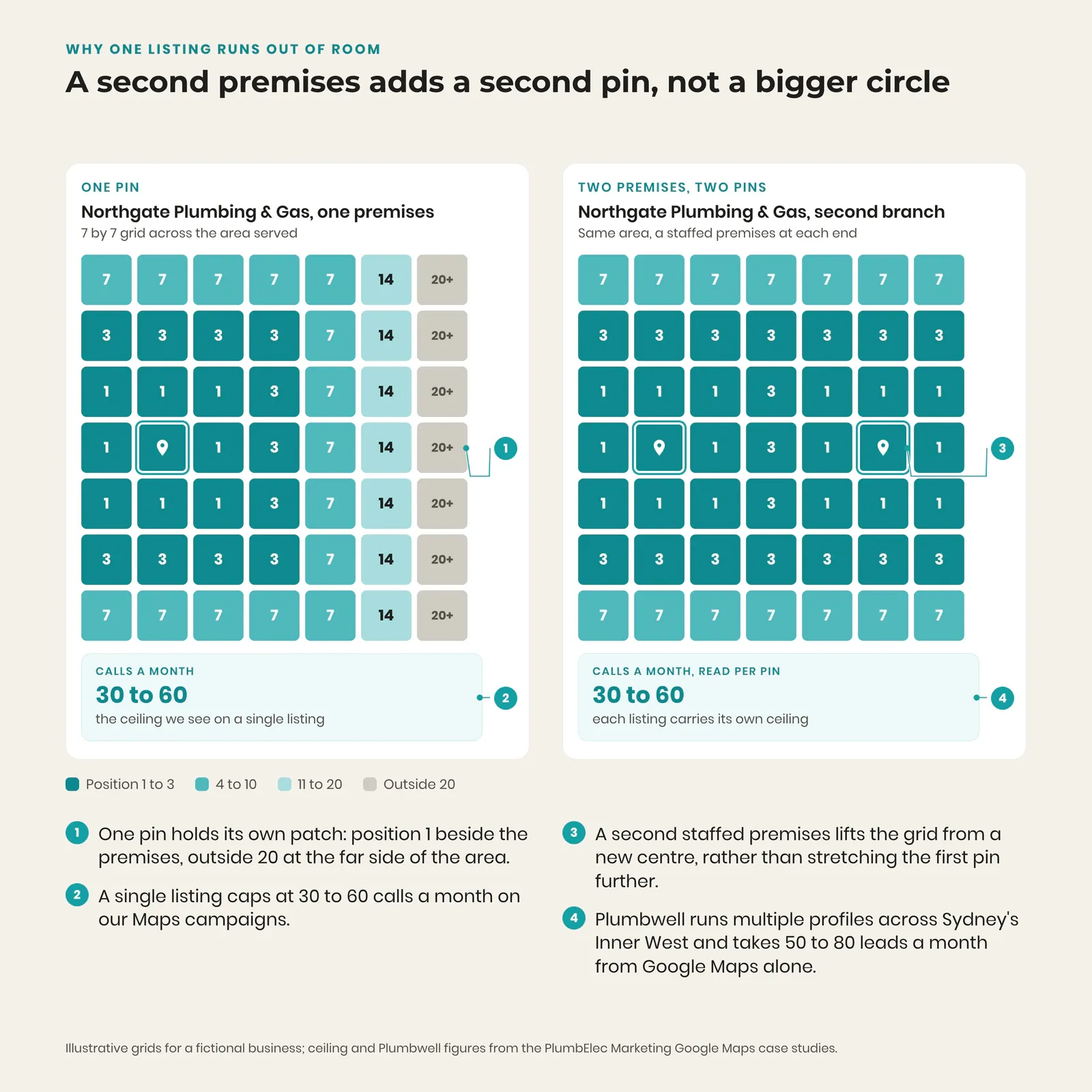
Picture Northgate Plumbing & Gas, a service-area business covering a whole metro on paper. The jobs from the far side of that area go to somebody whose pin is closer, every time, no matter how complete the profile is. That gap is distance doing its work, and no field on the dashboard shortens it.
Distance caps every pin
The map pack is hyper-local by design. Across the 300 map-pack listings we captured for plumber and electrician in 10 Australian metros, five suburbs in each, on 5 to 6 August 2026, 297 different business names filled the 300 slots.
Repeats are the exception, because each suburb’s pack is built from the listings closest to it. One rank check from your own office tells you what happens at one point on the map, which is why we run a grid: it shows the ring where the listing stops appearing. Our geo grid guide for plumbers and electricians explains how we read one.
The 30 to 60 call ceiling
On our Maps campaigns a single listing turns profitable by month 3 to 4, reaches 20 to 30 calls a month by month 6, and caps at 30 to 60 calls a month. Existing listings move faster than new ones.
That ceiling is where the second-profile question actually starts. The cap is a distance fact rather than a budget one: past a point the spend buys searches the pin cannot reach.
We measure a Maps campaign on listing clicks, geo grid expansion and calls attributed to the listing, and we treat 30+ service pages as the minimum on the site behind it.
Moving beats adding
Before anybody adds a profile, check whether the one they have is in the wrong place. A Northern Beaches electrician had a listing sitting in a low-population location, and moving it was “the difference between 5 calls and 50”.
Same licence, same reviews, one pin in a better spot, and no second listing to defend. Our guide to ranking higher on Google Maps works through the pin, the fields and the prominence in the order they pay.
So the sequence is move, then fill, then add only if a second premises exists. Which raises a fair question: does anybody hold two packs?
Field check: who holds more than one pack
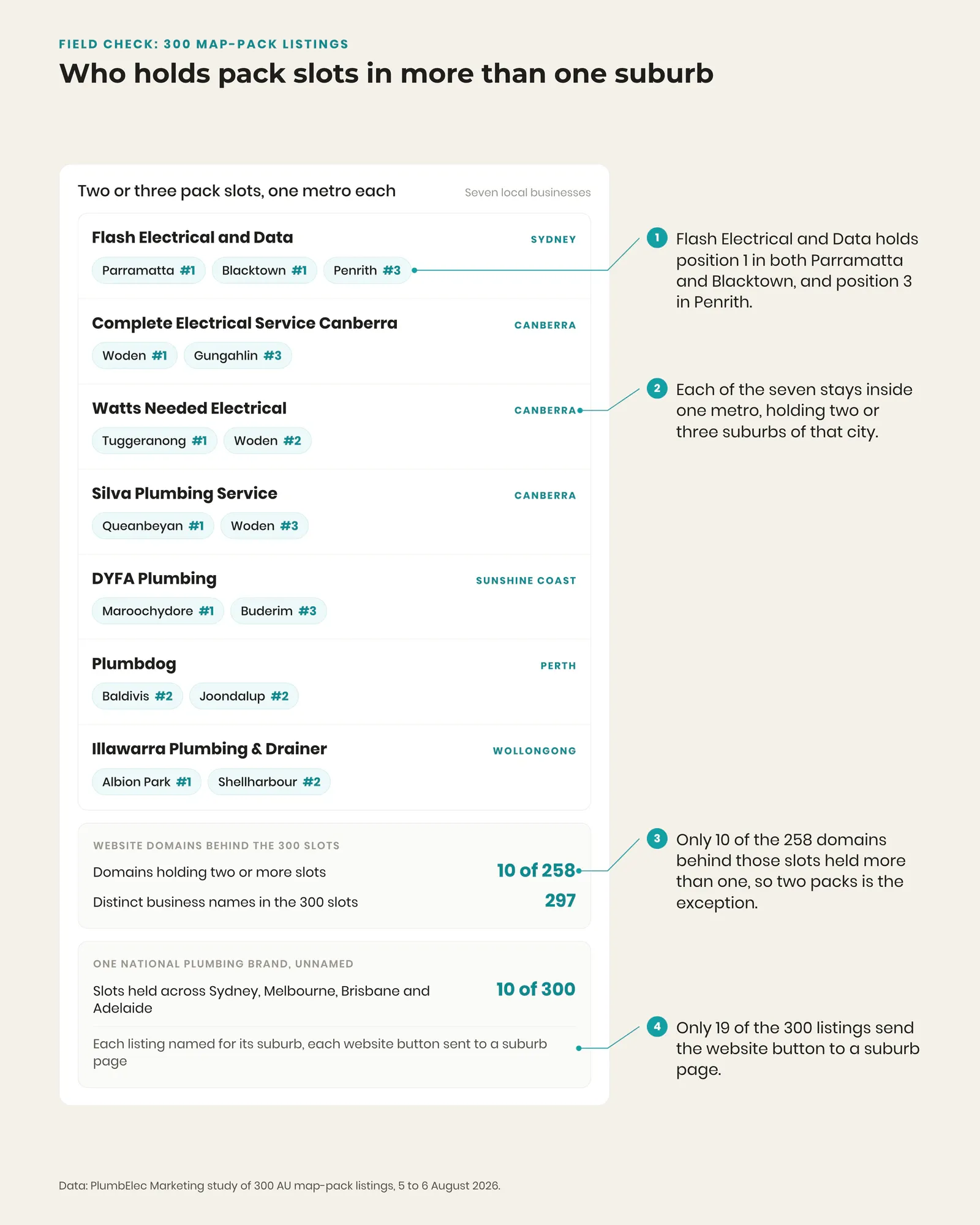
258 distinct website domains sat behind those 300 map-pack slots, and only 10 of them held two or more. Holding a pack spot in two suburbs of the same city is real, and it is rare enough that most owners have never seen it done properly by a business their own size.
How we checked
The August study took the map pack for plumber and electrician in 10 Australian metros, five suburbs in each, on 5 to 6 August 2026, giving 300 listings. We then grouped the slots by the website domain behind them rather than by business name.
Grouping by domain matters, because one operator can trade under two names and the pack shows the name while the website shows the owner.
Ten domains held two or more of those slots. Seven of the ten were local businesses holding two or three slots inside their own metro, and one was a national brand spread across four cities.
Seven local businesses, two suburbs each
Every one of the seven sits in a single metro and holds positions in two or three of its suburbs. Flash Electrical and Data in Sydney is the clearest example, at position 1 in Parramatta, position 1 in Blacktown and position 3 in Penrith, with each listing sending its website button to a suburb page.
Canberra accounts for three of the seven, which I did not expect from a market that size. Six of the seven hold a position 1 in at least one suburb, and Plumbdog in Perth holds position 2 in both Baldivis and Joondalup.
The seven, with the packs they held:
| Business | Metro | Packs held (suburb and position) |
|---|---|---|
| Flash Electrical and Data | Sydney | Parramatta 1, Blacktown 1, Penrith 3 |
| Complete Electrical Service Canberra | Canberra | Woden 1, Gungahlin 3 |
| Watts Needed Electrical | Canberra | Tuggeranong 1, Woden 2 |
| Silva Plumbing Service | Canberra | Queanbeyan 1, Woden 3 |
| DYFA Plumbing | Sunshine Coast | Maroochydore 1, Buderim 3 |
| Plumbdog | Perth | Baldivis 2, Joondalup 2 |
| Illawarra Plumbing & Drainer | Wollongong | Albion Park 1, Shellharbour 2 |
A national brand across four metros
One national plumbing brand held 10 of the 300 slots, across Sydney, Melbourne, Brisbane and Adelaide. Each listing was named for its suburb, and each sent its website button to a suburb page rather than the homepage.
That is the model owners picture when they ask about a second profile, and it runs on branches rather than borrowed addresses. Across all 300 listings the website button went to a suburb page on only 19, 6.3%, and to the homepage on 244, 81.3%. Ten domains out of 258 is the honest scale of it, against 297 different business names filling 300 slots.
Data: PlumbElec Marketing study of 300 AU map-pack listings, August 2026.
When a second profile is the right call
There is one question that settles it in under a minute: is there a second building, with your sign on it, that a customer could walk into during business hours? If yes, you are looking at a second profile. If no, the answer is a better pin and more pages, and that is genuinely faster anyway.
A second profile earns its place when:
- You have a second real premises: it carries your signage, it is staffed in business hours, and a customer who walks in finds somebody there. That is the condition Google’s guidelines set, and none of it is negotiable.
- A team is based there: vans leave from that address in the morning and come back to it, so the work genuinely starts at that pin rather than being dispatched to it.
- The second area sits outside the first pin’s reach: the geo grid shows the first listing fading out before it reaches those suburbs, and the drive time stays inside the boundary Google sets for a service area.
- A trade division has its own front door: the plumbing arm and the electrical arm work from separate premises, each staffed, each with its own categories and its own phone number.
- Never a mailbox, a mate’s garage or a virtual office: the guidelines say a rented mailing address you do not operate from is not eligible, and Google “may suspend or disable Business Profiles that don’t follow our guidelines”.
If you cannot answer that first question with a street address and a staff member, put the money into the pin, the fields and the pages behind the listing you already have. That is the version of this that holds up when somebody reports you.
How we run it on real clients
The listing that works has already taken the suburbs it can reach, and the quotes stop coming from anywhere else. Adding pins does nothing on its own, because a pin with no page and no reviews behind it sits below the established listing in that suburb and stays there. What moves the second suburb is running each premises as its own campaign, with its own page, photos and reviews.
Plumbwell across the Inner West
Plumbwell Plumbing Services runs multiple Google Business Profiles across Sydney’s Inner West and takes 50 to 80 leads a month from Google Maps alone. We only set up a profile where the business operates from that address, which is what keeps a setup like Sam’s inside the guidelines.
Our write-up puts the reasoning plainly: “Instead of relying on one listing to cover a wide area, we set up profiles in strategic locations so each one dominates its local map results.” Those leads are not one listing working harder, they are several pins holding their own patch. The numbers sit in our Google Maps case studies.
Mouritz across three locations
Mouritz Air Conditioning runs three locations in Western Australia, so three real premises and three pins. A 3-month Google Business Profile campaign added 150+ enquiries a month and a 450% increase in phone calls across the three locations, with “an increase of 157 calls per month” from the Maps work.
The Perth CBD location held #1 positions and took 4,100 calls in 2020. That 450% figure is a total across the three locations rather than the lift at one pin. Three branches, three campaigns, and each pin close to a different set of searches, which is the whole mechanism behind running more than one profile.
A page behind every pin
Most listings have nothing behind the website button. Across the 300 listings we captured, 244 pointed it at the homepage, 81.3%, and only 19 sent it to a suburb page, 6.3%.
Every pin we run gets its own location page, its own photos and reviews that name the suburb, and we treat 30+ service pages as the minimum on the site behind a Maps campaign. The site and the pins rise together: 28% of the 300 map-pack businesses also ranked in the organic top 10. Our Google Business Profile optimisation guide works through the fields themselves.
Skip the page work and a second pin inherits the first listing’s ceiling instead of lifting it. Hand the pins, the fields and the pages to one team and each premises builds its own prominence, which is what our local SEO and Maps service is built to do.
Setting up the second listing
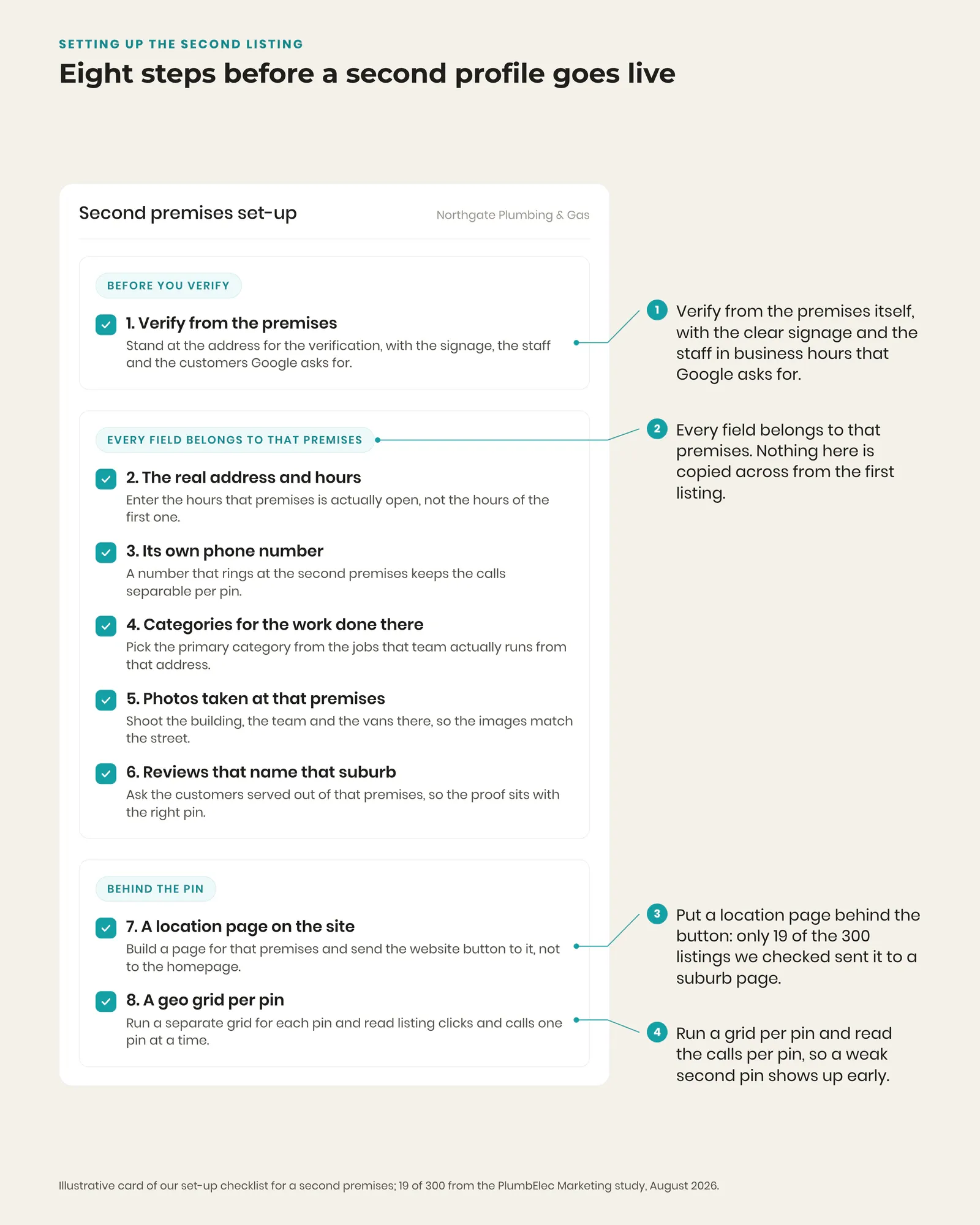
Once the second premises is real, the set-up is a single afternoon of careful data entry, and the mistakes that cost you are all copies. Copied hours, a copied phone number, the first location’s photos: each one tells Google the two profiles are the same business at one address. Every field belongs to the premises it sits on.
The eight steps we work through for a second listing:
| Step | What to do | Why |
|---|---|---|
| Verification | Verify from the premises itself | Google verifies the location, not the name |
| Address and hours | Its real address and its own opening hours | Copied hours read as one location |
| Phone number | A separate number ringing at that premises | A shared number ties the profiles together |
| Categories | The work actually done at that premises | Relevance is judged per profile |
| Photos | Images taken at that premises | Reused photos undercut a real second site |
| Reviews | Customers who name that suburb | Review wording feeds relevance |
| Location page | A page for that premises behind the website button | Only 19 of 300 listings had one |
| Geo grid | One grid per pin, calls read per pin | Each pin holds its own patch |
Run the first pin’s grid again once the second listing is live, so you can see which suburbs moved and which stayed. If the second pin is not shifting its own patch, look at the page and the reviews behind it before touching the profile.
Conclusion
One profile per real location is the rule, and everything else follows from it. A service-area business gets one profile for the whole area it serves, and an address you do not operate from is not eligible for a profile at all.
Distance caps every pin, so the first move is the pin itself and the pages behind it. A second premises comes before a second profile: signed, staffed, with vans leaving from it and a location page behind its website button.
Then measure per pin rather than per business. A grid for each listing and a call count for each listing tells you whether the second one is earning its keep or quietly sitting inside the first one’s patch.
FAQs
Can a plumber or electrician have two Google Business Profiles?
Yes, where there are two real premises, each staffed and receiving customers in business hours. Google’s guidelines allow one profile per location and forbid a second page for the same location.
Can I create a Google Business Profile for a suburb I service but have no office in?
No. Google’s service areas guidance says a service-area business can only have one profile for the whole area it serves, so the suburb goes in your service area and on your website.
Is a virtual office allowed for a Google Business Profile?
Not for a Business Profile. Google’s guidelines say a rented physical mailing address you do not operate out of, a virtual office, is not eligible. Co-working needs signage, customers and staff.
How many calls can one Google Business Profile bring in?
On our Maps campaigns a single listing caps at 30 to 60 calls a month, reaching 20 to 30 by month 6 and turning profitable by month 3 to 4.
Do I need a separate website page for each listing?
Yes. Only 19 of the 300 map-pack listings we captured sent the website button to a suburb page, so a page per premises is both rare and available to you.
What happens if Google finds a second listing at an address you don’t operate from?
The profile can be removed. Google says it “may suspend or disable Business Profiles that don’t follow our guidelines”, and a suspended listing stops taking calls while reinstatement runs.
One listing hitting its ceiling?
Your call count has flattened and the listing has taken everything it can reach. PlumbElec Marketing reads the grid, the guidelines and the pages together before anybody suggests a second profile, and we will say plainly when one listing is still the right answer.
We work with plumbers and electricians across Australia. Call (02) 9100 0985, book a time that suits you, or see how our local SEO services for trade businesses handle Maps.