Fake Google reviews and keyword-stuffed business names are the two ways a competitor cheats the map pack, and 124 of the 300 plumber and electrician map-pack listings we captured in August 2026, 41%, had a keyword or a suburb worked into the profile name. The study took the pack for plumber and electrician in 10 Australian metros, five suburbs in each, on 5 to 6 August 2026.
So the plumber who verified his profile properly, filled in every field and earned his reviews one job at a time sits underneath a name that reads like a search box. Most tradies I say this to assume that listing has found something clever.
This guide covers how common stuffed names are, what Google’s rules say about names and about reviews, how to report a stuffed name and a suspected fake review properly, who holds position one on a plain name, and what beats a stuffed listing without becoming one.
In this guide
How common name stuffing is
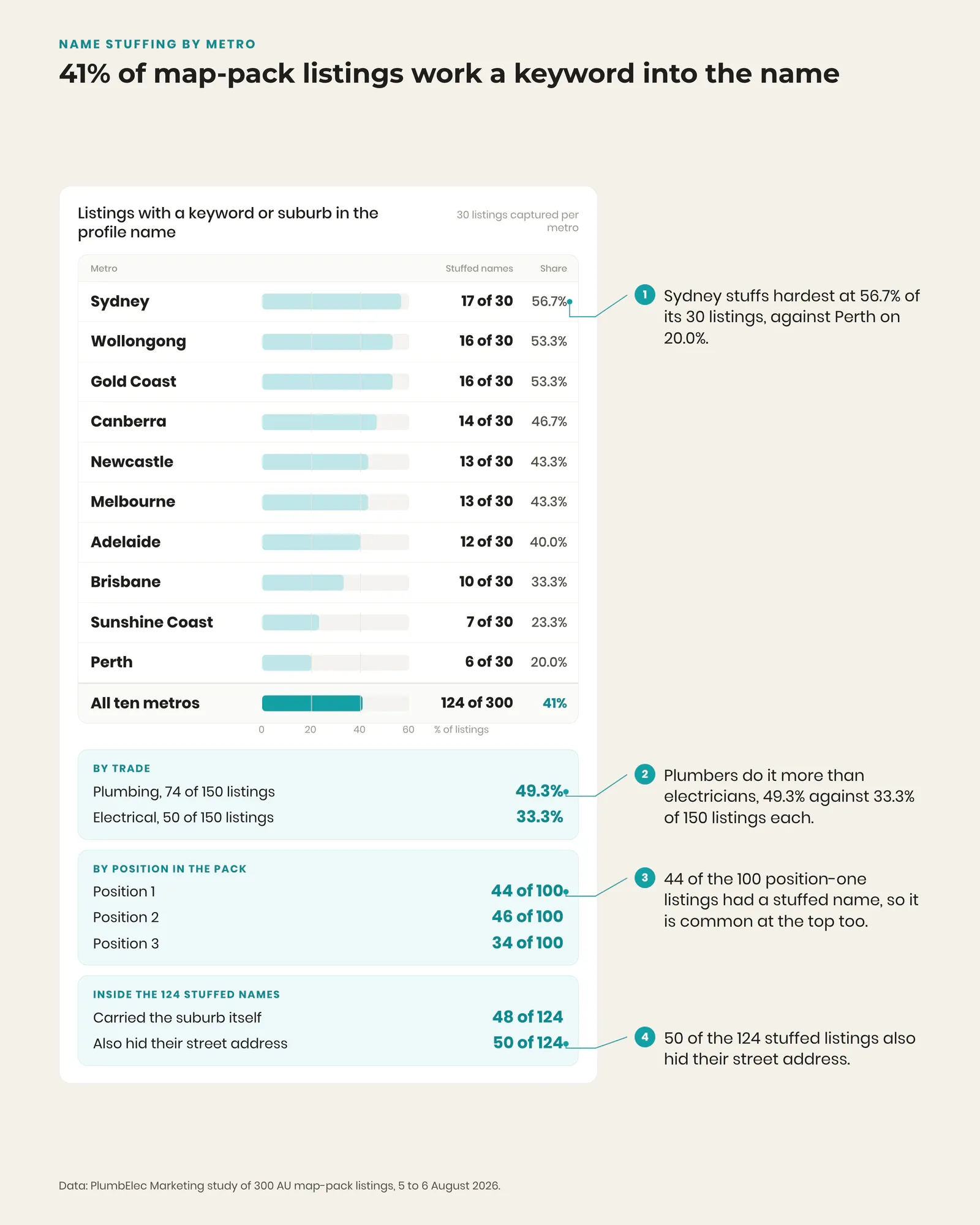
Name stuffing is not a fringe tactic. Across the 300 listings we captured, 124 carried a keyword or a suburb inside the business name, 41%, and at the top of the pack it ran higher still: 44 of the 100 position-one listings had one.
Stuffed names by city, out of the 30 listings we captured in each metro:
| City | Stuffed names of 30 | Share |
|---|---|---|
| Sydney | 17 | 56.7% |
| Wollongong | 16 | 53.3% |
| Gold Coast | 16 | 53.3% |
| Canberra | 14 | 46.7% |
| Newcastle | 13 | 43.3% |
| Melbourne | 13 | 43.3% |
| Adelaide | 12 | 40.0% |
| Brisbane | 10 | 33.3% |
| Sunshine Coast | 7 | 23.3% |
| Perth | 6 | 20.0% |
| All 300 listings | 124 | 41% |
By trade and by position
Plumbers do it more than electricians. Of the 150 plumbing listings, 74 had a keyword or a suburb in the name, 49.3%, against 50 of the 150 electrical listings, 33.3%.
By position it runs right down the pack: 44 of 100 at position 1, 46 of 100 at position 2 and 34 of 100 at position 3. Read that as correlation, not a lever, since a stuffed name sat second as often as first.
Sydney ran highest at 56.7% and Perth lowest at 20.0%, a spread of 36.7 points between the two ends of the same market. Our local SEO guide for plumbers and electricians sets the pack inputs out in order.
What a stuffed name looks like
Northgate Plumbing & Gas is the name on the van and the invoice. The stuffed version reads “Northgate Plumbing Emergency Plumber Blacktown 24/7”, with the trade, the suburb and the availability bolted onto a real name.
Of the 124 stuffed names, 48 carried the suburb itself and 50 also hid their address, so a listing can claim a suburb while showing no street behind it.
The test is simple: read the name out loud and ask whether that is what the invoice says. Anything you would not paint on the side of a ute is keyword copy, not a business name.
It does not buy reviews
The stuffed listings did not carry bigger review files. Their median was 81 reviews against 76.5 for the plain-named listings, which is a gap of 4.5 reviews across 300 listings.
Treat both medians as correlation: two groups of businesses measured across one two-day capture, not a before and after. Whatever the name is doing, it is not filling the review file: that still comes down to how many customers you ask. Where that word work belongs is in the parent guide to SEO for trade businesses.
Which leaves the question most owners never check, whether any of it is allowed.
What Google’s rules actually say
Ask an owner with a stuffed name which rule it breaks and you tend to get a blank look. Names and reviews are covered separately in Google’s own wording, and the review side answers to Australian Consumer Law as well.
The name is the real-world name
Google’s business name guideline is that the profile name must be the business’s real-world name, the one used on the shopfront, the van and the invoices. Extra keywords, suburbs and slogans are not allowed in that field.
That is a rule about identity, not a ranking setting. If the paperwork says Northgate Plumbing & Gas, the profile says Northgate Plumbing & Gas, the trade goes in the primary category and the suburbs go on your own website.
A suburb inside a genuine trading name is fine. Northgate Plumbing & Gas keeps the suburb because that is what the invoice says.
Reviews: no incentives, no gating
The review content policy is stricter than the naming rule and it catches things owners do by accident. It bans incentives for reviews “such as payment, discounts, free goods and/or services”, and it also bans discouraging negative reviews, selectively asking only the happy customers, and pressuring people while you are still on their premises.
Content “not based on a real experience” is fake engagement under the same policy, and a review from a current or former employee is a conflict of interest. The ACCC’s position runs alongside the policy: fake and incentivised reviews are misleading conduct under Australian Consumer Law.
Why we never do it
We do not stuff client names and we tell owners not to, for one practical reason. A stuffed name is one competitor report away from a suspension, and a suspended listing takes its calls with it while the pack refills the gap.
One year of that name is a poor trade against a profile that goes dark in the week the phone should ring. Our guide on getting a suspended Google Business Profile back covers what reinstatement takes.
Left in place, the name is a liability that sits there until somebody in the same suburb decides to file on it.
Reporting a stuffed name
You can report a stuffed name yourself, from your phone, with nobody in the loop. Google runs two tools for it, Suggest an edit inside Maps and the Business Redressal Complaint Form for businesses, and each one wants a different kind of evidence. Neither is a complaint box, so how you file matters more than how strongly you word it.
Report it in this order:
- Suggest an edit on the name: editing place information in Google Maps covers the place name, category, location, hours, phone number and website, or marking a place “closed or not here”. Google warns that “Edits that try to significantly change a business may be rejected.”
- Attach the evidence: the name on the van, the name on the website and the name on an invoice. The real-world name should be obvious from outside, so send the photograph, not the argument.
- Use the Business Redressal form for the rest: the Business Redressal Complaint Form handles fraudulent activity on “the name, phone number, or URL of a business”, and Google says that outside those three it “will not be able to review your complaint”. It also says “We cannot guarantee that any action will be taken on your complaint”. Submit it under your own name.
- Keep a dated log: screenshot the listing with the date on it, then note what you filed and when. If the name changes later, a dated screenshot is the only proof it was ever different.
- One report per issue, then stop: file once, properly, and leave it alone. Repeat filings on the same listing do not speed anything up, and they turn an afternoon’s admin into a dispute to manage.
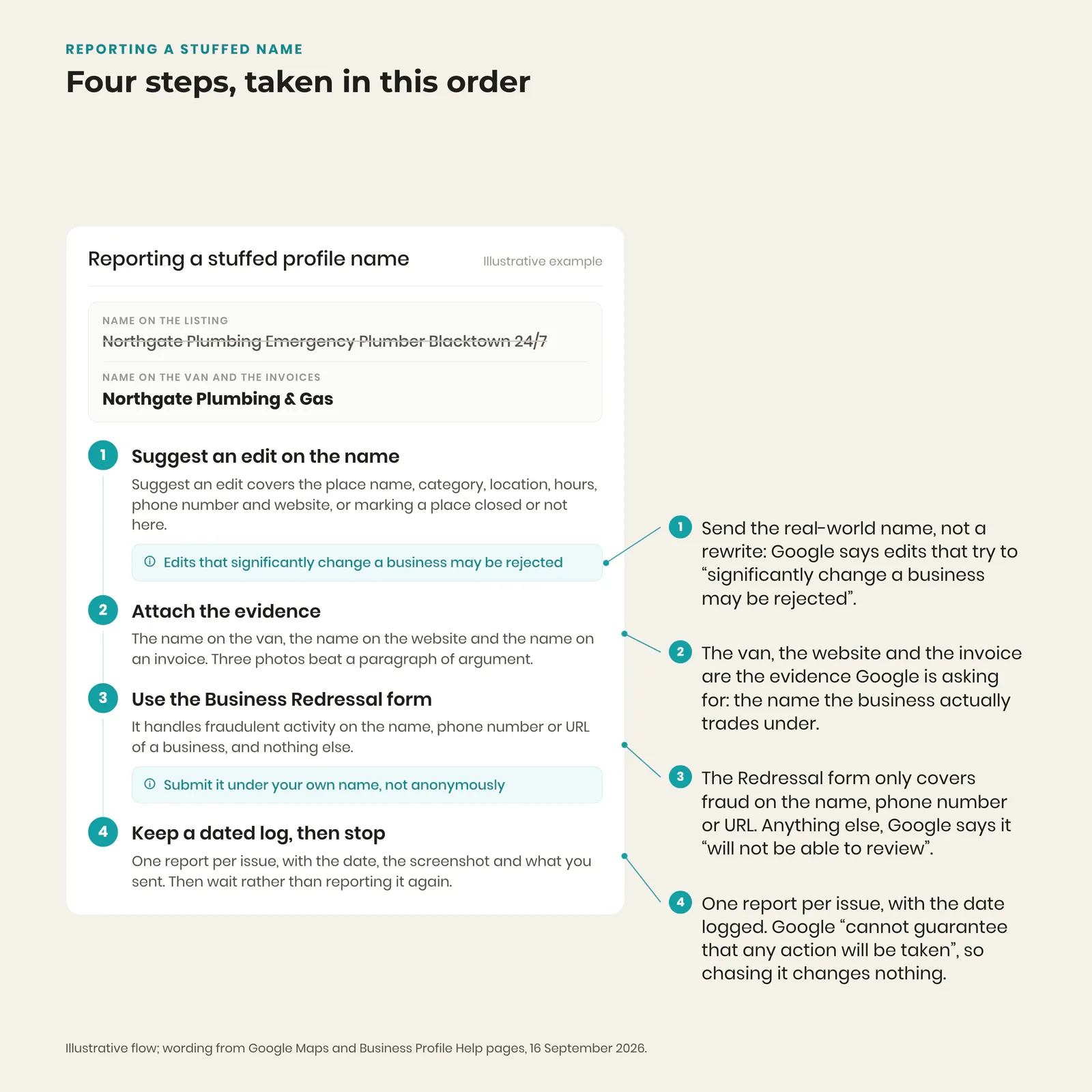
File it once with the photos attached, then put the rest of that afternoon into your own listing. The report is out of your hands the moment you submit it.
Reporting fake reviews
A one-star from a name you have never invoiced lands on a Friday afternoon and sits all weekend in front of every customer who looks you up. The process runs on policy breaches rather than on how unfair the review is.
What Google will remove
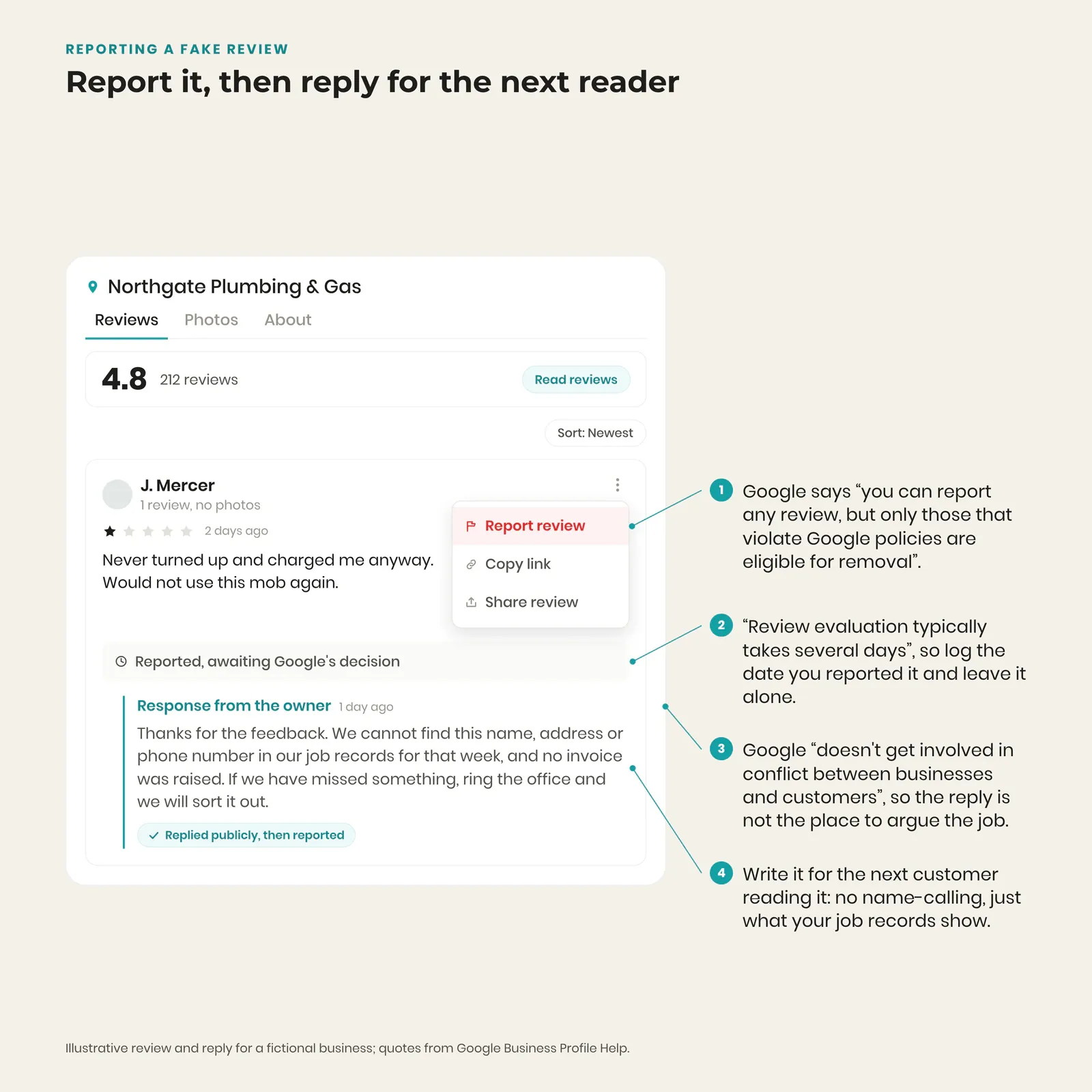
Reporting runs from the profile itself, and Google’s guidance on reporting inappropriate reviews on your Business Profile has you open the Read reviews screen and report from there.
The limits are plain: “You can report any review, but only those that violate Google policies are eligible for removal”, and “Review evaluation typically takes several days”. Google also says it “doesn’t get involved in conflict between businesses and customers”, so an argument about the job itself is not a policy breach.
Where a review does break them, “Flagged reviews that violate our content policies are removed and will no longer show on Maps and Search”.
What counts as evidence
Fill the report with things you can show, not your read on the reviewer. Three are worth documenting: no job record in your system for the reviewer’s name, a burst of reviews arriving on the one day, and reviewer accounts carrying a single review each.
None of those prove a review is fake, and none belong in a public reply. They are the notes that make a report specific, and the file you want if the pattern repeats.
Search your job software for the name before you file, because a job booked under a partner’s or landlord’s name is the common answer.
One-star reviews on your profile
Reply publicly first, and write it for the next reader rather than the reviewer. Three calm lines naming what you have checked, with a number to call, do more than a removal three weeks later. Our guide on replying to a Google review has the wording.
Then report it, log it and get back to the jobs. The strongest answer to a review you cannot place is a fortnight of real customers leaving real ones, which moves the rating while the report waits.
Listings that hold the top of a pack are worth a closer look, because the study found what their names actually say.
Field check: who holds position one on a plain name
56 of the 100 position-one listings in the study carried a plain name, with no keyword or suburb anywhere in it. The largest review file among them holds 1,057 reviews on a name you could read out over the phone without spelling it.
How we checked
We captured the map pack for plumber and electrician in 10 Australian metros, five suburbs in each, on 5 to 6 August 2026, which gave 300 listings, three to a pack.
For each one we read the profile name as Google displayed it and marked whether a keyword or a suburb had been worked into it. We made no check of review authenticity, so nothing here says any listing has fake reviews. Names were the only thing this study measured.
We also recorded each listing’s review count and whether it showed a street address, which is where the 50 of 124 figure comes from.
Plain names at the top
The eight plain-name holders of position one with the largest review files are HOTT Electrics in Wollongong on 1,057 reviews, The Plumbing Doctor in Burleigh Heads on 1,014, True Connection Electrical in Gungahlin on 699 and Woden Valley Plumbing & Gasfitting in Canberra on 498.
Baywood Plumbing & Gas holds Canning Vale on 479, Ember Plumbing & Gas holds Perth on 400, Green Planet Plumbing holds Cardiff on 305 and DYFA Plumbing holds Maroochydore on 281.
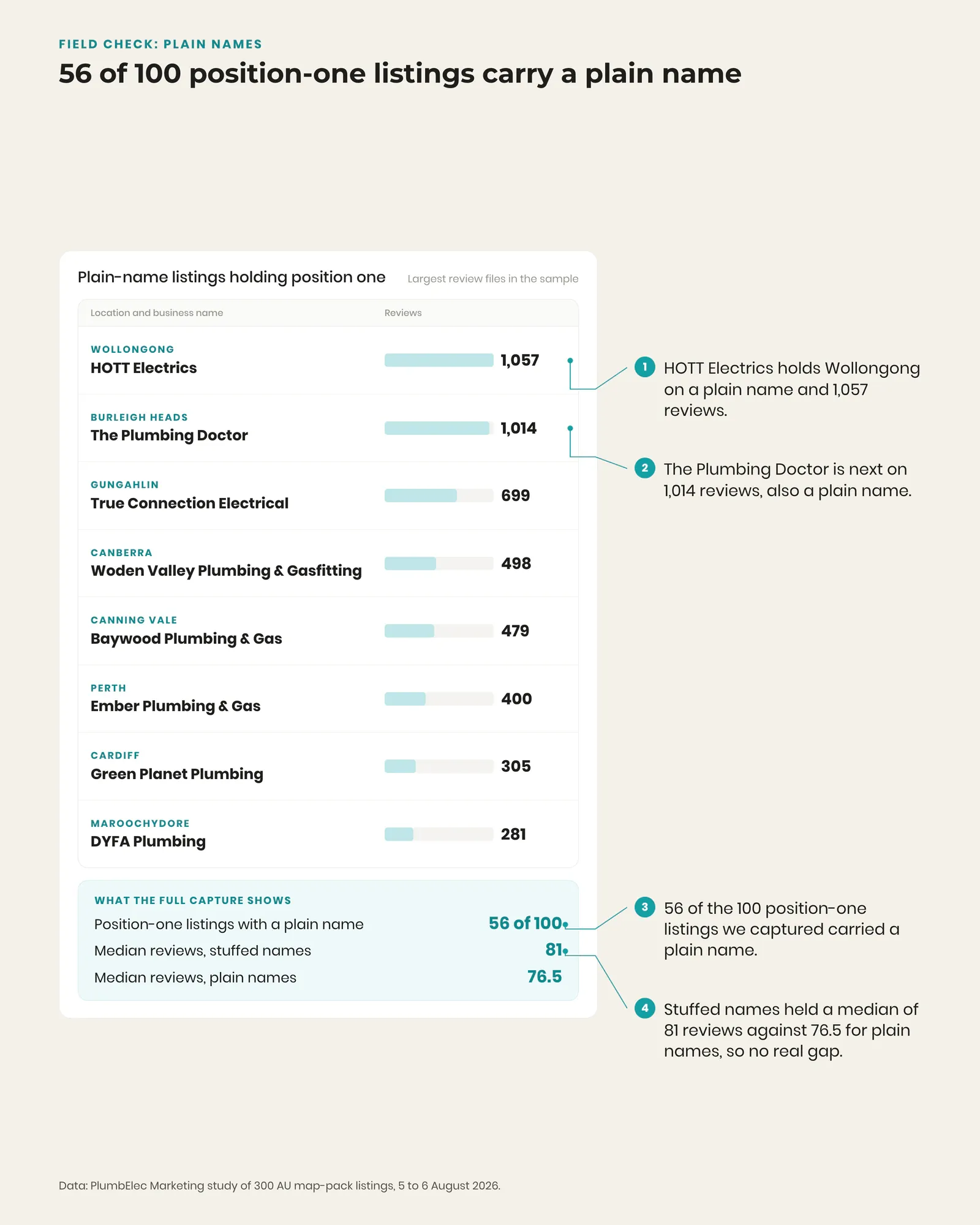
So the top spot goes to a plain name more often than not, while 41% of the pack spends its name field on keywords it did not need.
Data: PlumbElec Marketing study of 300 AU map-pack listings, August 2026.
Beating a stuffed name without becoming one
Everything a stuffed name is trying to fake can be built for real in the fields Google already gives you. Five moves do that work, and two of them are an afternoon in the dashboard, not a project you have to plan for.
Do these five things instead:
- Category and services: set the primary category to the trade itself, then fill the services list out properly. Our Google Business Profile optimisation guide works through both fields.
- The pin where the work is: put the pin in the middle of the suburbs the jobs come from, not where the trailer is parked, which is the suburb you want the calls from.
- Review velocity: ask every customer on the day, with a link or a card in their hand. Keep the ask running so reviews keep landing month after month, and remember incentives are out.
- Real suburb pages: write a page for each suburb you want, with the streets, the housing stock and the work you actually do out there. That is where suburb names belong.
- Measure it on a grid: run a geo grid before you change anything and again after, so the move can be proven. Our guide on ranking higher on Google Maps covers reading the pattern.
None of that needs a name change and all of it compounds. If you would rather hand the pin, the fields and the suburb pages over, that is what our local SEO services for trade businesses do.
Do the category and the pin this week, make the review ask a standing habit, and leave the competitor’s name to Google.
Conclusion
124 of the 300 listings we captured had a stuffed name and 44 of the 100 at position one did, so the tactic is common and it is common at the top. It is a rule breach rather than a ranking trick, and the listing carrying it is one report away from going dark.
The review medians say the rest: 81 against 76.5, which is no gap worth a suspension. 56 of the 100 position-one listings hold their spot on a plain name.
If a name in your pack is stuffed, report it once with the evidence attached, then leave it with Google. Spend the time you would have spent watching that listing on the category, the pin, the review ask and the suburb pages, because those are the parts nobody can report and nobody can take off you.
FAQs
Is it against Google’s rules to put my suburb in my business name?
Yes. Google’s naming guideline requires the profile name to be your real-world business name, the one on the van and the invoices, so an added suburb or keyword breaks it.
Can I report a competitor’s keyword-stuffed business name?
Yes, two ways. Suggest an edit on the name inside Google Maps, or file the Business Redressal Complaint Form, which covers fraudulent activity on the name, phone number or URL of a business.
How do I report a fake Google review?
Open the Read reviews screen on the Business Profile and report the review from there. Google says you can report any review, but only ones that break its policies are eligible for removal.
How long does Google take to remove a reported review?
Google says review evaluation typically takes several days. Removal is never guaranteed, because only reviews that violate its content policies are eligible, and it stays out of disputes between businesses and customers.
Will Google suspend a listing with a stuffed name?
It can. The name is a rule breach, so a stuffed listing is one competitor report away from a suspension, and a suspended profile takes its calls with it while the pack refills.
Are fake Google reviews illegal in Australia?
The ACCC’s position is that fake and incentivised reviews are misleading conduct under Australian Consumer Law. They also breach Google’s review content policy, which bans incentives for reviews outright.
Being cheated out of the pack?
Is the listing sitting above you holding that spot on a name it should not have, and is your own profile giving Google everything it asks for? PlumbElec Marketing reads the pin, the profile and the pages together, then measures the work on grid coverage and calls we can attribute to your listing.
We work with plumbers and electricians right across Australia. Call (02) 9100 0985, book a time that suits you, or see how our local SEO services for plumbers and electricians work first.